• Post Reply Bookmark Topic Watch Topic
  • New Topic
permaculture forums growies critters building homesteading energy monies kitchen purity ungarbage community wilderness fiber arts art permaculture artisans regional education skip experiences global resources cider press projects digital market permies.com pie forums private forums all forums
this forum made possible by our volunteer staff, including ...
master stewards:
  • Carla Burke
  • Nancy Reading
  • John F Dean
  • r ransom
  • Jay Angler
  • Timothy Norton
stewards:
  • paul wheaton
  • Pearl Sutton
  • Tereza Okava
master gardeners:
  • Christopher Weeks
  • M Ljin
gardeners:
  • thomas rubino
  • Jeremy VanGelder
  • Megan Palmer

Re-crunching your biochar

 
gardener
Posts: 4551
745
7
forest garden fungi trees food preservation bike medical herbs
  • Likes 12
  • Mark post as helpful
  • send pies
    Number of slices to send:
    Optional 'thank-you' note:
  • Quote
  • Report post to moderator
Many people on this list crush their biochar to make it smaller before inoculating it.  There have been findings that the inoculation doesn't go very deep into the biochar, so if it's a big chunk, it's mostly not inoculated. It might take much longer to really behave as a microbe hotel in a homeostasis with the soil.  

I have been crushing it in burlap bags in the driveway, then driving over it.  One thing I noticed again today is that during the first time you drive over it, you get a very satisfying ASMR type sound. (ASMR are those videos that make sounds that make you relaxed and comfortable to sleep). However, you usually never hear that again.  On the second time, it's nearly silent.  It feels like it isn't crunching any more.  

Today, after crunching it, I stopped the car and went back out to fluff it back up.  Then I drove over it again.  It was not silent this time. You could definitely hear that crunching sound again.  I feel like I"m crushing it to a higher degree.  Previously, it was crushed pretty well, but I would have wanted it crushed a little bit more.  I'll check this time and see if it's better, or if I still want to crush it some more.

John S
PDX OR
 
master gardener
Posts: 2198
Location: Zone 5
1222
ancestral skills forest garden foraging composting toilet fiber arts bike medical herbs seed writing ungarbage
  • Likes 3
  • Mark post as helpful
  • send pies
    Number of slices to send:
    Optional 'thank-you' note:
  • Quote
  • Report post to moderator

John Suavecito wrote:Many people on this list crush their biochar to make it smaller before inoculating it.  There have been findings that the inoculation doesn't go very deep into the biochar, so if it's a big chunk, it's mostly not inoculated. It might take much longer to really behave as a microbe hotel in a homeostasis with the soil.  


So is this maybe the difference between biochar and terra preta—that the former isn’t fully inoculated and biologized, but the latter is?
 
John Suavecito
gardener
Posts: 4551
745
7
forest garden fungi trees food preservation bike medical herbs
  • Likes 6
  • Mark post as helpful
  • send pies
    Number of slices to send:
    Optional 'thank-you' note:
  • Quote
  • Report post to moderator
That's a great question.  Maybe our biochar is hoping to eventually become terra preta-like. I have noticed that after a few years, it is harder to find the bigger chunks of biochar and I'm more likely to find black soil and smaller pieces where there were chunks of biochar.  I would think that microbes and other beings in the soil have something to do with breaking it down into smaller and smaller units.   I have no scientifically measured way of accurately describing how fast the process happens, but it's a great question.  

I know that there are some biochar enthusiasts who don't crush their biochar at all.  In some methods, it would be logistically difficult to do much crushing.  The trench method comes to mind.  Some people consider themselves to be healing the Earth as much as improving their soil for their own benefit.  It's a noble effort.  Personally, I'd prefer to both heal the Earth and improve my soil for my benefit.  Others use a more minimalist effort to crush the biochar.  It's not my place to tell other people what to do. My land, ability to make fires, access to wood, and other factors are different than other people's situations.   I just like to share ideas, because most of what I've learned and developed about biochar has been sharing and learning on this forum.

John S
PDX OR
 
master pollinator
Posts: 5682
Location: Canadian Prairies - Zone 3b
1613
  • Likes 7
  • Mark post as helpful
  • send pies
    Number of slices to send:
    Optional 'thank-you' note:
  • Quote
  • Report post to moderator
I find that big chunks of char do not soak up my crude inoculants even if immersed for quite a long time. That doesn't matter much to me, since my system (mechanical + frost cracking) compensates for that and slowly breaks it up smaller and smaller in situ. Still, what I've observed suggests the principle is sound. The other part of it is that finer char may hold moisture much better.
 
John Suavecito
gardener
Posts: 4551
745
7
forest garden fungi trees food preservation bike medical herbs
  • Likes 6
  • Mark post as helpful
  • send pies
    Number of slices to send:
    Optional 'thank-you' note:
  • Quote
  • Report post to moderator
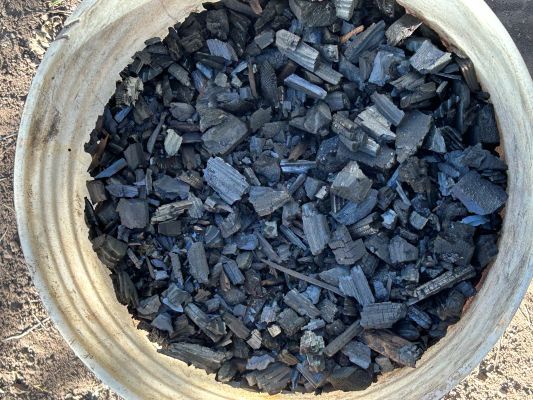
I just checked it and it's much smaller than before.  It looks about perfect now.  1/4" gravel sized.  I'll have to remember to do this next time.
John S
PDX OR
 
Posts: 88
Location: Rhode Island, USA
34
  • Likes 3
  • Mark post as helpful
  • send pies
    Number of slices to send:
    Optional 'thank-you' note:
  • Quote
  • Report post to moderator
The "fluffing up" must reposition things in a way that makes additional passes more effective. Makes sense that after driving over a bag of biochar it gets "mushed" together in a way that more pressure just doesn't help. Moving around the pieces creates nice fresh edges and angles for more crushing.
 
John Suavecito
gardener
Posts: 4551
745
7
forest garden fungi trees food preservation bike medical herbs
  • Likes 4
  • Mark post as helpful
  • send pies
    Number of slices to send:
    Optional 'thank-you' note:
  • Quote
  • Report post to moderator
I think that's exactly what's going on. It looked like the flattened pieces from the first time got set at new angles, so they could get crushed much better this time.  

John S
PDX OR
 
pollinator
Posts: 1170
Location: Greybull WY north central WY zone 4 bordering on 3
356
hugelkultur trees solar woodworking composting homestead
  • Mark post as helpful
  • send pies
    Number of slices to send:
    Optional 'thank-you' note:
  • Quote
  • Report post to moderator
Is the answer to find smaller sources instead of breaking bigger output?
 
John Suavecito
gardener
Posts: 4551
745
7
forest garden fungi trees food preservation bike medical herbs
  • Likes 4
  • Mark post as helpful
  • send pies
    Number of slices to send:
    Optional 'thank-you' note:
  • Quote
  • Report post to moderator
Burning wood chips doesn't really work.  With biochar, we are trying to limit the amount of oxygen to the burn, but we need some.  Imagine trying to burn a pile of flour or sugar.  Not enough oxygen in it.  It has to be burned in a specific way first.  Then it can be crushed.

JohN S
PDX OR
 
pollinator
Posts: 352
Location: 6a Alpine Southwest USA
179
cat hunting cooking building woodworking
  • Likes 5
  • Mark post as helpful
  • send pies
    Number of slices to send:
    Optional 'thank-you' note:
  • Quote
  • Report post to moderator
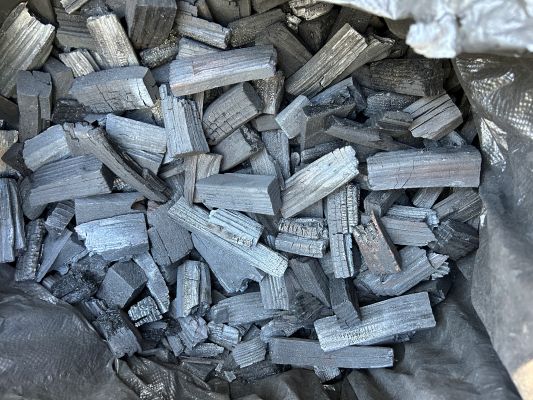
I was outside today crunching some charcoal I made and stored for a few years. I crush it and use it periodically. I started with 160 pounds of it, so it will last me a while.
Yeah, I know what you are thinking, where did you get 160 pounds of charcoal? (my system is down at the bottom herewebpage.)
Anyway, I decided to chuck it into my little SunJoe woodchipper to see how that worked.
I started with these pieces that are anywhere from 1-1/2" square and 4" long to pieces 1/2" thick and just as long, down to pieces that were about 1" square.


After about 10 minutes or so, I had about 4-gallons of this and a lot of powder at the bottom of the pail.


Posts: 35
2
  • Likes 4
  • Mark post as helpful
  • send pies
    Number of slices to send:
    Optional 'thank-you' note:
  • Quote
  • Report post to moderator
Anyone tried using a sink garbage disposal unit to mill biochar? Presumably one would have to mill wet to prevent dust explosions and minimize the respiratory hazard.
Edit: should have looked at the old threads......of course someone here tried a garbage disposal here! I would crush or mill wet to prevent dust though.
 
pollinator
Posts: 898
Location: Illinois
203
  • Likes 5
  • Mark post as helpful
  • send pies
    Number of slices to send:
    Optional 'thank-you' note:
  • Quote
  • Report post to moderator
I don't worry about it. It's a long-term project and eventually it all gets processed by nature.
 
pollinator
Posts: 1623
Location: NW California, 1500-1800ft,
509
2
hugelkultur dog forest garden solar wood heat homestead
  • Likes 4
  • Mark post as helpful
  • send pies
    Number of slices to send:
    Optional 'thank-you' note:
  • Quote
  • Report post to moderator
I also do not crush unless mixing into potting soil or seed starting mix, when I sift it to 1/4”. Biochar is quite brittle, and will break down with foot traffic from people and animals. It also breaks down as birds, worms and others eat it. Heavy rain can also do quite a bit, and I think it may be adapted to hold soil together as it gets caught in post fire floods. Coarse woody debris also holds water exponentially longer with volume. In August, 75% of the water available to plants in an old growth PNW temperate rainforest is in very large pieces of dead wood.

I have looked at biochar under a microscope and it looks like a black hole, so I am wondering how folks above checked for inoculation?
 
John Suavecito
gardener
Posts: 4551
745
7
forest garden fungi trees food preservation bike medical herbs
  • Mark post as helpful
  • send pies
    Number of slices to send:
    Optional 'thank-you' note:
  • Quote
  • Report post to moderator
My understanding of it was that they took pieces of biochar, inoculated them,  and then measured how for into the biochar it went.  It didn't go far.  I don't know about the micro details of the experiment.

John S
PDX OR
 
I agree. Here's the link: http://stoves2.com
reply
    Bookmark Topic Watch Topic
  • New Topic