• Post Reply Bookmark Topic Watch Topic
  • New Topic
permaculture forums growies critters building homesteading energy monies kitchen purity ungarbage community wilderness fiber arts art permaculture artisans regional education skip experiences global resources cider press projects digital market permies.com pie forums private forums all forums
this forum made possible by our volunteer staff, including ...
master stewards:
  • Carla Burke
  • John F Dean
  • Nancy Reading
  • r ransom
  • Jay Angler
  • Timothy Norton
stewards:
  • paul wheaton
  • Pearl Sutton
  • Anne Miller
master gardeners:
  • Christopher Weeks
  • M Ljin
gardeners:
  • Jim Garlits
  • thomas rubino
  • William Bronson

Drawing the line - what trees do you save?

 
gardener
Posts: 5701
Location: Cincinnati, Ohio,Price Hill 45205
1311
forest garden trees urban
  • Likes 11
  • Mark post as helpful
  • send pies
    Number of slices to send:
    Optional 'thank-you' note:
  • Quote
  • Report post to moderator
I was weeding a patch of ground at my sister's house to plant an American Plum and found 4 elm trees and a hickory of some kind, in a 4'x4' patch!
I pulled 3 of the elms and left the other one and the hickory.
Looking up elms, I wouldn't plant one in my urban yard, so I'll probably cut the last one down.
Will I be potting up the other three for the the community garden free nursery?
Maybe?
I would let the hickory grow, but I don't think my brother inlaw would want a huge tree so near the house.
I will try to save that one for the nursery

Where would you draw the line on these trees?
What about other trees, what do you save, what do discard?
 
pollinator
Posts: 94
Location: Zone 7b, 600', Sandy-Loam, Cascadian Maritime Temperate
76
  • Likes 7
  • Mark post as helpful
  • send pies
    Number of slices to send:
    Optional 'thank-you' note:
  • Quote
  • Report post to moderator
Around here the Squirrels and Birds plant a lot of Filberts and Cherries.  Also volunteering frequently are: Maples, Cottonwoods, Ash, Cedar, Fir, Oak, Butternuts, Plums, Cherry-Laurel, Hawthorne, and Holly.  
A lot of these die off on their own from the Summer dry season, unless they are randomly situated in good and protected spots.  The stands of Brambles/Blackberries make for good protective chaperones for many of these volunteers.  
If I find random trees growing in places that I am otherwise not tending much, I will usually leave them to do their work and improve the site with roots and leaf-drop.  Though, with many of them, I have intentions of cutting them down before they get too large.
If they are in my highly tended zones, where they don't fit well into my particular plans, I will sometimes dig them up and pot them to plant elsewhere or give away - or cut them down.  I don't know what my parameters are for choosing which to cull and which to pot up, or which to leave growing where they are.  
If they are a fruit tree, I am always curious what they might yield, so I often let them grow so I can see if it is some great new variety.
Many of the others I consider useful for branch/leaf mulch sources (chop and drop), or for firewood, or other utility/craft purposes.
However, some trees just show up in the wrong place, and it is much easier to remove them when they are small.  Close to building foundations, many trees' roots can wreak havoc too.  
I will say in my situation I err on the side of leaving them to grow even if it makes more work for me later on.
 
steward & author
Posts: 47114
Location: Left Coast Canada
19166
10
art trees books chicken cooking fiber arts
  • Likes 8
  • Mark post as helpful
  • send pies
    Number of slices to send:
    Optional 'thank-you' note:
  • Quote
  • Report post to moderator
New property and evaluating existing trees, I ask myself three questions.

1. Will the roots make me sad?  Spreader roots like willow can tear up cement to get to water and pipes are no problem.   So much damage from tree roots with spreading and seeking habbits.  That tree got to go.  Same with foundation planting which attracts rats, damages house, and makes cleaning gutters too often.

2. How many fruit trees can I fit in that space?  We replaced 12 trees with nearly 200 fruit trees in he current farm.  Urban lots may not alwas be so fortunate.  Fruit trees provide mulch, stack functions as well as almost any tree, and make fruit.  As the tree matures, the wood can be quite valuable compared to common wood.

3. Can the tree provide shade while i grow up better trees...but if I do that, will there be an easy way to fell the older tree when the time comes?

Those are my lines,  fuzzy questions to ask as each property is unique and has different needs and possibilities.
 
Posts: 237
67
kids urban seed
  • Likes 9
  • Mark post as helpful
  • send pies
    Number of slices to send:
    Optional 'thank-you' note:
  • Quote
  • Report post to moderator
The hickory is the one I would fight to keep personally. They take forever to get to fruiting size and once you lose one you really feel it. Elm on the other hand volunteers everywhere around here and I have never felt bad pulling one. The fruit tree rule of thumb works well — if a volunteer would take 20 years to do something useful, it goes. If it might fruit in 5-7, it stays.
 
William Bronson
gardener
Posts: 5701
Location: Cincinnati, Ohio,Price Hill 45205
1311
forest garden trees urban
  • Likes 8
  • Mark post as helpful
  • send pies
    Number of slices to send:
    Optional 'thank-you' note:
  • Quote
  • Report post to moderator
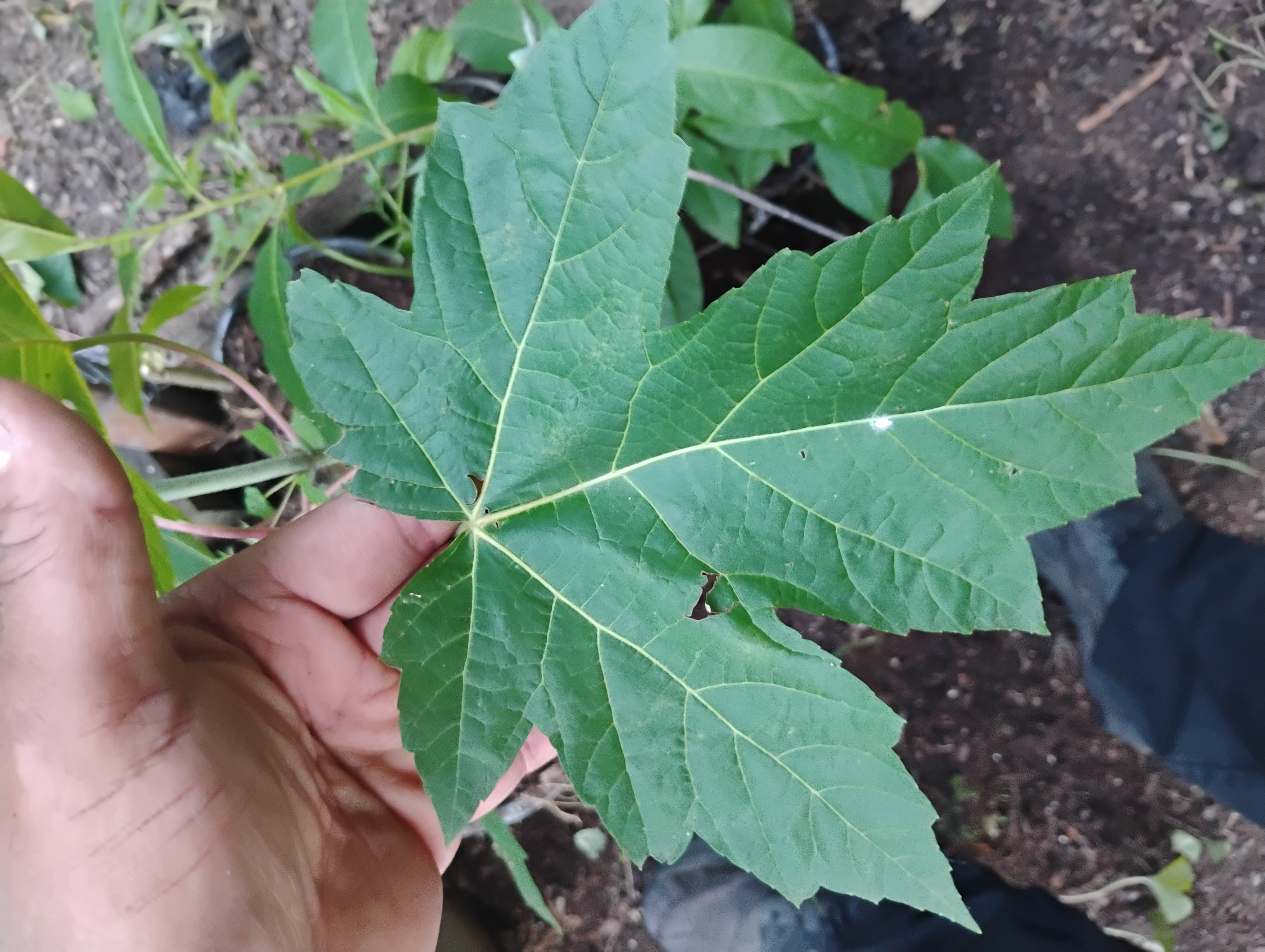
I salvaged more trees today, a staghorn sumac,a black cherry, and some kind of maple, plus two rooted elderberry and a bunch of elderberry cuttings.
This was at the community garden, so I'll put them all in the nursery there.
if I were at my house, I prolly wouldn't save the maple or the black cherry, but who knows what someone else might need.

Concerning the trees from my sisters house, I left the elms to dry out and I'll go back to take out the last one.

I really want a sweetgum seedling.
They grow impractically large, but the mother tree  at  my parents house is very dear to me and it's threatening to die any decade now.

IMG_20260605_203951493.jpg
Bigleaf, Red or something else
 
gardener
Posts: 3742
Location: Western Slope Colorado.
908
5
goat dog food preservation medical herbs solar greening the desert
  • Likes 10
  • Mark post as helpful
  • send pies
    Number of slices to send:
    Optional 'thank-you' note:
  • Quote
  • Report post to moderator
I leave multiple seedlings of tree volunteers.  I can remove them later if I must… is my logic.

We don’t really know what’s coming, or who will inhabit the place in the future.

Instead of removing everything i don’t know for sure i want, I only remove the plants i am sure I don’t want, in the current location.  There’s one tree I always remove.  Ailanthus, it has many names, tree of heaven, and chinese sumac are two.  Invasive, stinks.

I used to consider siberian elms “trash trees”, it’s a very common attitude in Western Colorado.  After I came to know the tree, I changed my mind.  Fast growing hard wood with beautiful grain, tolerates neglect, excellent shade, fabulous firewood, good wood for turning, seeds are edible, leaves are fodder for sheep and goats, the wood is beautiful, can be made into furniture, flooring, or anything else oak, maple, hickory and more widely known decorative hard woods are used for.

I have received many comments about why I plant small trees at this phase of my life…. “You aren’t going to live to enjoy them”

“What if the only trees in your life were the ones you personally planted?”  is my answering question.
 
Posts: 74
Location: Half acre on a hill in Central Alabama, Zone 8a and 8b
66
hugelkultur fungi foraging
  • Likes 8
  • Mark post as helpful
  • send pies
    Number of slices to send:
    Optional 'thank-you' note:
  • Quote
  • Report post to moderator
This has been a perennial question since we moved to our half-acre yard three-plus years ago. The wood-adjacent space had been neglected for years (except for the four hundred pounds of non-native grass seed the former owners added in hopes of enhancing curb appeal), and was being taken over by thickets of thorny olive hedge. The thorny olive was the easy choice. We have been systematically removing it, and replacing it with native plum and elderberry.

Rather than mow everything else into submission, we spent over a year just looking and letting things grow, transplanting wildflowers and native edibles into more practical locations. As for the hundreds of tiny trees marking their places out in the lawn, we're still mostly watching, but we have a tree-age plan.

Pecan saplings get to stay. If they wind up being in the way, we'll relocate them to the woods or to a pot to share with friends.  Cedar sprigs get transplanted in the woods, to replace the trees I harvest for projects (posts, etc.). Elm and ash are allowed to stay and grow until they are shovel-handle or tomato cage size. Pines: To the woods, though we are keeping a few close by to make pine needle soda-pop. Redbuds are left alone around the borders, but their branches make great tomato cages, and you don't even need twine to tie them - just strip the bark.

Oaks? We literally have thousands of saplings from the ton of tiny acorns that fall on us every season. They are on the chop-and-drop list, knowing they will all be back next year. One day I may make an effort to shell the acorns and leach them for flour, but for now they make great barbecue fuel.

At some point I'll probably establish a dedicated stand of mixed species for utilitarian purposes, but for now, small trees are just part of the scenery.
 
master pollinator
Posts: 5413
Location: Due to winter mortality, I stubbornly state, zone 7a Tennessee
2376
7
forest garden foraging books food preservation cooking fiber arts bee medical herbs
  • Likes 6
  • Mark post as helpful
  • send pies
    Number of slices to send:
    Optional 'thank-you' note:
  • Quote
  • Report post to moderator

Yeardly Arthur wrote:Redbuds are left alone around the borders, but their branches make great tomato cages, and you don't even need twine to tie them - just strip the bark.


Nope, you're not getting away with that one. I require pictures!
 
out to pasture
Posts: 13293
Location: Portugal
4438
goat dog duck forest garden books wofati bee solar rocket stoves greening the desert
  • Likes 8
  • Mark post as helpful
  • send pies
    Number of slices to send:
    Optional 'thank-you' note:
  • Quote
  • Report post to moderator
I just pulled out all the radishes that went to seed instead of forming roots in the GAMCOD bed and found this fella growing between them. I think it's a white mulberry grown from the mulberry tree that's been threatening to take over and shade out half the bed, the one that's kept us in fresh greens for months and that I've just taken a pair of loppers to as its lower branches have been attempting to literally shade out an entire section of bed. I've been trying to take cuttings from it but so far they've all failed. I'm going to go outside and dig this fella up and put it in a pot, do a taste-test on the leaves when it's a bit bigger in case it's hybridised with the black mulberry growing next to it that gives not-such-good greens, and offer it to a friend of mine who can grow it for easy greens for himself and give surplus branches to his goats.

Everything I've read about white mulberry says it's invasive and weedy, but it's been one of the most productive things I've ever grown and requires very little care apart from snipping off the young leaves that grow on the tip of the stems to eat, then snipping off the ten that grow further back along the stem to replace them. I think it's related to the mythical hydra - the more I cut off, the more grow...

white-mulberry-seedling.jpg
[Thumbnail for white-mulberry-seedling.jpg]
 
Yeardly Arthur
Posts: 74
Location: Half acre on a hill in Central Alabama, Zone 8a and 8b
66
hugelkultur fungi foraging
  • Likes 10
  • Mark post as helpful
  • send pies
    Number of slices to send:
    Optional 'thank-you' note:
  • Quote
  • Report post to moderator

Joylynn Hardesty wrote:

Yeardly Arthur wrote:Redbuds are left alone around the borders, but their branches make great tomato cages, and you don't even need twine to tie them - just strip the bark.


Nope, you're not getting away with that one. I require pictures!


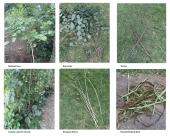
Here ya go. They ain't pretty, but I think they tell the story.
I probably should make a separate post on the process, but it's pretty straightforward: Cut the branches. Peel the bark. Use the bark strips to tie the cage together.
Happy to answer any questions.
Redbud-Bark.png
[Thumbnail for Redbud-Bark.png]
Redbud-Tomato-Cage.png
[Thumbnail for Redbud-Tomato-Cage.png]
 
Joylynn Hardesty
master pollinator
Posts: 5413
Location: Due to winter mortality, I stubbornly state, zone 7a Tennessee
2376
7
forest garden foraging books food preservation cooking fiber arts bee medical herbs
  • Likes 4
  • Mark post as helpful
  • send pies
    Number of slices to send:
    Optional 'thank-you' note:
  • Quote
  • Report post to moderator
Thanks Yeardly! From a fellow "redbud farmer"
 
Rusticator
Posts: 9826
Location: Missouri Ozarks
5432
7
personal care gear foraging hunting rabbit chicken cooking food preservation fiber arts medical herbs homestead
  • Likes 5
  • Mark post as helpful
  • send pies
    Number of slices to send:
    Optional 'thank-you' note:
  • Quote
  • Report post to moderator

Joylynn Hardesty wrote:Thanks Yeardly! From a fellow "redbud farmer"


Ditto!! I only have one redbud, but it's huge and in need of some serious pruning. I also need tomato cages, so this is PERFECT!! Thank you!!
 
pollinator
Posts: 3947
Location: Kent, UK - Zone 8
751
books composting toilet bee rocket stoves wood heat homestead
  • Likes 8
  • Mark post as helpful
  • send pies
    Number of slices to send:
    Optional 'thank-you' note:
  • Quote
  • Report post to moderator
We've been on our patch of land for about 20 years now as a family. It's mostly garden, but with some silvopasture adjacent, and a veggie patch. Personally I wouldn't be saving any self-seeded trees in our land, because we have lots of large established trees already and I'm continually working to cut back and clear boundaries where the woodland is trying to encroach and shade out stuff.

If I did want a new tree it would be deliberately chosen for the spot, serving a specific purpose that the hundreds of other trees don't.

I kill a few thousand tree seedlings each year in the lawn and garden beds.
 
Posts: 5
3
  • Likes 8
  • Mark post as helpful
  • send pies
    Number of slices to send:
    Optional 'thank-you' note:
  • Quote
  • Report post to moderator

Joao Winckler wrote:The hickory is the one I would fight to keep personally. They take forever to get to fruiting size and once you lose one you really feel it..


I don't like to cut down hickories either, but the small trees are so thick in some areas that their removal is required. As for those that I do cut down, the ones that are walking stick size get greased on the ends, and placed on a drying rack.

Cottonwood, sycamore, and soft maple are on the chopping list. Any oaks in poor condition are cut down for firewood.
The property is 19 acres, 15 wooded. For whatever reason, the previous owner didn't keep up on property maintenance. I've cleared out roughly 2 acres of heavy brush and saplings.
 
Posts: 139
Location: Nuevo Mexico, Alta California, upland New York, aiming Andalucia
21
forest garden trees greening the desert
  • Likes 4
  • Mark post as helpful
  • send pies
    Number of slices to send:
    Optional 'thank-you' note:
  • Quote
  • Report post to moderator
I practise different protocols on the three sites under my long-term care.  

In northern Appalachia over-stocked degraded mixed forest lacking natural hardwoods regeneration for 40-60 years I drop most pine to get light to forest floor & keep deer off long enough for any of what was once a carpet of maple & oak seedlings to get to above browse.  There's only a couple of black cherry & shagbark hickory left out there on 120ac, no young-uns, but I've seen the occasional hickory nut lying around.  As I finish heavy thinning over the next few years, I'll plant back black walnut, more cherry & hickory, diverse other quality hardwoods/ ecological keystone/ fruit-nut-berry, into the strategic fuelbreaks & especially propagation repositories & regeneration sources at their intersections.  I hope to have the question you're posing but never have to do anything about it.  

In inner-urban high desert I have, in order, windblown elm (I save lacebark only), bird-dropped hackberries (leave best-/ move worst-placed), gravity-dropped honeylocust (ditto), rarely a mulberry (ditto but white coveted over black).  None of the many high- & dry-land adapted fruit/ nut/ berry are volunteering yet, except apricots which are wide crosses & I move to test/ use for rootstock, but we're aiming for more of that as we propagate up & integrate in to a high-country river valley/ mesa forest location burned over with full range of impacts in our state's biggest ever wildfire.    

In coastal sub-tropics, food production let alone reseeding is heavily impacted by birds & rodents, so I only see loquat (nispero, move for rootstock), pitanga (surinam cherry, give to friends), rootstock plum (cull), + many fly-ins mostly Brasilian pepper & what looks to me like Guaje (namesake of Oaxaca) both highly desirable for different reasons but invasive so culled.
 
Please enjoy this holographic presentation of our apocalyptic dilemma right after this tiny ad:
Contemplate spending the next 20 years puttering in permaculture projects
https://wheaton-labs.com/bootcamp
reply
    Bookmark Topic Watch Topic
  • New Topic