• Post Reply Bookmark Topic Watch Topic
  • New Topic
permaculture forums growies critters building homesteading energy monies kitchen purity ungarbage community wilderness fiber arts art permaculture artisans regional education skip experiences global resources cider press projects digital market permies.com pie forums private forums all forums
this forum made possible by our volunteer staff, including ...
master stewards:
  • Carla Burke
  • Nancy Reading
  • John F Dean
  • r ransom
  • paul wheaton
  • Jay Angler
  • Timothy Norton
stewards:
  • Pearl Sutton
  • Tereza Okava
  • Nicole Alderman
master gardeners:
  • Christopher Weeks
gardeners:
  • M Ljin
  • Megan Palmer
  • Pete Podurgiel

butterflies in our garden! (with updates)

 
Posts: 10719
Location: a temperate, clay/loam spot on planet earth, the universe
3899
4
  • Likes 13
  • Mark post as helpful
  • send pies
    Number of slices to send:
    Optional 'thank-you' note:
  • Quote
  • Report post to moderator
This is a corner of our 'flat garden' ...an old homestead garden site that was newly chisel plowed for us by a neighbor just two years ago.  It is deep black sticky clay/loam...rich but difficult in many ways.  

The flowers... sunflowers, cosmos, mexican sunflowers and marigolds have taken over this end...there are some vegetables out there also but the flowers and butterflies have fed our souls for weeks now.  I've left the rest of the sweet allysum, calendula, g. basil and holy basil (tulsi) to bloom and go to seed but they are overshadowed right now

I'm collecting seeds of course and because the orange cosmos is one of my natural dyes, I collect the flowers a couple times a week  to dry which also keeps them blooming longer.  

There are lots of bumblebees, honey bees and other small flying insects also...just buzzing with activity all day long.

I'm wondering what to do in the fall.
We'll cover crop any bare places but I think I should leave this area standing for the winter. I know that most of the pollinators lay eggs elsewhere but am not certain on what and I know that the birds, as that gold finch on my echinacea seed will clean up and spread the wealth.

I might have doubled up some photos...for much of the summer I took short videos of their activity.... I have no way to add those to this post though.  I got a you tube channel just to post some.
IMG_3355-(2).JPG
butterfly garden
butterfly garden
IMG_3356-(2).JPG
butterfly garden
butterfly garden
IMG_3358-(2).JPG
butterfly garden
butterfly garden
IMG_3360-(2).JPG
butterfly garden
butterfly garden
IMG_3300-(2).JPG
butterfly garden
butterfly garden
IMG_3305-(2).JPG
butterfly garden
butterfly garden
IMG_3307-(2).JPG
butterfly garden
butterfly garden
IMG_3121-(2).JPG
butterfly garden
monarch
IMG_3127-(2).JPG
butterfly garden
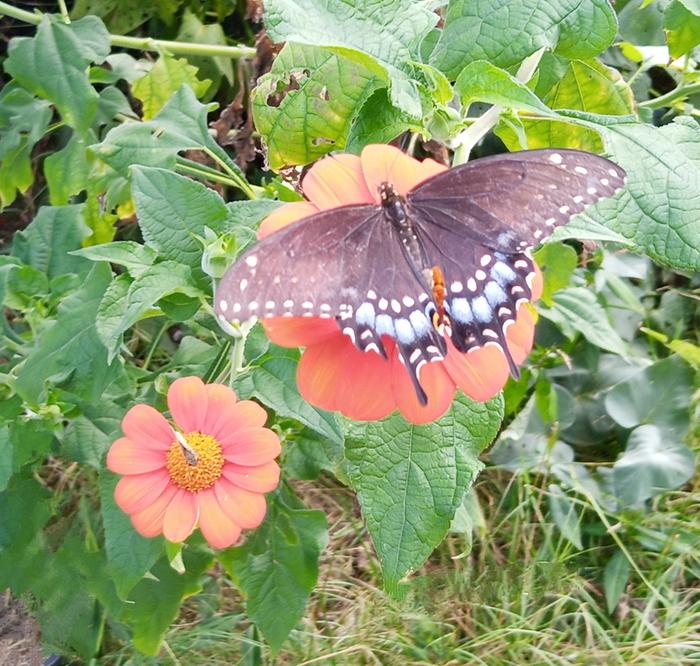
dark morph of the eastern tiger swallowtail
IMG_3129-(3).JPG
butterfly garden
eastern tiger swallowtail
IMG_3048-(2).JPG
butterfly garden
monarch
IMG_3049a.jpg
butterfly garden
monarch
IMG_3050a.jpg
butterfly garden
monarch
IMG_3052-(2).JPG
butterfly garden
eastern tiger swallowtail
IMG_3054a.jpg
butterfly garden
dark morph of the eastern tiger swallowtail'
IMG_3060-(2).JPG
butterfly garden
skippers
IMG_3065a.jpg
butterfly garden
IMG_3074-(2).JPG
butterfly garden
IMG_3169-(2).JPG
goldfinch eating echinacea seed
 
Judith Browning
Posts: 10719
Location: a temperate, clay/loam spot on planet earth, the universe
3899
4
  • Likes 6
  • Mark post as helpful
  • send pies
    Number of slices to send:
    Optional 'thank-you' note:
  • Quote
  • Report post to moderator
Just a few butterflies are out there acting frantic as the wind comes up and the storm moves in....hard to get a good photo.

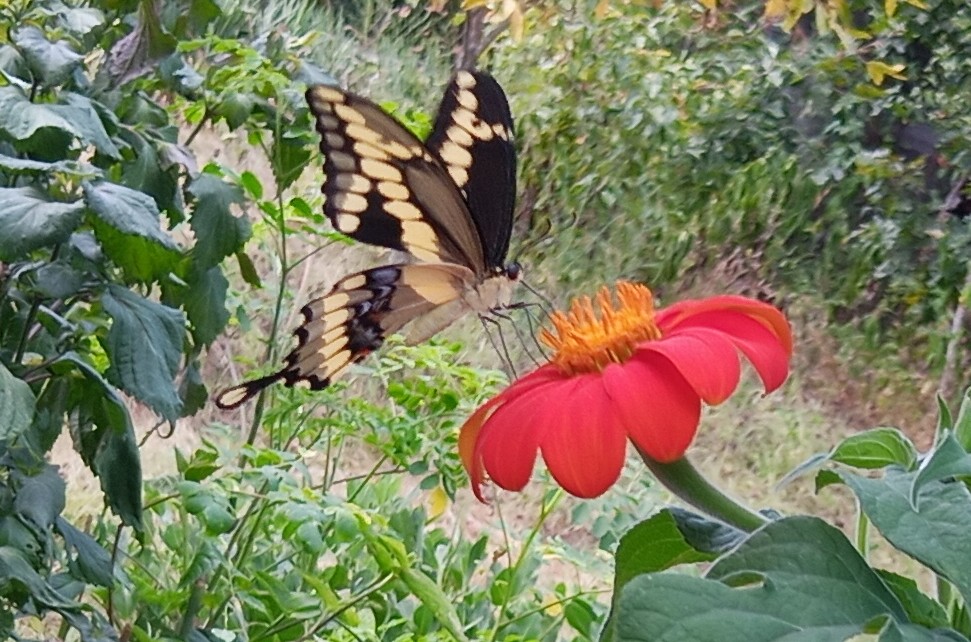
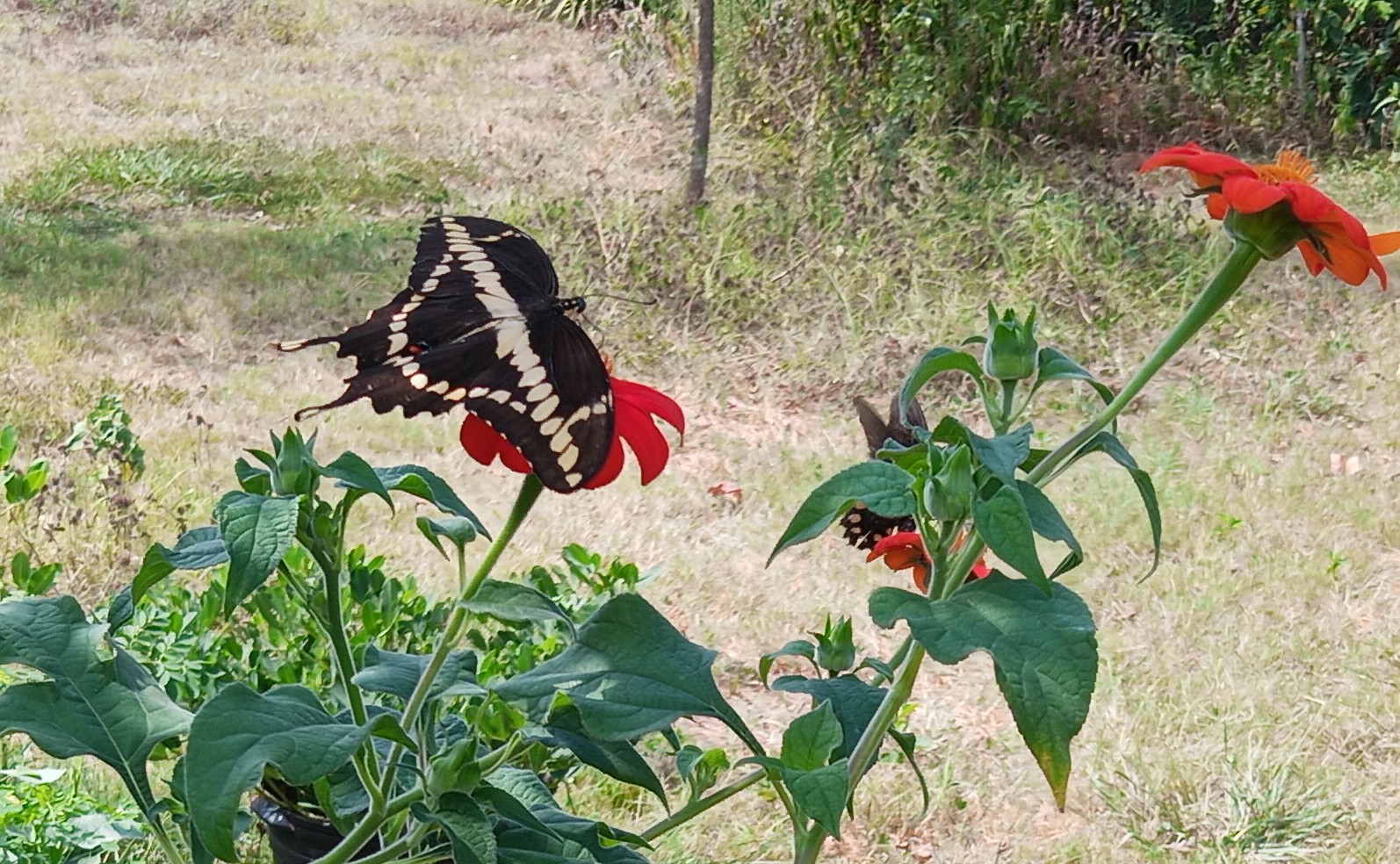
This one is a giant swallowtail that we rarely see.
IMG_3488-(2).JPG
giant swallowtail
giant swallowtail
IMG_3493-(2).JPG
giant swallowtail
giant swallowtail
IMG_3494-(2).JPG
giant swallowtail
giant swallowtail
IMG_3495-(2).JPG
[Thumbnail for IMG_3495-(2).JPG]
giant swallowtail
 
Judith Browning
Posts: 10719
Location: a temperate, clay/loam spot on planet earth, the universe
3899
4
  • Likes 5
  • Mark post as helpful
  • send pies
    Number of slices to send:
    Optional 'thank-you' note:
  • Quote
  • Report post to moderator
I need to get better at ID...we see the same ones frequently.  

Several, like this one are getting ragged.....
IMG_3507-(2).JPG
Pipevine Swallowtail
dark morph of the eastern tiger swallowtail'
IMG_3508-(2).JPG
Pipevine Swallowtail
dark morph of the eastern tiger swallowtail'
IMG_3509-(2).JPG
Pipevine Swallowtail
dark morph of the eastern tiger swallowtail'
IMG_3514-(2).JPG
Pipevine Swallowtail
dark morph of the eastern tiger swallowtail'
IMG_3515-(2).JPG
Pipevine Swallowtail
dark morph of the eastern tiger swallowtail'
 
steward
Posts: 19525
Location: USDA Zone 8a
4915
dog hunting food preservation cooking bee greening the desert
  • Likes 5
  • Mark post as helpful
  • send pies
    Number of slices to send:
    Optional 'thank-you' note:
  • Quote
  • Report post to moderator
That last one with the blue is a Pipevine Swallowtail!
 
Judith Browning
Posts: 10719
Location: a temperate, clay/loam spot on planet earth, the universe
3899
4
  • Likes 2
  • Mark post as helpful
  • send pies
    Number of slices to send:
    Optional 'thank-you' note:
  • Quote
  • Report post to moderator

Anne Miller wrote:That last one with the blue is a Pipevine Swallowtail!


Thank you Anne!
I knew you would know these

I'll go back and label them.
 
gardener
Posts: 1873
Location: the mountains of katuah, southern appalachia
624
forest garden trees foraging chicken food preservation wood heat
  • Likes 5
  • Mark post as helpful
  • send pies
    Number of slices to send:
    Optional 'thank-you' note:
  • Quote
  • Report post to moderator
here’s a good reference for differentiating dark swallowtails:

http://louisiananaturalist.blogspot.com/2009/06/four-dark-swallowtails.html

according to that, the one you’re calling pipeline swallowtail is probably the dark morph of the eastern tiger swallowtail.
i also see (9th image down in your first post in this thread) the main dark swallowtail in my area, the spicebush swallowtail - most identifiable by the shape of the big spots on the hind wing (kind of a thick ‘carat’ or arch shape).
 
Judith Browning
Posts: 10719
Location: a temperate, clay/loam spot on planet earth, the universe
3899
4
  • Likes 2
  • Mark post as helpful
  • send pies
    Number of slices to send:
    Optional 'thank-you' note:
  • Quote
  • Report post to moderator

greg mosser wrote:here’s a good reference for differentiating dark swallowtails:

http://louisiananaturalist.blogspot.com/2009/06/four-dark-swallowtails.html

according to that, the one you’re calling pipevine swallowtail is probably the dark morph of the eastern tiger swallowtail.
i also see (9th image down in your first post in this thread) the main dark swallowtail in my area, the spicebush swallowtail - most identifiable by the shape of the big spots on the hind wing (kind of a thick ‘carat’ or arch shape).


thanks Greg....I'll study that closer when I'm on my pc with some larger images.  The dark morph is what my husband was looking at but still was not certain?  I'm still leaning towards the pipevine but maybe I'll leave the photo label blank for now

that particular one is somewhat ragged and a little faded looking? Seems like I had some pictures of it's under wing also and that would help and ID.

EDIT: positive ID is a 'dark morph of the eastern tiger swallowtail'
 
greg mosser
gardener
Posts: 1873
Location: the mountains of katuah, southern appalachia
624
forest garden trees foraging chicken food preservation wood heat
  • Likes 4
  • Mark post as helpful
  • send pies
    Number of slices to send:
    Optional 'thank-you' note:
  • Quote
  • Report post to moderator
I think the thing I retained most from that blog is that pipevine swallowtails, both male and female, have blue that extends down the tail.
 
steward
Posts: 3580
Location: Maine, zone 5
2223
9
hugelkultur dog forest garden trees foraging food preservation cooking solar seed wood heat homestead
  • Likes 5
  • Mark post as helpful
  • send pies
    Number of slices to send:
    Optional 'thank-you' note:
  • Quote
  • Report post to moderator
Thank you!  I babysit a 2 year old on the weekends and she climbed up on my lap to stare at your butterfly garden Judith.  She LOVED your picctures!
 
Judith Browning
Posts: 10719
Location: a temperate, clay/loam spot on planet earth, the universe
3899
4
  • Likes 2
  • Mark post as helpful
  • send pies
    Number of slices to send:
    Optional 'thank-you' note:
  • Quote
  • Report post to moderator

Greg Martin wrote:Thank you!  I babysit a 2 year old on the weekends and she climbed up on my lap to stare at your butterfly garden Judith.  She LOVED your pictures!


oh, that's sweet Greg!
you are very welcome
 
pollinator
Posts: 1302
Location: Chicago
455
dog forest garden fish foraging urban cooking food preservation bike
  • Likes 6
  • Mark post as helpful
  • send pies
    Number of slices to send:
    Optional 'thank-you' note:
  • Quote
  • Report post to moderator
The photo that is img-3054a, one of the dark swallowtails look like female black swallowtail.
 
Judith Browning
Posts: 10719
Location: a temperate, clay/loam spot on planet earth, the universe
3899
4
  • Likes 1
  • Mark post as helpful
  • send pies
    Number of slices to send:
    Optional 'thank-you' note:
  • Quote
  • Report post to moderator
Thank you Greg Mosser for the link to that excellent site!
I'm going to try to post one of the pictures here just to have handy for comparison.  
I do believe you are correct in that the butterfly photos in my last reply above are the dark morph of the eastern female tiger swallowtail shown in the upper right of this image ....although the one in my image is old and ragged and maybe a little faded and I'm not seeing any bit of orange? I went back and looked at more of my flash drive photos and the orange is there....it is just the same color as the mexican sunflowers and I thought I was seeing those through the wings!

The top right is the female Eastern Tiger Swallowtail, dark morph. Notice the white spots on her forewings are really dashes. Also notice the white spots on her hindwings have a little orange in them, especially the ones on either end of the row. Sometimes you can still see a little yellow and maybe even a tiger stripe, but the dashes and the extra orange is always there. She's a bit bigger than the other dark swallowtails, too.


...top left in the photo from Louisiana Naturalistis a Black Swallowtail, top right the female Eastern Tiger, lower left a Spicebush, and lower right is the Pipevine.

I've only posted one of the images from the site...there are other views that compare the dark swallowtails that help confirm ID.

...and now I see that the whole image did not show...had to find it elsewhere to copy here as I could not from the blog...well worth going there for the full image and more
 
pollinator
Posts: 3571
Location: Meppel (Drenthe, the Netherlands)
1228
dog forest garden urban cooking bike fiber arts
  • Likes 5
  • Mark post as helpful
  • send pies
    Number of slices to send:
    Optional 'thank-you' note:
  • Quote
  • Report post to moderator
You have wonderful butterflies there!

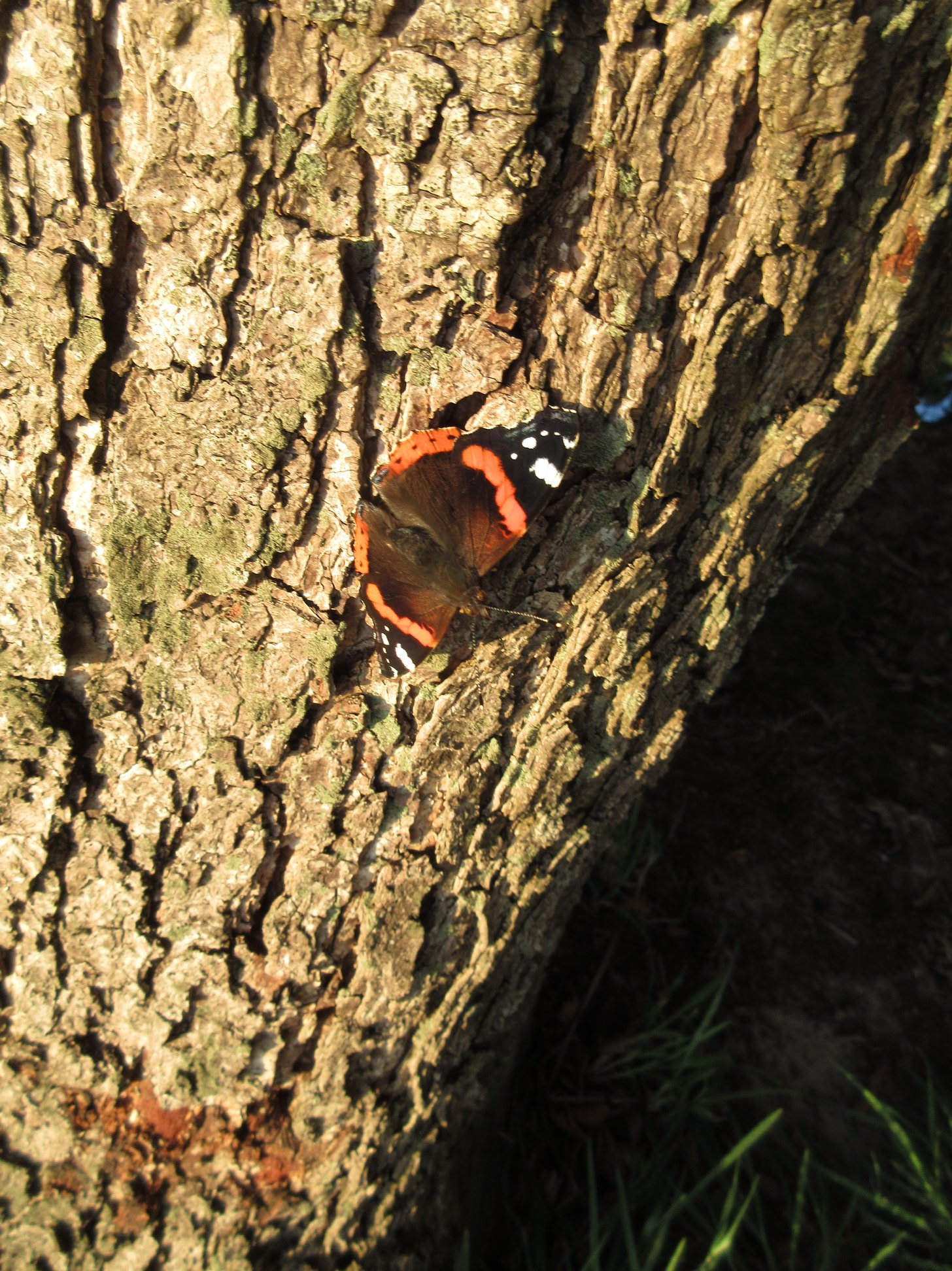
One of the largest butterflies here in the Netherlands is the Atalanta. As you see it is dark brown-black with red and white. Th is also called 'number butterfly', because sometimes the white spots look like numbers (9 or 6) .
 
Judith Browning
Posts: 10719
Location: a temperate, clay/loam spot on planet earth, the universe
3899
4
  • Likes 2
  • Mark post as helpful
  • send pies
    Number of slices to send:
    Optional 'thank-you' note:
  • Quote
  • Report post to moderator

Mk Neal wrote:The photo that is img-3054a, one of the dark swallowtails look like female black swallowtail.


thank you Mk...I think you are correct! Now I need to dig through the rest of my photos to see if I have one that shows the 'orange dot with a black spot' that is definitive?

Male and female Black Swallowtails can always be identified by the black dot inside the orange dot.


I wish I would have been thinking more about ID when I was taking pictures and during the busiest times for them....hopefully they'll be back in these numbers next year.
 
Judith Browning
Posts: 10719
Location: a temperate, clay/loam spot on planet earth, the universe
3899
4
  • Likes 1
  • Mark post as helpful
  • send pies
    Number of slices to send:
    Optional 'thank-you' note:
  • Quote
  • Report post to moderator

Inge Leonora-den Ouden wrote:You have wonderful butterflies there!

One of the largest butterflies here in the Netherlands is the Atalanta. As you see it is dark brown-black with red and white. Th is also called 'number butterfly', because sometimes the white spots look like numbers (9 or 6) .


Thanks Inge!

What an interesting butterfly...the 'number butterfly' sounds familiar? I never knew where they were from.
 
Posts: 2
3
  • Likes 9
  • Mark post as helpful
  • send pies
    Number of slices to send:
    Optional 'thank-you' note:
  • Quote
  • Report post to moderator
I have found many crystalis and cocoons in the old stands of tithonia, seedum, zinnia, asclepias. Leaving the stalks overwinter is a good idea both for the plant and the insects. For spring clean up, take stalks and find a place to stand them up so they have a chance to emerge and live. I used to burn, compost or shred this garden waste, but not any more.
 
Judith Browning
Posts: 10719
Location: a temperate, clay/loam spot on planet earth, the universe
3899
4
  • Likes 6
  • Mark post as helpful
  • send pies
    Number of slices to send:
    Optional 'thank-you' note:
  • Quote
  • Report post to moderator
Playing with posting my videos to a youtube channel this rainy morning.  

I made the video 'unlisted' so not sure if I can embed?
I think the private setting probably won't let me post even a link though?

Here's the first test  second test...I had to make it public to show here.in the end, with Nicole's help, I have it 'unlisted' and it works...must have had it private the first time?

...the butterflies have been at least that abundant every sunny hot day for weeks!


Posts: 502
Location: West Midlands UK (zone 8b) Rainfall 26"
142
  • Likes 4
  • Mark post as helpful
  • send pies
    Number of slices to send:
    Optional 'thank-you' note:
  • Quote
  • Report post to moderator

Inge Leonora-den Ouden wrote:You have wonderful butterflies there!

One of the largest butterflies here in the Netherlands is the Atalanta. As you see it is dark brown-black with red and white. Th is also called 'number butterfly', because sometimes the white spots look like numbers (9 or 6) .


That, to me, is a Red Admiral.  I've never heard them called Number Butterfly in this country.  Maybe we are less mathematically minded than in the Netherlands!

A little late, but I give you the Scarlet Tiger moth.
IMG_5272.JPG
[Thumbnail for IMG_5272.JPG]
 
Rocket Scientist
Posts: 600
Location: Northwest Missouri
283
forest garden fungi gear trees plumbing chicken cooking ungarbage
  • Likes 2
  • Mark post as helpful
  • send pies
    Number of slices to send:
    Optional 'thank-you' note:
  • Quote
  • Report post to moderator
I planted a test patch of an American Meadows blend and it looks similar to what you have growing. I too am torn on what to do before winter. The suggestion from the supplier is to high mow it after everything has browned up for the year so the seeds will disperse. But geeze dang, I don't imagine this will be easy to mow as thick and thickly stalked as it is! My patch is in a prominent location so I likely will mow or scythe it down so that I'm not looking at a patch of dead stalks all winter.
 
Judith Browning
Posts: 10719
Location: a temperate, clay/loam spot on planet earth, the universe
3899
4
  • Mark post as helpful
  • send pies
    Number of slices to send:
    Optional 'thank-you' note:
  • Quote
  • Report post to moderator

Matt Todd wrote:I planted a test patch of an American Meadows blend and it looks similar to what you have growing. I too am torn on what to do before winter. The suggestion from the supplier is to high mow it after everything has browned up for the year so the seeds will disperse. But geeze dang, I don't imagine this will be easy to mow as thick and thickly stalked as it is! My patch is in a prominent location so I likely will mow or scythe it down so that I'm not looking at a patch of dead stalks all winter.


I am going to try to leave these at least until the birds have had a chance to finish up the sunflower seeds and mexican sunflower seeds...I'm collecting a lot of seed as they mature also and I think there will still be volunteers.

I'm cutting some back as they get a little wind blown....and yes, there's the neighborhood Everyone has loved them all summer...so maybe I'll make a sign about the wintered over stalks?

I think you're right, it would take a scythe or even loppers for some of the stalks....can't imagine mowing unless they mean a bush hog?

What is in your american meadows blend?

The mexican sunflower, tithonia, has been the most popular here...butterflies, hummingbirds, bumblebees, honey bees....etc. sometimes fight over the blooms.  Everything else is busy also but I can tell tithonia rules.....
 
Matt Todd
Rocket Scientist
Posts: 600
Location: Northwest Missouri
283
forest garden fungi gear trees plumbing chicken cooking ungarbage
  • Likes 2
  • Mark post as helpful
  • send pies
    Number of slices to send:
    Optional 'thank-you' note:
  • Quote
  • Report post to moderator

Judith Browning wrote:

What is in your american meadows blend?

The mexican sunflower, tithonia, has been the most popular here...butterflies, hummingbirds, bumblebees, honey bees....etc. sometimes fight over the blooms.  Everything else is busy also but I can tell tithonia rules.....


"Spring into Summer" is the American Meadows blend I have. But here's the thing... It's dominated by the tithonia which isn't even supposed to be in the blend! I love the patch, just didn't expect it to be over 7 feet tall and I am a little peeved that the 46 species blend seems to be full of stowaways like the tithonia and another sunflower which have shaded out most of the shorter varieties that are supposed to compose the blend. This is my test patch. I have a much larger chunk of yard smothering under tarps currently for fall planting (thanks to your advise and I believe I will only allow SOME of that patch to grow tithonia in the spring so the others get a chance too.
Banner.jpg
[Thumbnail for Banner.jpg]
 
Judith Browning
Posts: 10719
Location: a temperate, clay/loam spot on planet earth, the universe
3899
4
  • Likes 2
  • Mark post as helpful
  • send pies
    Number of slices to send:
    Optional 'thank-you' note:
  • Quote
  • Report post to moderator
Matt, I don't think anything has a chance with tithonia around...and most things prefer it.  I haven't had it volunteer though like I was told it would?

At least you intended your meadow...mine is about a third of our vegetable garden...shaded out the bush beans and other things.  I just didn't have the heart to cut them down.  The sunflowers were saved seed and I had wanted a lot of mexican sunflower (I even knew how large they get) ...but yes, the lower growing things did not stand a chance
 
Judith Browning
Posts: 10719
Location: a temperate, clay/loam spot on planet earth, the universe
3899
4
  • Likes 5
  • Mark post as helpful
  • send pies
    Number of slices to send:
    Optional 'thank-you' note:
  • Quote
  • Report post to moderator
Here are a couple videos showing how popular the tithonia is!
I did not keep recording because I thought the honey bee chasing away the monarch was the end of the action...then the bumble bee that is lurking to the right in the first video, zipped in and chased off the honey bee...I only caught it after the fact.


Anne Miller
steward
Posts: 19525
Location: USDA Zone 8a
4915
dog hunting food preservation cooking bee greening the desert
  • Likes 4
  • Mark post as helpful
  • send pies
    Number of slices to send:
    Optional 'thank-you' note:
  • Quote
  • Report post to moderator
We got Mexican Sunflower, tithonia seeds in a mix we got from one of the Monarch organizations.  The Monarchs really loved it.

I saved seeds to plant the next year.

I planted four but something got three of them.  The fourth one was yellow and not as popular as the orange ones.

Then something [deer?] ate it.

Probably the best thing to do is wait for the sunflowers to die then remove the stalks.  Then you can mow.  That is what we did with our sunflower plot.
 
Judith Browning
Posts: 10719
Location: a temperate, clay/loam spot on planet earth, the universe
3899
4
  • Likes 8
  • Mark post as helpful
  • send pies
    Number of slices to send:
    Optional 'thank-you' note:
  • Quote
  • Report post to moderator
Yesterday we had a surprise on the ceiling of our front porch!

I can't believe we hadn't noticed the chrysalis before then...early dawn I saw the butterfly had emerged.

We were gone until 1pm or so and saw it was still in the same spot so thought it had died from the cooler weather.
A couple hours later, in the heat of the day, my husband was looking at its markings to ID and it flew away
Of course, no camera handy then and I tried to go look around the flowers for it with no luck.

The Arkansas Butterfly group says it's a Question Mark because of the slightly visible 'punctuation' on the wing.
We had thought either that or a Comma, as they are similar looking and Commas like hops flowers which is what we have growing on the porch trellis.

When I went searching in the flowers for it, I did see a Monarch and various pale yellow cloud butterflies...no swallowtails at all now.
IMG_4099-(3).JPG
[Thumbnail for IMG_4099-(3).JPG]
IMG_4099-(4).JPG
[Thumbnail for IMG_4099-(4).JPG]
IMG_4099-(5).JPG
[Thumbnail for IMG_4099-(5).JPG]
IMG_4100-(3).JPG
[Thumbnail for IMG_4100-(3).JPG]
IMG_4101-(3).JPG
[Thumbnail for IMG_4101-(3).JPG]
IMG_4102-(3).JPG
[Thumbnail for IMG_4102-(3).JPG]
 
Judith Browning
Posts: 10719
Location: a temperate, clay/loam spot on planet earth, the universe
3899
4
  • Likes 6
  • Mark post as helpful
  • send pies
    Number of slices to send:
    Optional 'thank-you' note:
  • Quote
  • Report post to moderator
Have not had a great 'butterfly summer' since I first began this thread in 2020 although this year is better than the last few.

In addition to the garden I planted more Mexican Sunflowers, tithonia, in view of the glider on the back porch so I have been more observant of just this one big plant off and on during the hot part of the day.

The pipevines have been the most active...all day long once the sun is up and always 3-5 at a time ...they sometimes 'allow' another butterfly on the flowers, like the gulf fritillary https://en.wikipedia.org/wiki/Gulf_fritillary and eastern tiger swallow tail in these recent photos....also an occasional fast moving monarch...skippers too and the sulphurs are out but seem to prefer the cosmos.

Hummingbirds like tithonia also but have to come earlier to get a chance at the flowers as the butterflies chase them off!
...and the bumble bees usually like tithonia...have not seen as many nor the neighborhood honey bees.
IMG_20250821_173000_327-3.jpg
[Thumbnail for IMG_20250821_173000_327-3.jpg]
gulf fritillary
IMG_20250821_172848_494-2.jpg
[Thumbnail for IMG_20250821_172848_494-2.jpg]
female black swallowtail
IMG_20250821_172917_223-2.jpg
[Thumbnail for IMG_20250821_172917_223-2.jpg]
eastern tiger swallowtail
IMG_20250821_172951_777-2.jpg
[Thumbnail for IMG_20250821_172951_777-2.jpg]
gulf fritillary
IMG_20250821_172948_306-2.jpg
[Thumbnail for IMG_20250821_172948_306-2.jpg]
gulf fritillary
IMG_20250821_172849_450-2.jpg
[Thumbnail for IMG_20250821_172849_450-2.jpg]
female black swallowtail
IMG_20250821_172919_880-2.jpg
[Thumbnail for IMG_20250821_172919_880-2.jpg]
eastern tiger swallowtail
 
Judith Browning
Posts: 10719
Location: a temperate, clay/loam spot on planet earth, the universe
3899
4
  • Likes 5
  • Mark post as helpful
  • send pies
    Number of slices to send:
    Optional 'thank-you' note:
  • Quote
  • Report post to moderator
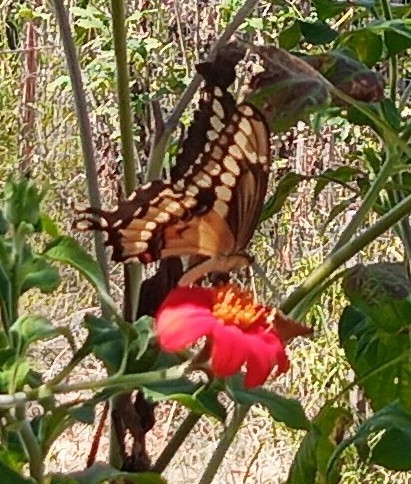
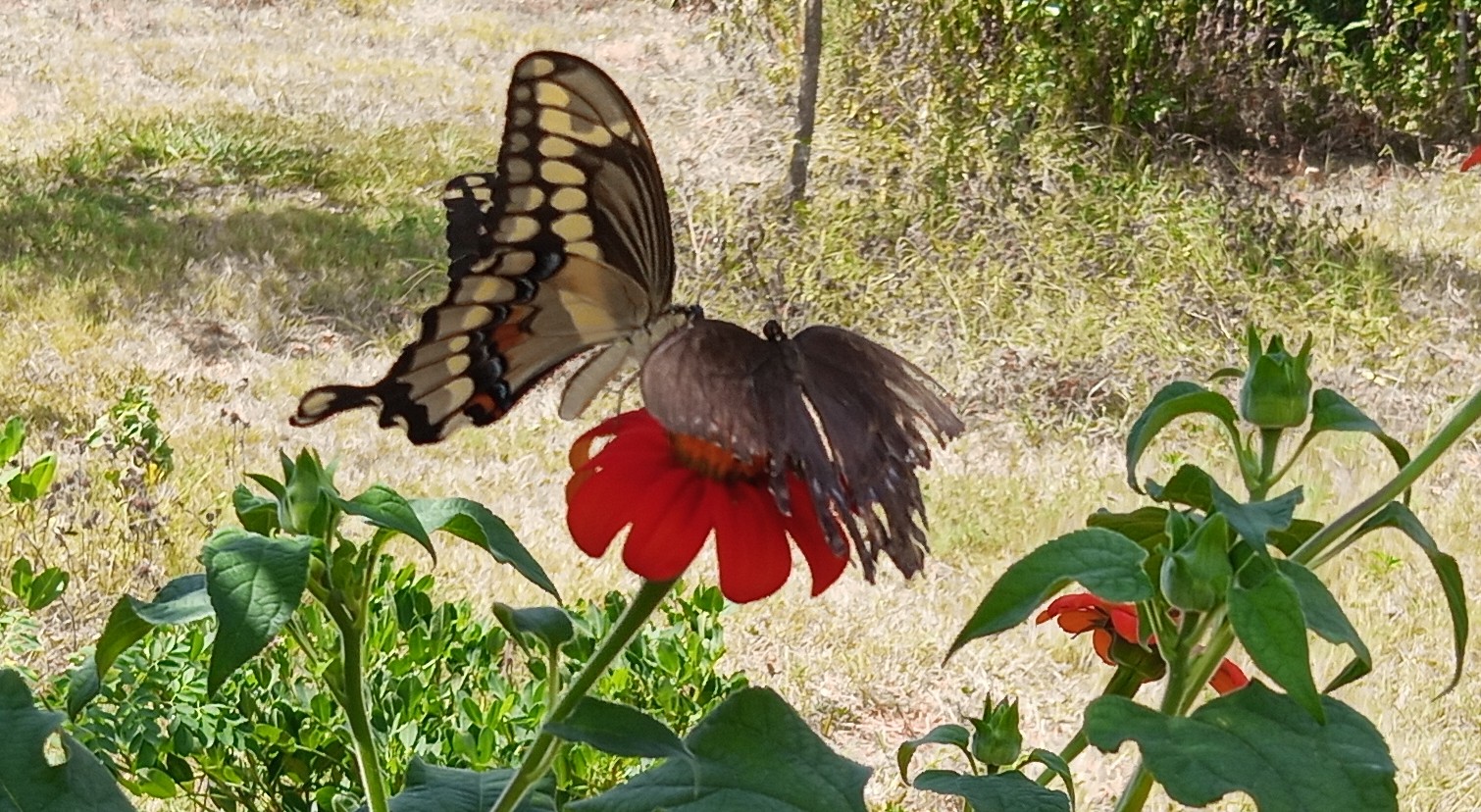
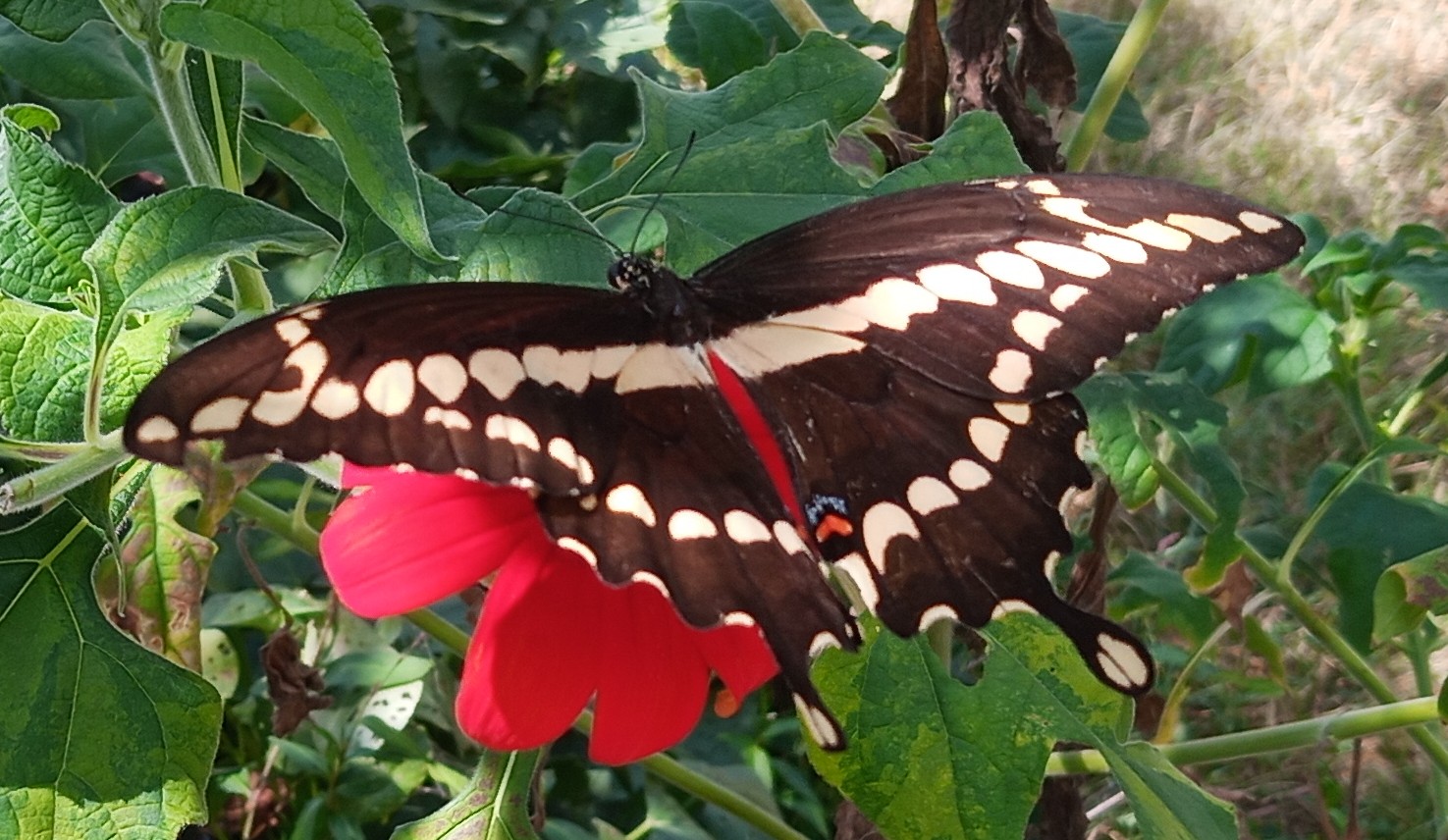
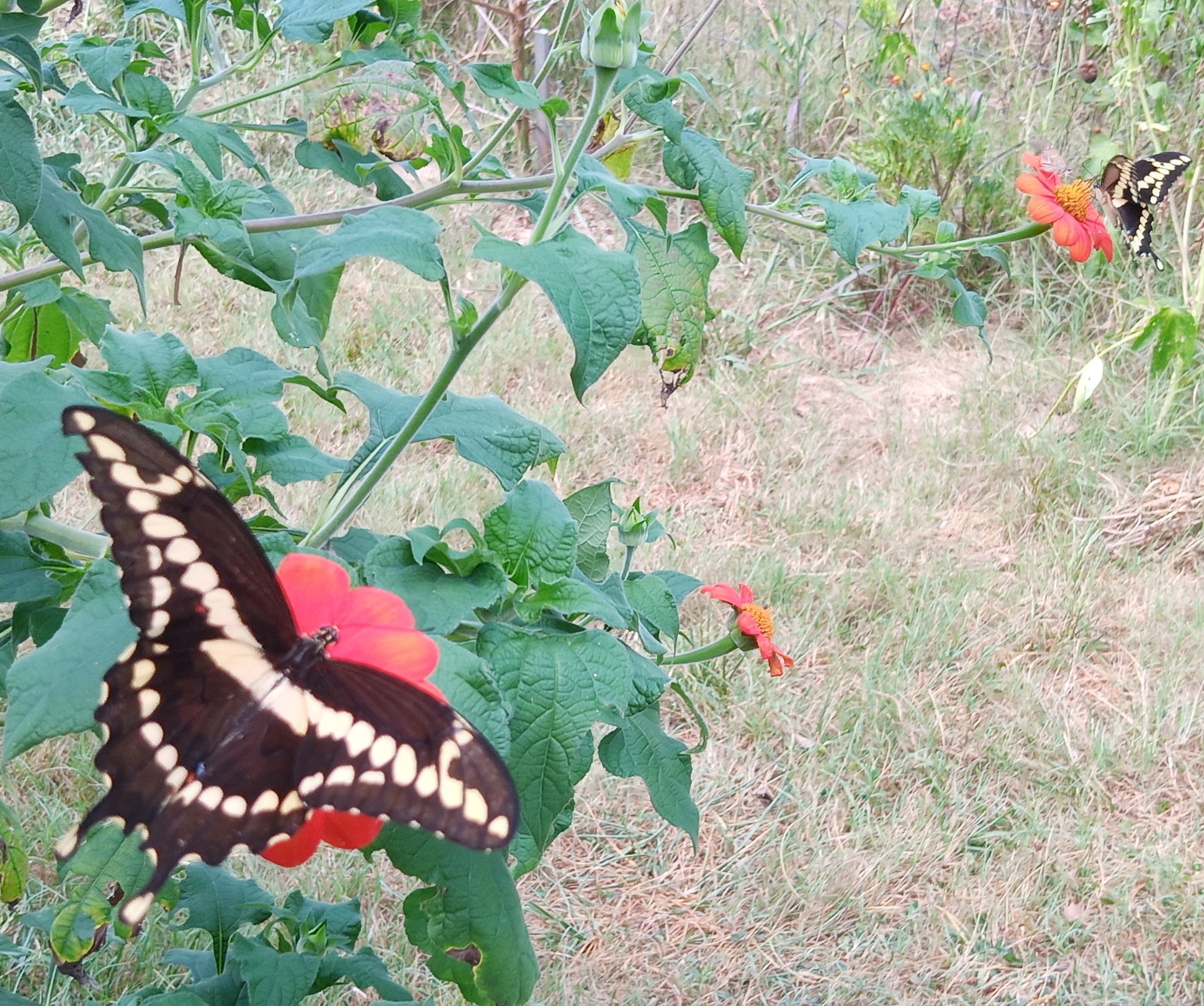
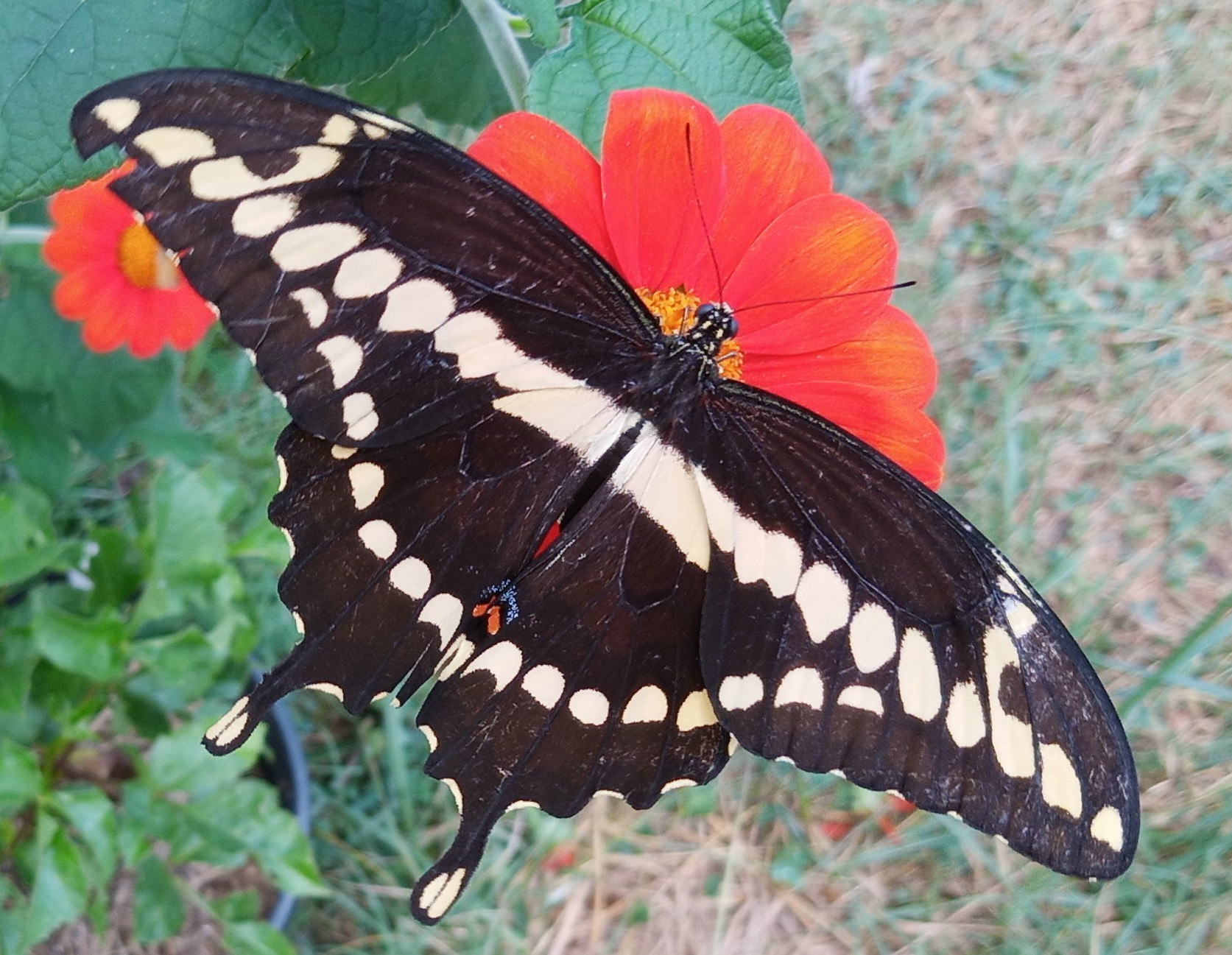
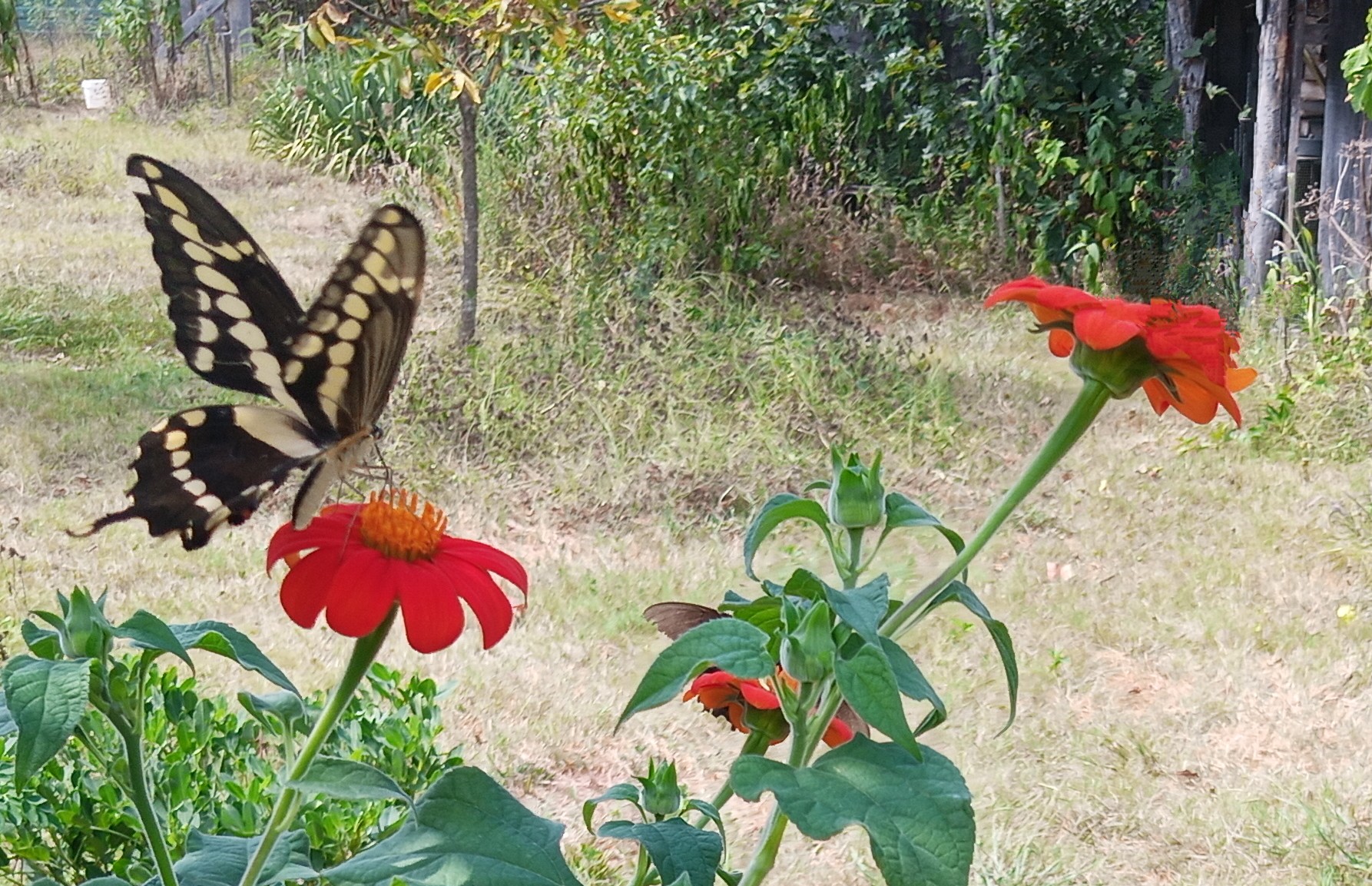
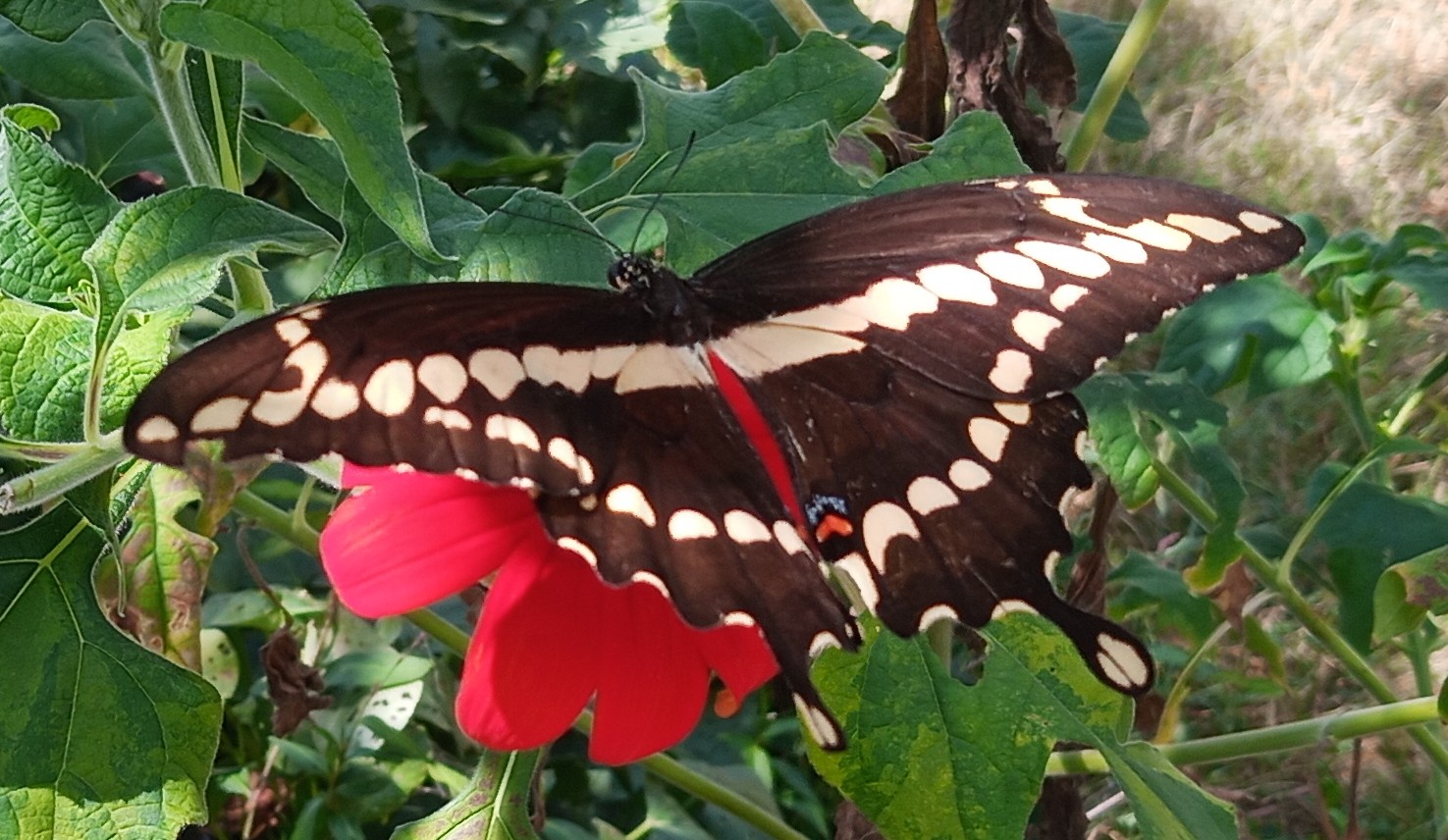
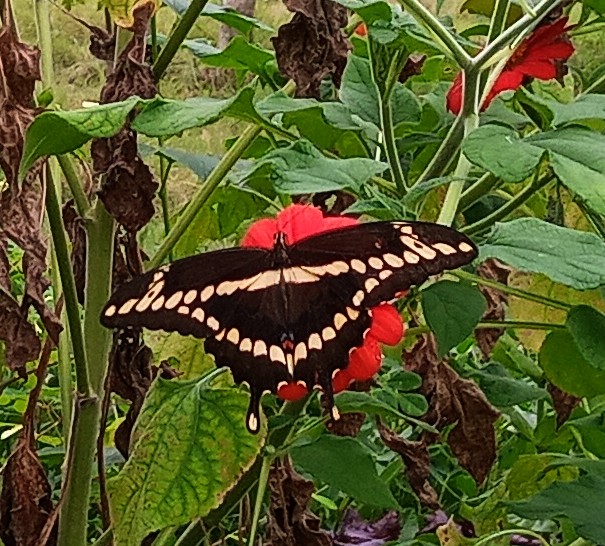
today, the giant swallowtails (Papilio cresphontes) showed up.
The first quite large and calm for picture taking and the second one half the size and very skittish...and the pipevines were still as busy as ever.
IMG_20250822_143756_118-4.jpg
giant swallowtail on tithonia bloom
IMG_20250822_141317_663-2.jpg
giant swallowtail on tithonia bloom
giant swallowtail and a ragged pipevine on tithonia bloom
IMG_20250822_141254_060-2.jpg
giant swallowtail on tithonia bloom
IMG_20250822_144902_568-2.jpg
giant swallowtail on tithonia bloom
IMG_20250822_144848_659-2.jpg
giant swallowtail on tithonia bloom
two giant swallowtail on tithonia blooms
IMG_20250822_144835_994-2.jpg
giant swallowtail on tithonia bloom
IMG_20250822_143510_581-2.jpg
[Thumbnail for IMG_20250822_143510_581-2.jpg]
giant swallowtail and pipevine on tithonia blooms
IMG_20250822_142603_963-2.jpg
giant swallowtail on tithonia bloom
IMG_20250822_142601_960-2.jpg
giant swallowtail on tithonia bloom
IMG_20250822_141254_060-2.jpg
giant swallowtail on tithonia bloom
 
Judith Browning
Posts: 10719
Location: a temperate, clay/loam spot on planet earth, the universe
3899
4
  • Likes 5
  • Mark post as helpful
  • send pies
    Number of slices to send:
    Optional 'thank-you' note:
  • Quote
  • Report post to moderator
.
IMG_20250822_141302_659-2.jpg
[Thumbnail for IMG_20250822_141302_659-2.jpg]
pipevine swallowtail
IMG_20250822_143756_118-4.jpg
[Thumbnail for IMG_20250822_143756_118-4.jpg]
giant swallowtail
IMG_20250822_143504_151-2.jpg
[Thumbnail for IMG_20250822_143504_151-2.jpg]
IMG_20250822_143816_389-2.jpg
[Thumbnail for IMG_20250822_143816_389-2.jpg]
IMG_20250822_142702_901-2.jpg
[Thumbnail for IMG_20250822_142702_901-2.jpg]
IMG_20250822_143816_389-3.jpg
[Thumbnail for IMG_20250822_143816_389-3.jpg]
IMG_20250822_141216_805-2.jpg
[Thumbnail for IMG_20250822_141216_805-2.jpg]
 
Judith Browning
Posts: 10719
Location: a temperate, clay/loam spot on planet earth, the universe
3899
4
  • Likes 6
  • Mark post as helpful
  • send pies
    Number of slices to send:
    Optional 'thank-you' note:
  • Quote
  • Report post to moderator
the tithonia is still busy...and I saw a monarch on the cosmos.
an occasional hummingbird, bumble bee, many variegated fritillaries and a few sulphurs.
not as many pipevines and the ones left are pretty ragged.
and a nice great spangled fritillary...a female apparently as they are darker.
IMG_20250902_145559_995-3.jpg
[Thumbnail for IMG_20250902_145559_995-3.jpg]
great spangled frittilary
IMG_20250902_145617_570-2.jpg
[Thumbnail for IMG_20250902_145617_570-2.jpg]
pipevine swallowtail
IMG_20250902_145559_995-2.jpg
[Thumbnail for IMG_20250902_145559_995-2.jpg]
great spangled frittilary
IMG_20250902_151203_387-3.jpg
[Thumbnail for IMG_20250902_151203_387-3.jpg]
monarch
IMG_20250902_145544_527-2.jpg
[Thumbnail for IMG_20250902_145544_527-2.jpg]
great spangled frittilary
 
Judith Browning
Posts: 10719
Location: a temperate, clay/loam spot on planet earth, the universe
3899
4
  • Likes 4
  • Mark post as helpful
  • send pies
    Number of slices to send:
    Optional 'thank-you' note:
  • Quote
  • Report post to moderator
our cat, Peaches, got interested in all the fluttering at the tithonia so has camped out under it daily this week 🙄
IMG_20250903_084307_153-2.jpg
[Thumbnail for IMG_20250903_084307_153-2.jpg]
 
Judith Browning
Posts: 10719
Location: a temperate, clay/loam spot on planet earth, the universe
3899
4
  • Likes 9
  • Mark post as helpful
  • send pies
    Number of slices to send:
    Optional 'thank-you' note:
  • Quote
  • Report post to moderator
when I began this thread in 2020 our big garden was a flutter with butterflies...almost scary numbers to stand in the middle of...(see the videos I posted)
Since then far fewer each year but I also have fewer flowers all in one place so I'm reminding myself  that next year I need to plant the flower 'forest' again.

Tithonia is still the winner as far as attracting the most butterflies of all kinds, then my 'bright lights' cosmos....sunflowers too and zinnias.

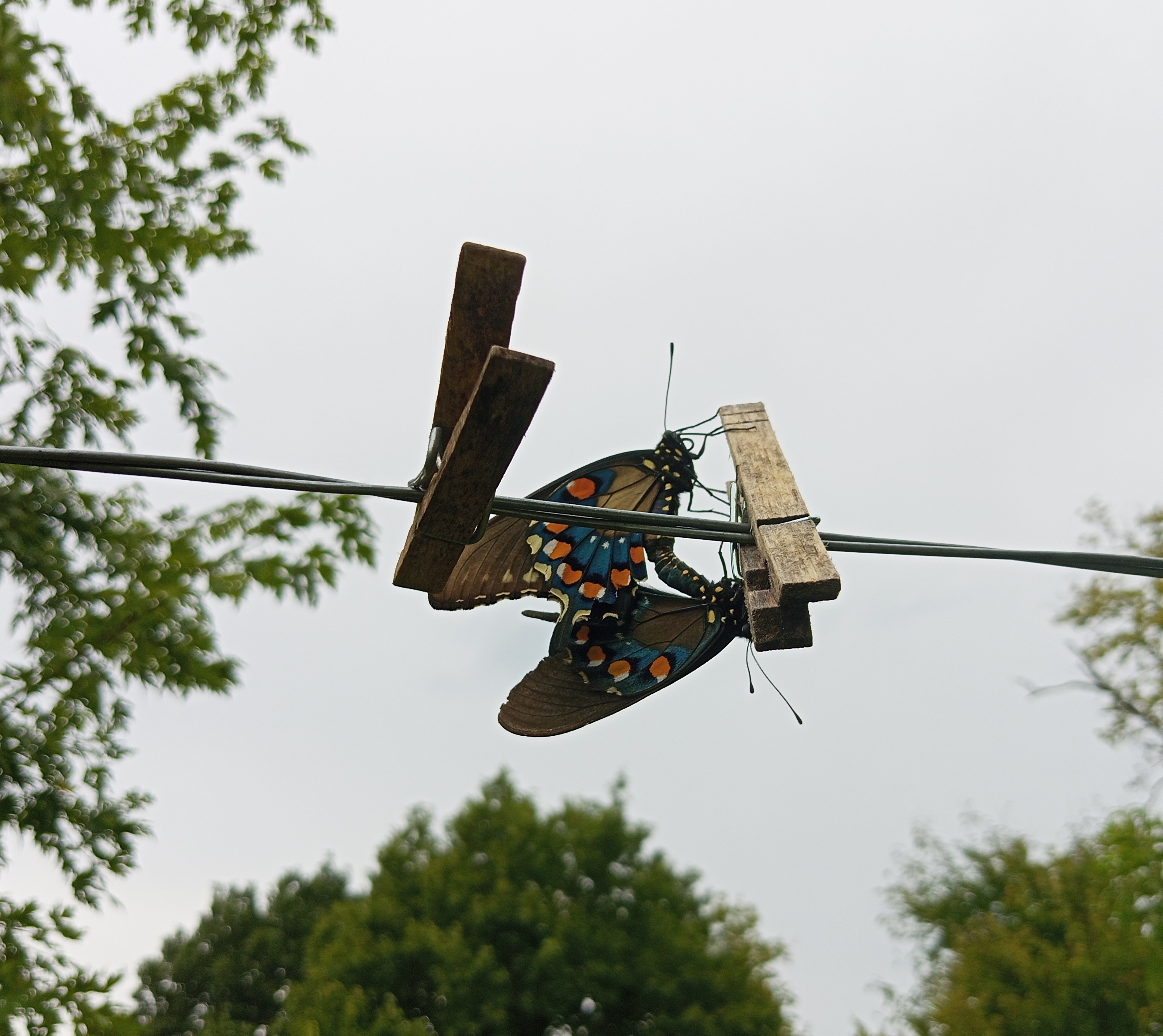
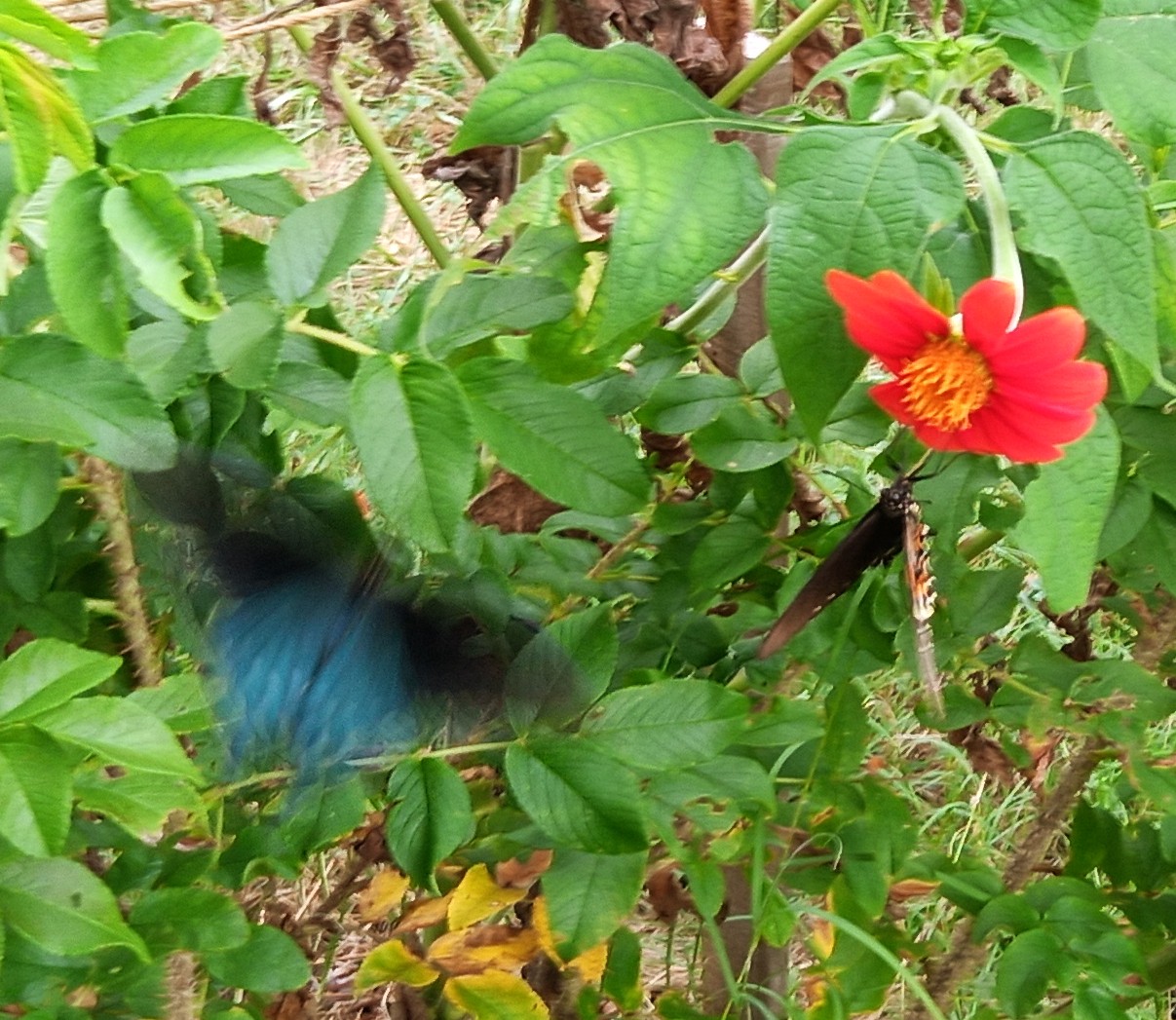
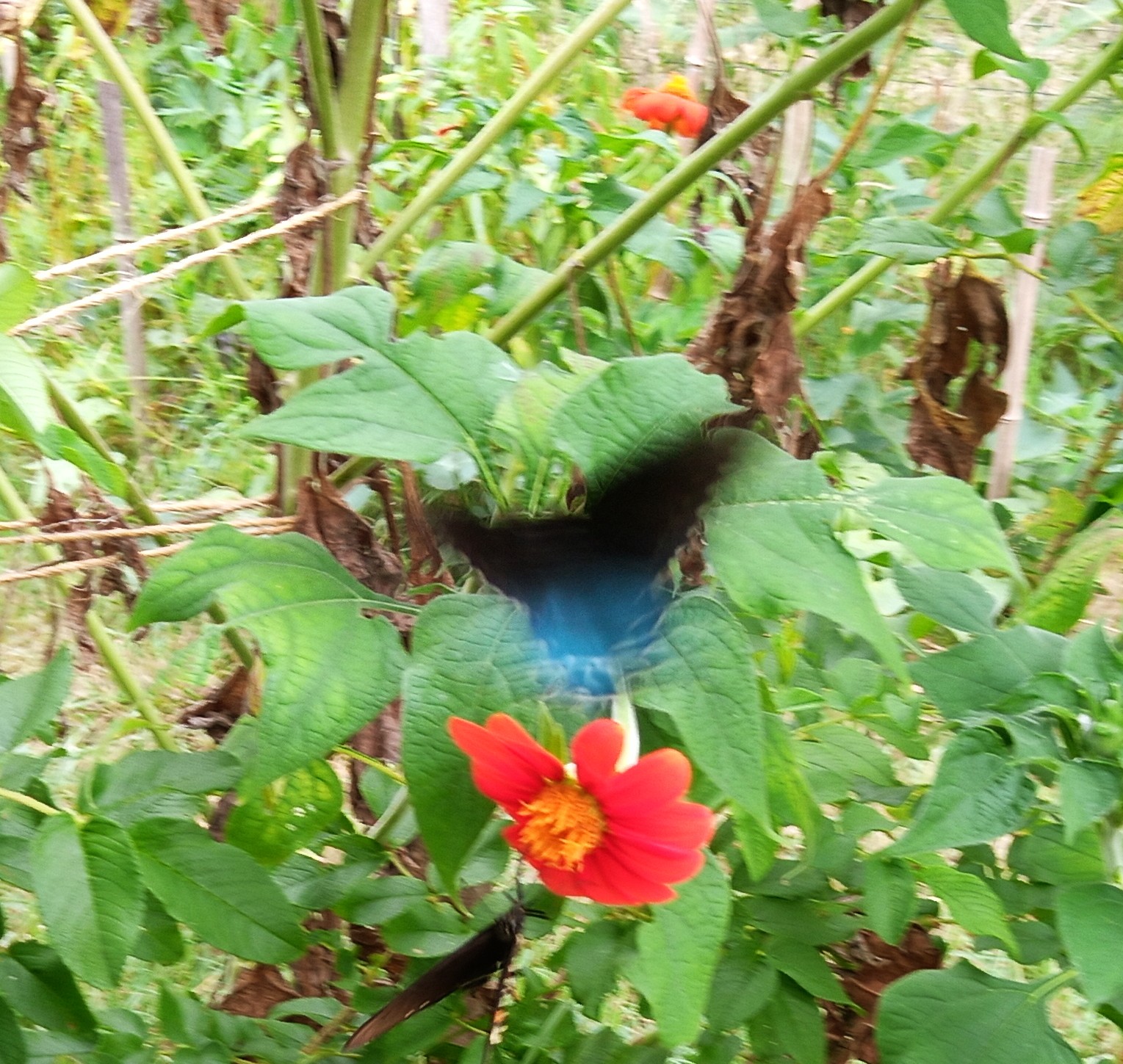
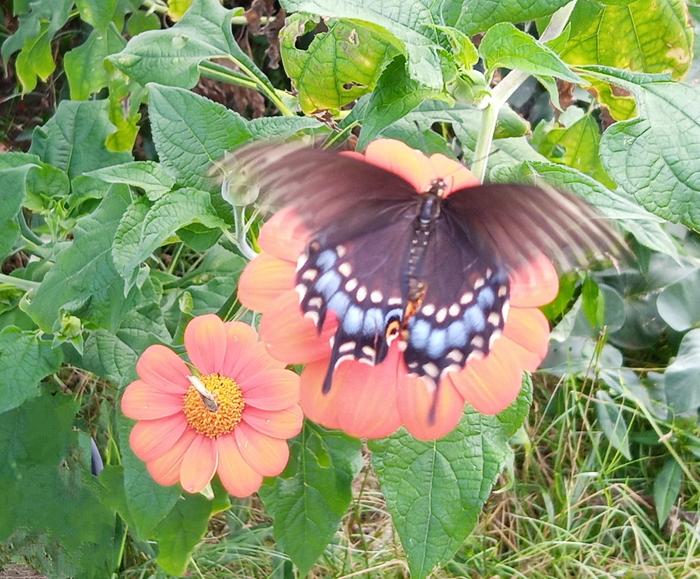
I think that's a pair of pipevine butterflies on my clothesline🙄

IMG_20260822_170150_BURST4-2.jpg
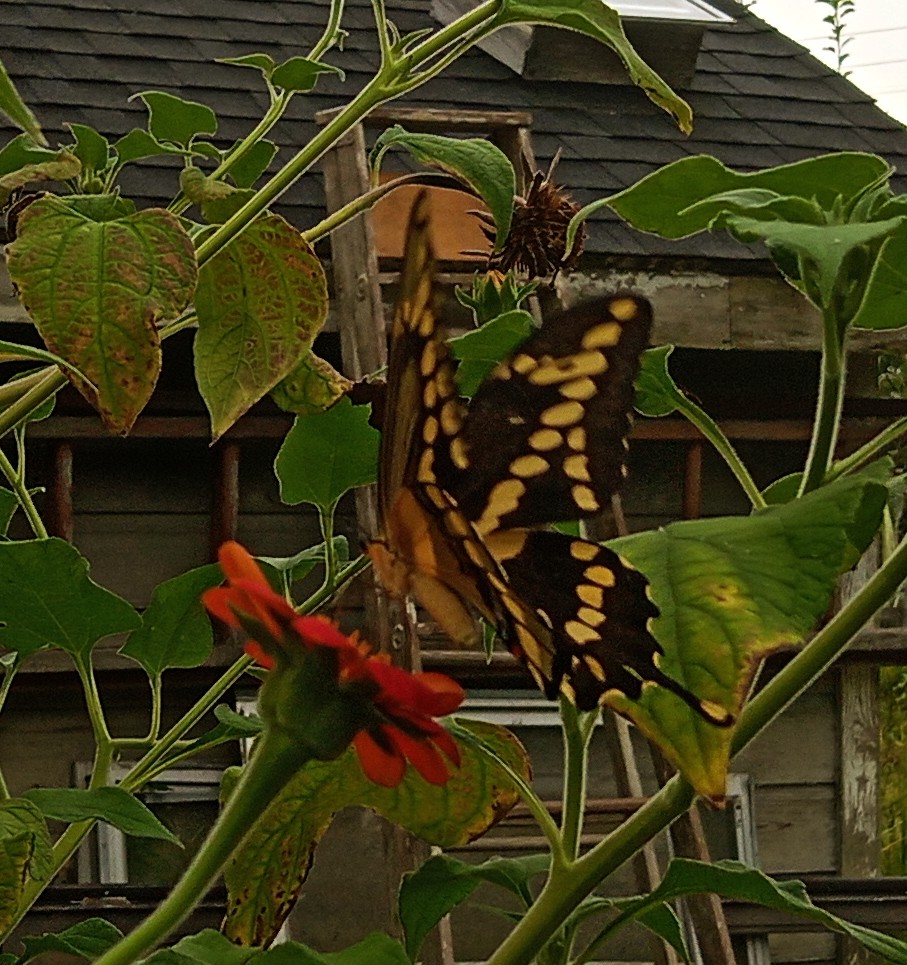
giant swallowtail
giant swallowtail
IMG_20260822_170205_043-2.jpg
giant swallowtail
giant swallowtail
IMG_20260822_170003_680-2.jpg
😯
😯
IMG_20260822_165849_570-2.jpg
pipevine
pipevine swallowtail
IMG_20260822_165855_549-2.jpg
pipevine
pipevine swallowtail
 
Judith Browning
Posts: 10719
Location: a temperate, clay/loam spot on planet earth, the universe
3899
4
  • Likes 4
  • Mark post as helpful
  • send pies
    Number of slices to send:
    Optional 'thank-you' note:
  • Quote
  • Report post to moderator
going back over this thread I see I am still confused about ID for the butterfly I've been calling a pipevine swallowtail.....will try to better ID them and correct.
 
gardener
Posts: 2297
Location: Zone 6b
1506
forest garden fungi books chicken fiber arts ungarbage
  • Likes 6
  • Mark post as helpful
  • send pies
    Number of slices to send:
    Optional 'thank-you' note:
  • Quote
  • Report post to moderator
There are several dark-colored butterflies that look similar. Check this out for identification.
https://usinggeorgianativeplants.blogspot.com/2020/08/confusing-dark-swallowtails.html?m=1
 
Judith Browning
Posts: 10719
Location: a temperate, clay/loam spot on planet earth, the universe
3899
4
  • Likes 3
  • Mark post as helpful
  • send pies
    Number of slices to send:
    Optional 'thank-you' note:
  • Quote
  • Report post to moderator
Thanks May!
Between that link and the one Greg M posted earlier in this thread I think I have a better grip on 'who's who' now
 
Judith Browning
Posts: 10719
Location: a temperate, clay/loam spot on planet earth, the universe
3899
4
  • Likes 6
  • Mark post as helpful
  • send pies
    Number of slices to send:
    Optional 'thank-you' note:
  • Quote
  • Report post to moderator
Have not been getting photos of the fritillary s nor the small skippers but here is our first monarch in a long time.   the sulphurs are here daily.


IMG_20260824_140218_845-2.jpg
[Thumbnail for IMG_20260824_140218_845-2.jpg]
sulphur butterfly
IMG_20260824_140048_299-2.jpg
[Thumbnail for IMG_20260824_140048_299-2.jpg]
monarch butterfly
 
Judith Browning
Posts: 10719
Location: a temperate, clay/loam spot on planet earth, the universe
3899
4
  • Likes 5
  • Mark post as helpful
  • send pies
    Number of slices to send:
    Optional 'thank-you' note:
  • Quote
  • Report post to moderator
I labeled these two photos in an earlier post in this thread as 'female black swallowtail'...the description matches.

The wikipedia article https://en.wikipedia.org/wiki/Papilio_polyxenes suggests a more likely similar looking one for my area called an Ozark Swallowtail https://en.wikipedia.org/wiki/Papilio_joanae

I'm confused again.
these are my two images:


and the following two are from the Wikipedia articles...
Pristine_Black_Swallowtail.jpg
[Thumbnail for Pristine_Black_Swallowtail.jpg]
female black swallowtail
Papilio_joanae_female.jpg
[Thumbnail for Papilio_joanae_female.jpg]
female ozark swallowtail
 
steward and tree herder
Posts: 14361
Location: Isle of Skye, Scotland. Nearly 70 inches rain a year
8030
6
transportation dog forest garden foraging trees books food preservation woodworking wood heat rocket stoves ungarbage
  • Likes 7
  • Mark post as helpful
  • send pies
    Number of slices to send:
    Optional 'thank-you' note:
  • Quote
  • Report post to moderator
I like butterflies and moths for butterfly identification. This is their pages on black swallowtail and
Ozarks swallowtail It seems the difference is very small - to do with the orange spot on the back wings.

Nearly identical to Black Swallowtail (Papilio polyxenes). Face is yellow; black pupil in eyespot trailing edge of hindwing is not centered and touches inner edge of windwing.

whereas the black spot is more central on the normal black swallowtail - although it looks like there is a lot of regional variations. Whichever it is they are beautiful - thank you!
 
pollinator
Posts: 1864
Location: southern Illinois, USA
405
fungi foraging composting toilet food preservation wood heat homestead
  • Likes 8
  • Mark post as helpful
  • send pies
    Number of slices to send:
    Optional 'thank-you' note:
  • Quote
  • Report post to moderator
For butterflies the other thing to pay attention to is what do the caterpillars eat.  If that plant isn't around, then there won't be any of the adults no matter what flowers you have, or only a few that wander in from a distance.  Many species eat pretty common things, but there are some that are very specific, such as the pipevine swallowtail on pipevine (Aristolochia), monarchs on milkweed, and zebra swallowtails on pawpaw.  Planting these is crucial to supporting populations of butterflies sustainably, particularly in areas where wildlands are uncommon or being degraded.  And yes, leave the stuff there through winter and into spring, since many beneficial insects and pollinators overwinter in it, sometimes burrowing into hollow stems to hibernate in shelter. If you need to "clean up" then moving the whole stalks somewhere out of sight and piling them loosely is a good compromise.  By the following late spring most things will be hatched out and the stuff can then be broken up for mulch or compost as you like.
 
Judith Browning
Posts: 10719
Location: a temperate, clay/loam spot on planet earth, the universe
3899
4
  • Likes 6
  • Mark post as helpful
  • send pies
    Number of slices to send:
    Optional 'thank-you' note:
  • Quote
  • Report post to moderator
thank you both!

I'm back to my original 'female black swallowtail' ID.
Reading further, the Ozark Swallowtail is rare and the caterpillars feed on plants that I don't think are in our immediate area.
I do ordinarily check for what the caterpillars feed on but had not for the Ozark Swallowtail.

The biggest surprise was the pipevine swallowtail as the young only feed on pipevine.
It turns out we have it along the creek close by.  I had only seen it at the Buffalo river previously.
 
Judith Browning
Posts: 10719
Location: a temperate, clay/loam spot on planet earth, the universe
3899
4
  • Likes 5
  • Mark post as helpful
  • send pies
    Number of slices to send:
    Optional 'thank-you' note:
  • Quote
  • Report post to moderator
On the back porch in the sun....just emerged I think.
We have hackberry trees within a few yards of the porch.

https://en.wikipedia.org/wiki/Asterocampa_celtis

   Asterocampa celtis, the hackberry emperor, is a North American butterfly that belongs to the brushfooted butterfly family, Nymphalidae.[2] It gets its name from the hackberry tree (Celtis occidentalis and others in the genus Celtis) upon which it lays its eggs. The hackberry tree is the only host plant for A. celtis and is the food source for larvae.
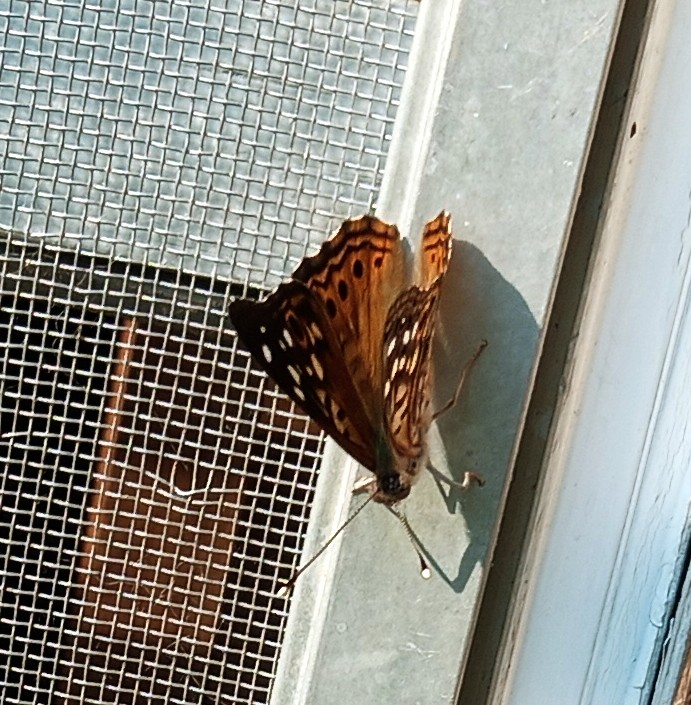
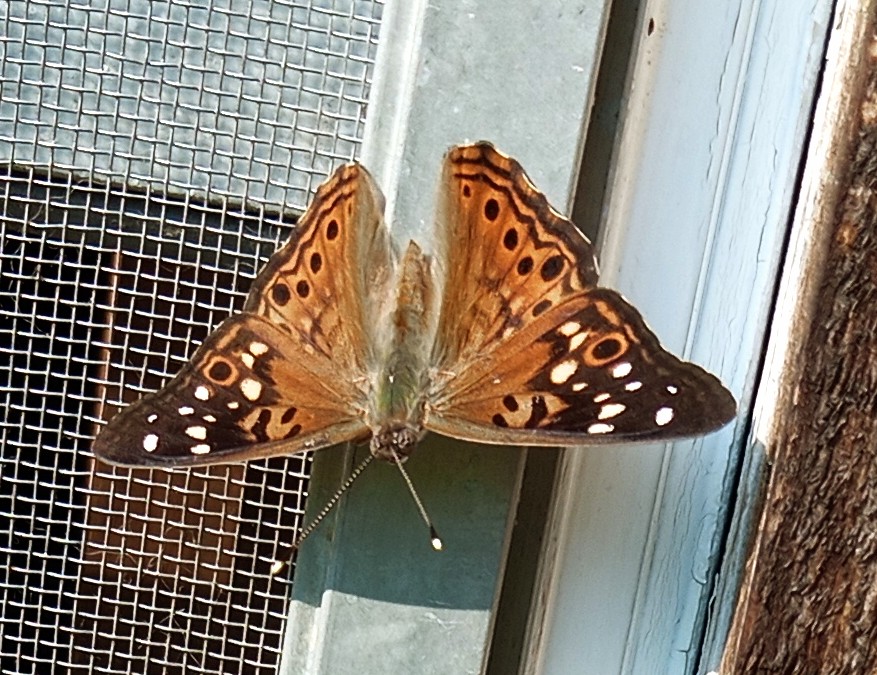
IMG_20260825_093418_909-2.jpg
Asterocampa celtis, the hackberry emperor
IMG_20260825_093420_756-2.jpg
Asterocampa celtis, the hackberry emperor
 
I'm tired of walking, and will rest for a minute and grow some wheels. This is the promise of this tiny ad:
12 Better World books +12 SKIP books +12 Cob Style DVDs
https://permies.com/wiki/380865/World-books-SKIP-books-Cob
reply
    Bookmark Topic Watch Topic
  • New Topic