
• Post Reply Bookmark Topic Watch Topic
  • New Topic
permaculture forums growies critters building homesteading energy monies kitchen purity ungarbage community wilderness fiber arts art permaculture artisans regional education skip experiences global resources cider press projects digital market permies.com pie forums private forums all forums
this forum made possible by our volunteer staff, including ...
master stewards:
  • Devaka Cooray
  • Carla Burke
  • John F Dean
  • Nancy Reading
  • Timothy Norton
  • r ranson
stewards:
  • Jay Angler
  • Pearl Sutton
  • paul wheaton
master gardeners:
  • Christopher Weeks
  • M Ljin
gardeners:
  • thomas rubino
  • Eino Kenttä
  • Jeremy VanGelder

Shorty sidewinder, 200 mm (approx. 8") system, lots of mass

 
gardener
Posts: 1150
Location: +52° 1' 47.40", +4° 22' 57.80"
567
woodworking rocket stoves wood heat
  • Likes 21
  • Mark post as helpful
  • send pies
    Number of slices to send:
    Optional 'thank-you' note:
  • Quote
  • Report post to moderator
Over a year ago, the people at the Beeldhouwwinkel (Sculpture Shop) in The Hague asked me if I could create a design for them. Until then, the approximately 30 meter (98.4 ft) square shop space was heated by a cast iron wood-burning stove, which burned almost constantly during opening hours. Unfortunately, this often resulted in smoke in the customer's parking lot. The high-efficiency natural gas heating was still kicking in quite frequently.

The situation was that the gas consumption of the (large) building was skyrocketing, 600 m³ (21200 cu. ft.) in November 2024 alone. Without that wood-burning stove, which was fueled exclusively with hardwood, the gas bill would have been much higher. The shop is open from Tuesday to Saturday, and staff are also present on Mondays, busy checking inventory, cleaning, and maintaining the shop. In short, the shop is heated on six days out of seven, so what to do to get through Sunday? With lots of kilograms of weight is the answer, roughly 100 kg (220 lbs) of brick or other masonry materials per every hour of operation. So the target was set at *at least* 4000 kg (4.41 US tons), a whopper of a stove; there seems to be no other way to look at it.


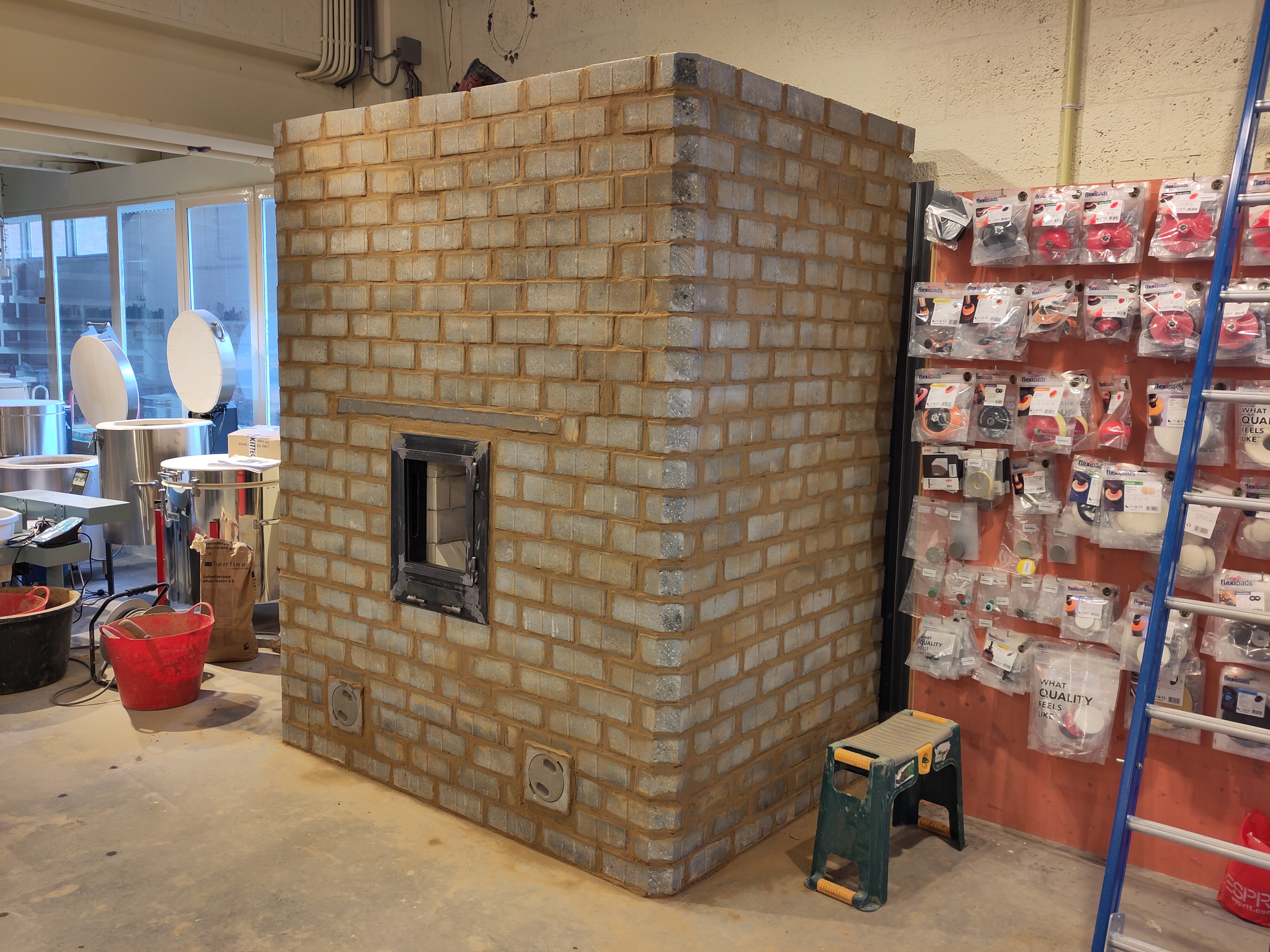
And this is what the design became: a 200 mm (8") sidewinder Shorty core surrounded by a double shell of concrete street clinkers. Concrete clinkers are surprisingly dense, heavy, inexpensive, readily available (in Europe) and also have a lower energy content than bricks. That sounds strange, but the only ingredient that requires a lot of energy to produce is cement. That's also the most expensive part, so the manufacturer only uses just enough to achieve the required quality. Everything else is sand and gravel, dredged and sieved according to fraction size.


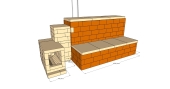
The placement of the door is quite high, 85 cm (2.79 ft) from the floor, primarily to facilitate refilling and lighting, made possible by the limited height of the Shorty core. Because it had to accommodate at least 50 cm (1.64 ft) of fuel length (the more time the design process takes, the more requirements seem to pop up), the entire core didn't really fit within the available depth. For that reason, I opted for a left-hand sidewinder, so the short riser is sitting next to the firebox. The flue, shown in the drawing above, is outside to the stove itself. That's another choice; with two 45-degree bends through the wall to the outside, sweeping from the parking deck is a breeze; nothing needs to be dismantled.

Construction was postponed for a year, but on October 21st, the circus finally got underway.


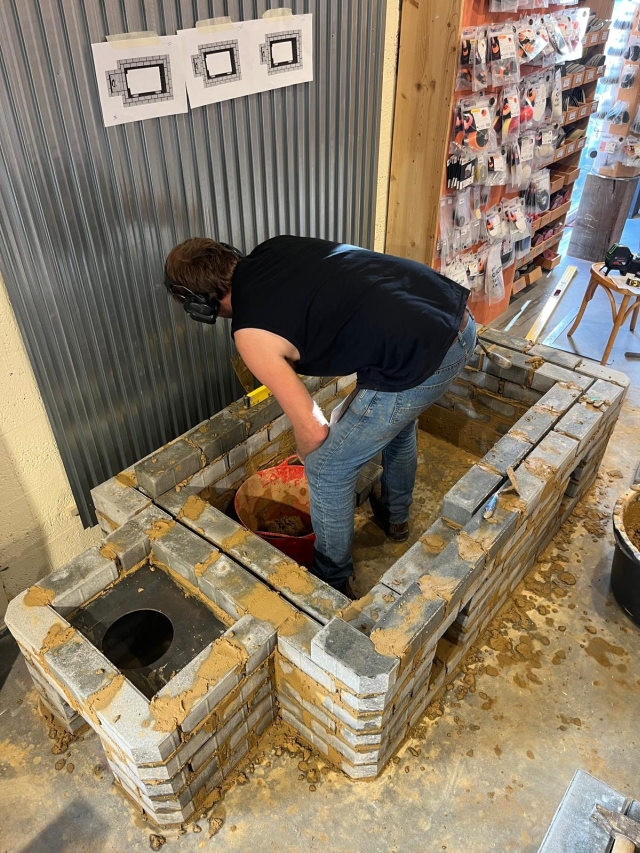
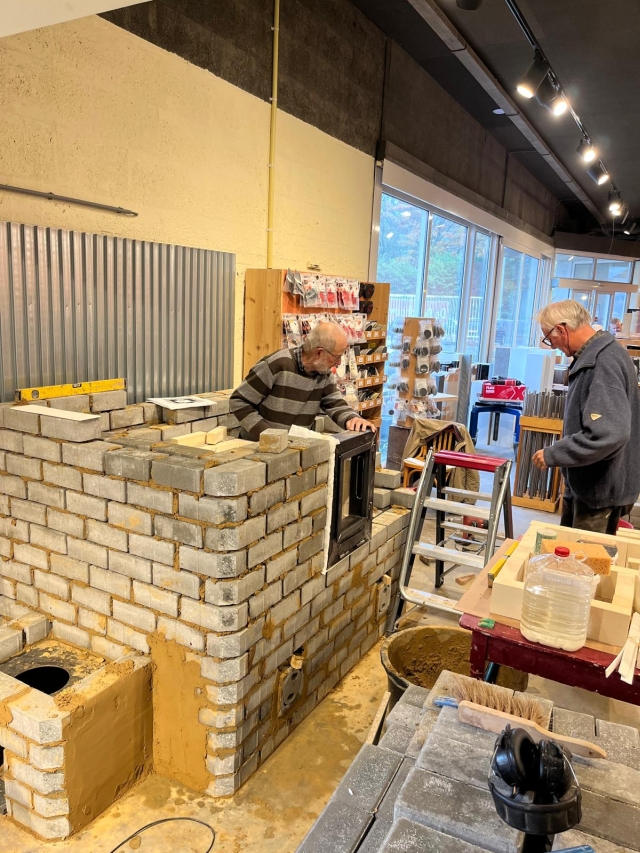
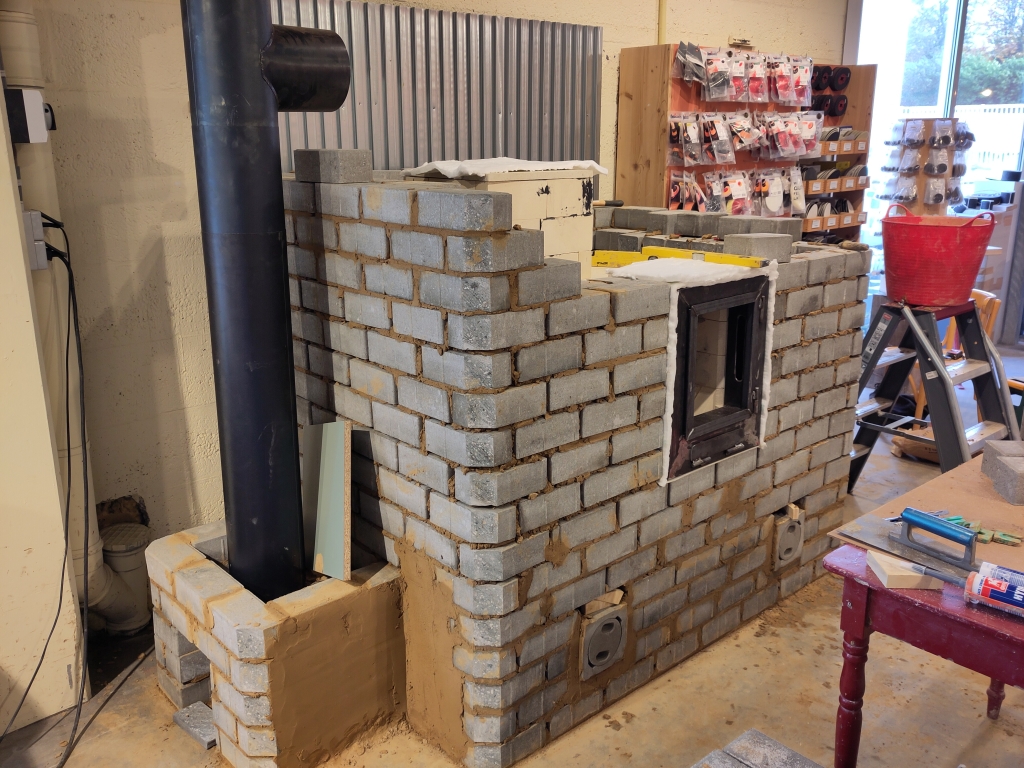
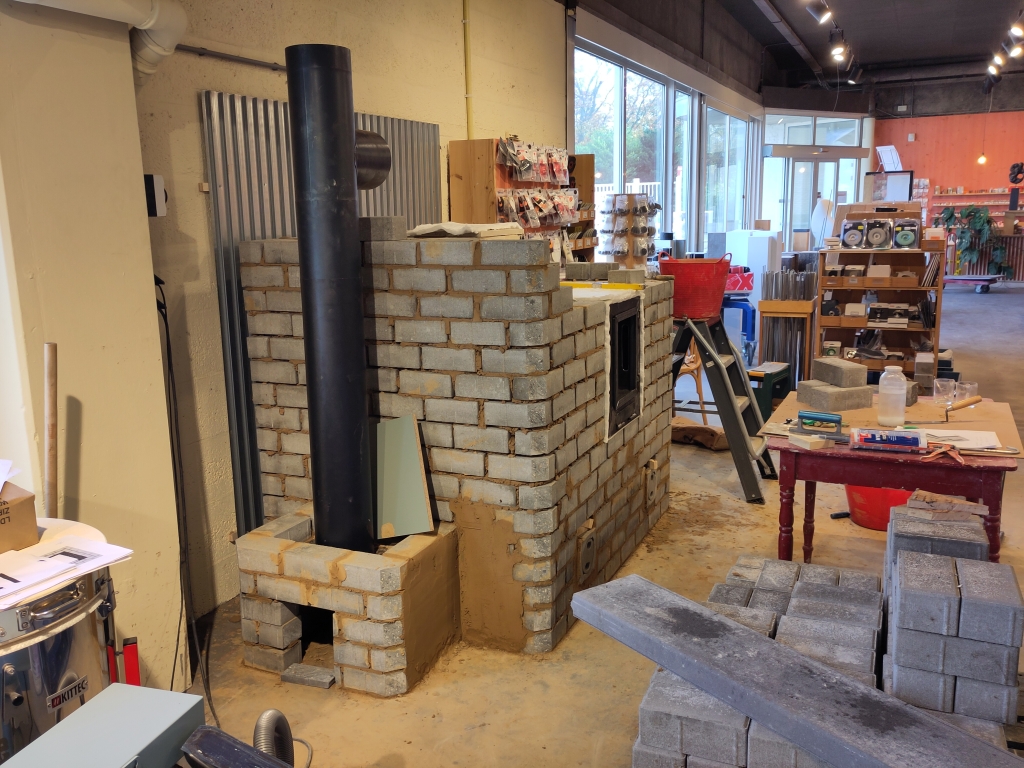
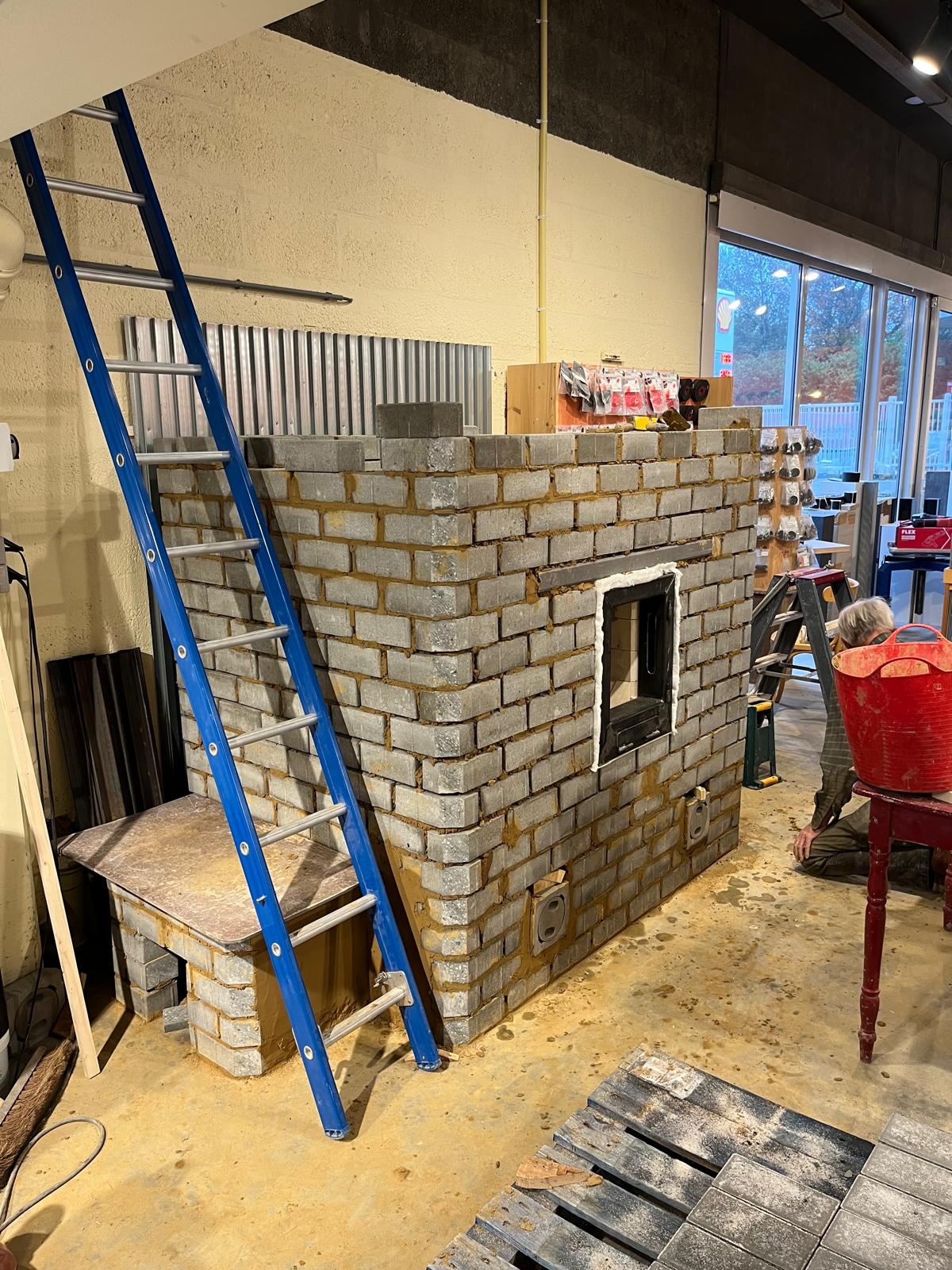
Here, the first layer of the outer shell has been laid with clay/sand mortar. The wooden boxes are there to keep the space for the sweeping hatches vacant. The Lewis corrugated screen is attached on spacers to the wall to prevent the (uninsulated) wall from heating up.


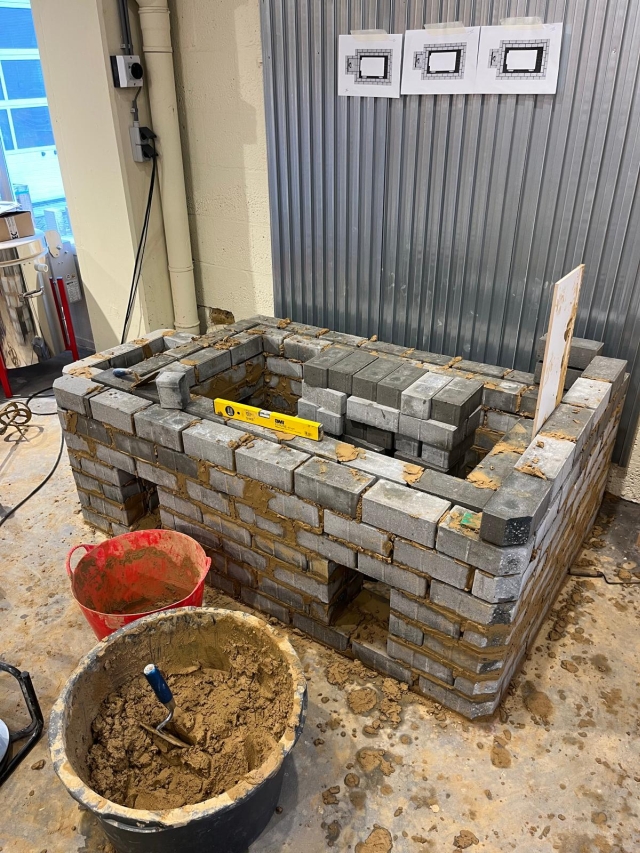
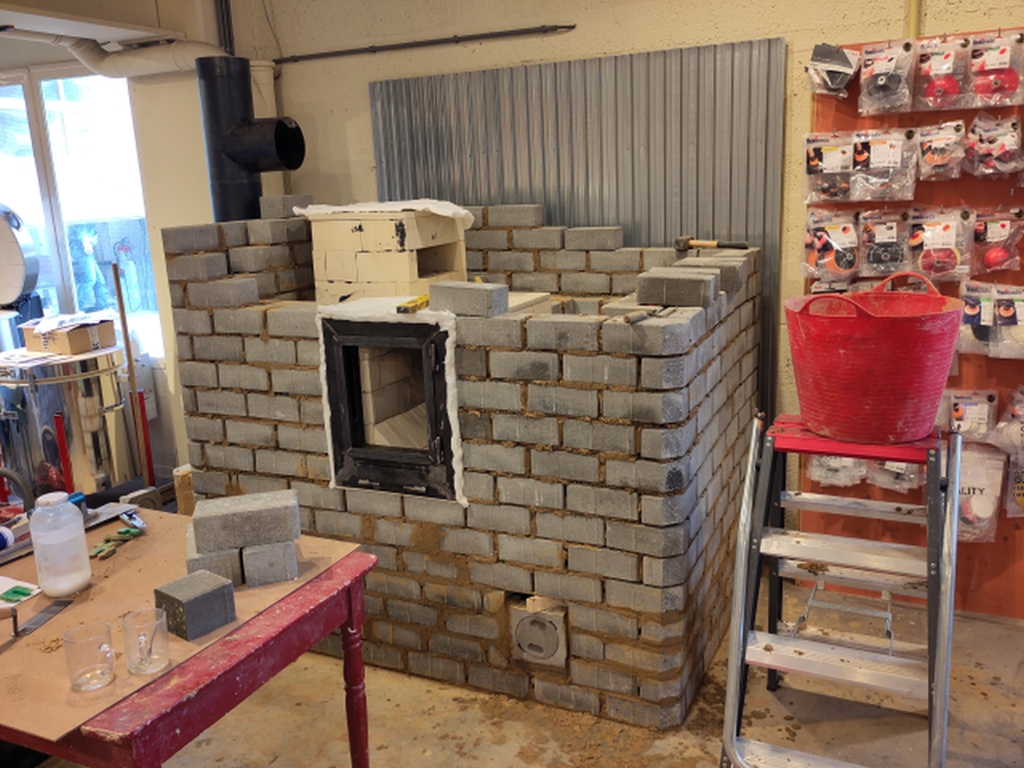
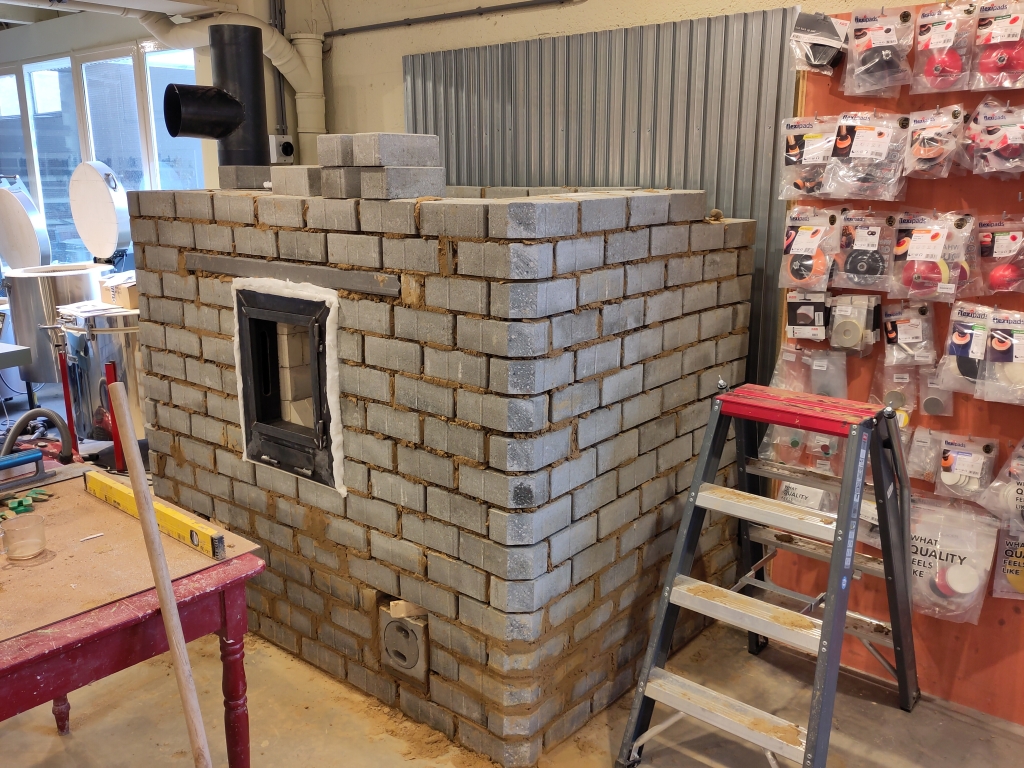
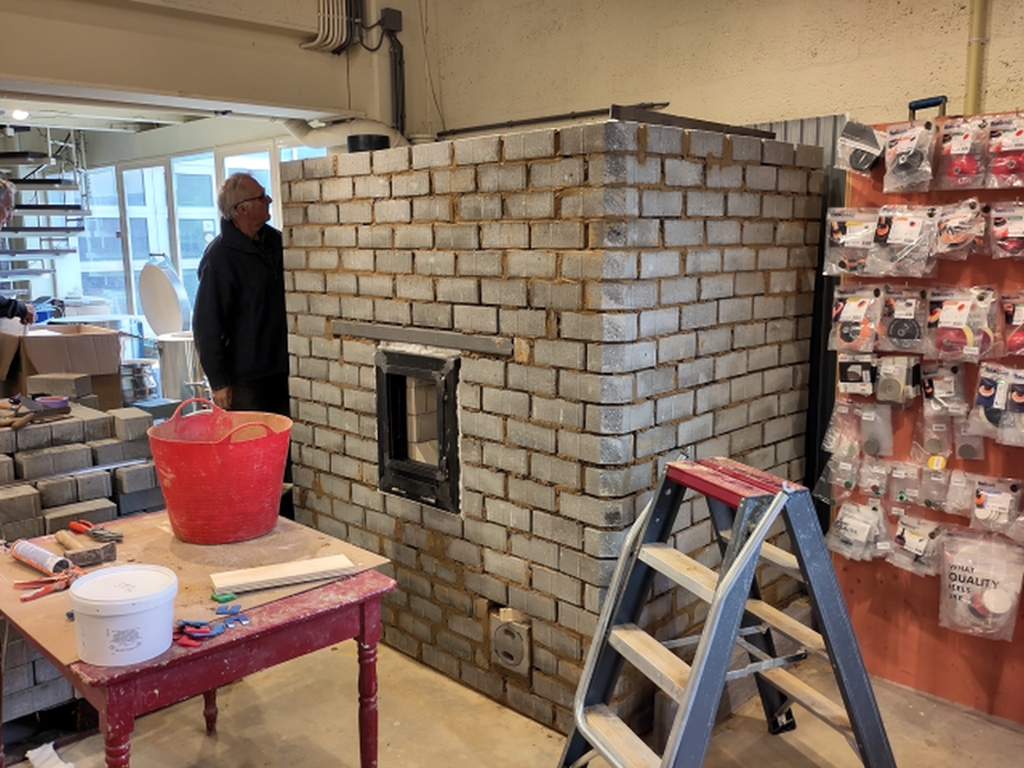
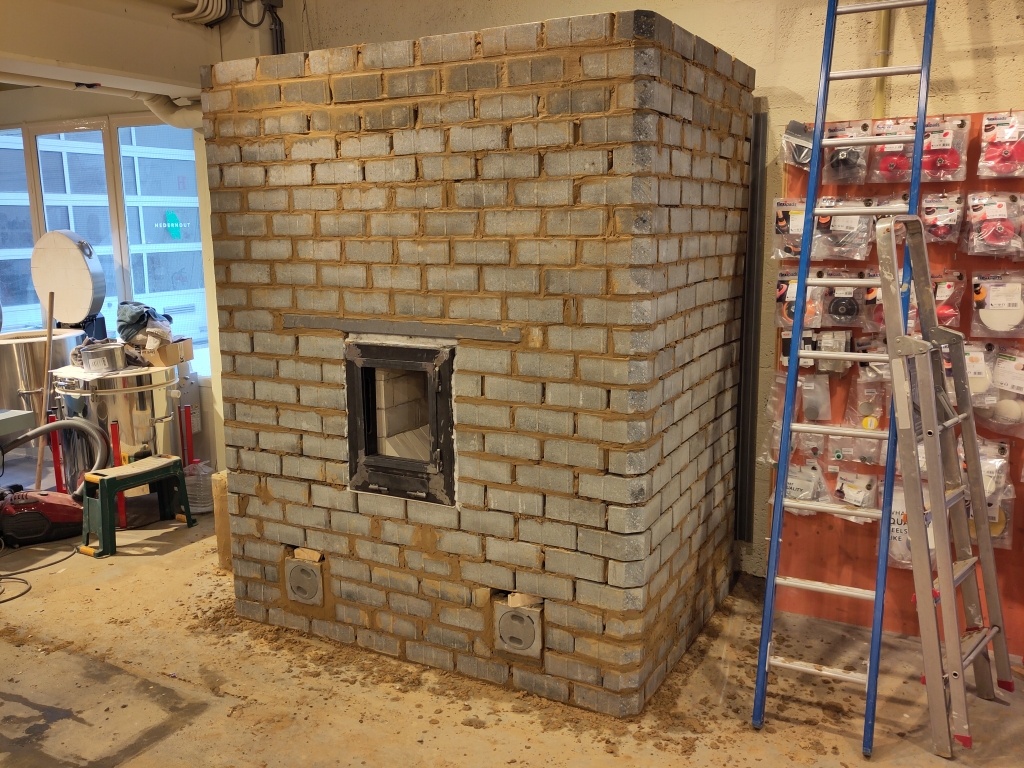
This is layer 5; the bridging of the sweeping hatches and the wide exhaust opening are clearly visible.


A 4 mm (0.157") steel plate with a 200 mm (8") hole through it has been incorporated into the brickwork of the exhaust box. The stove pipe will be inserted there, with the crimps facing down.


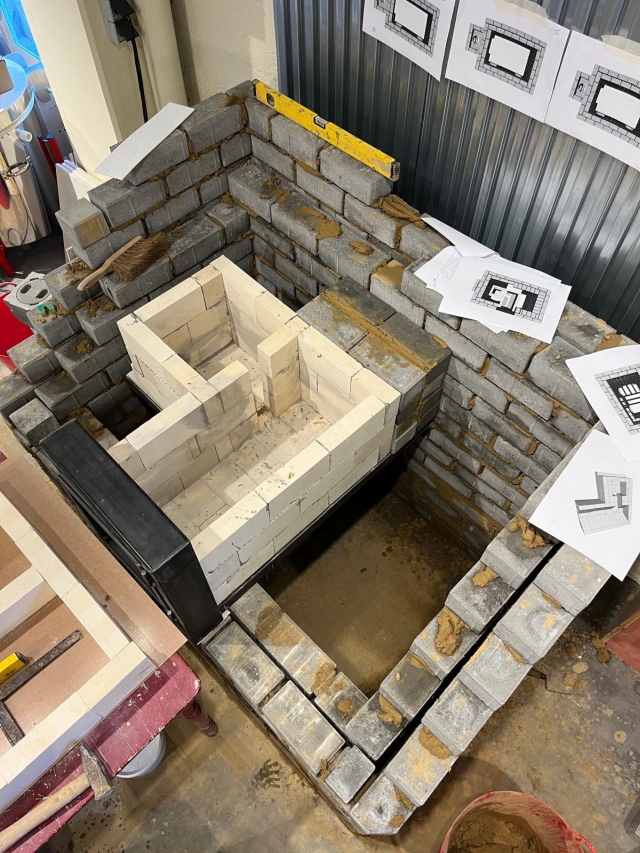
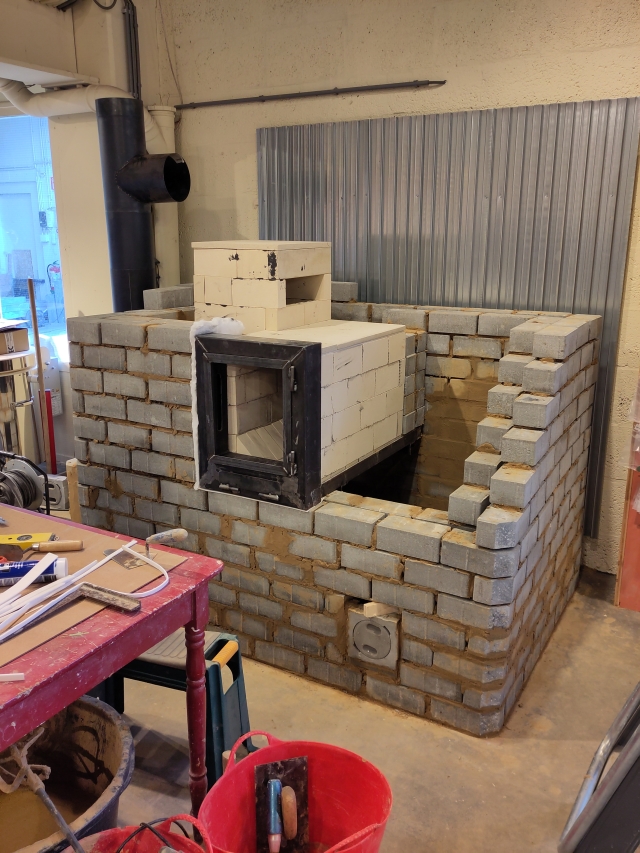
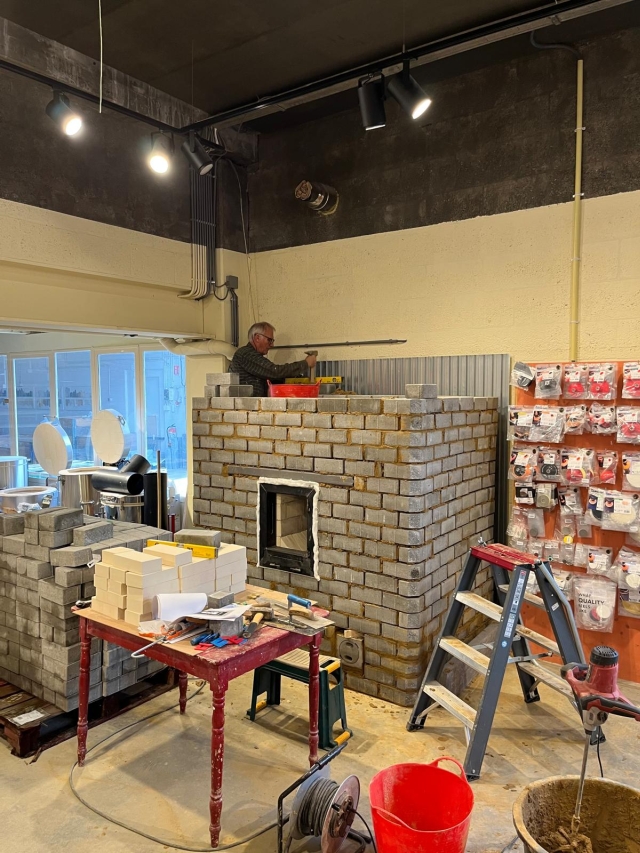
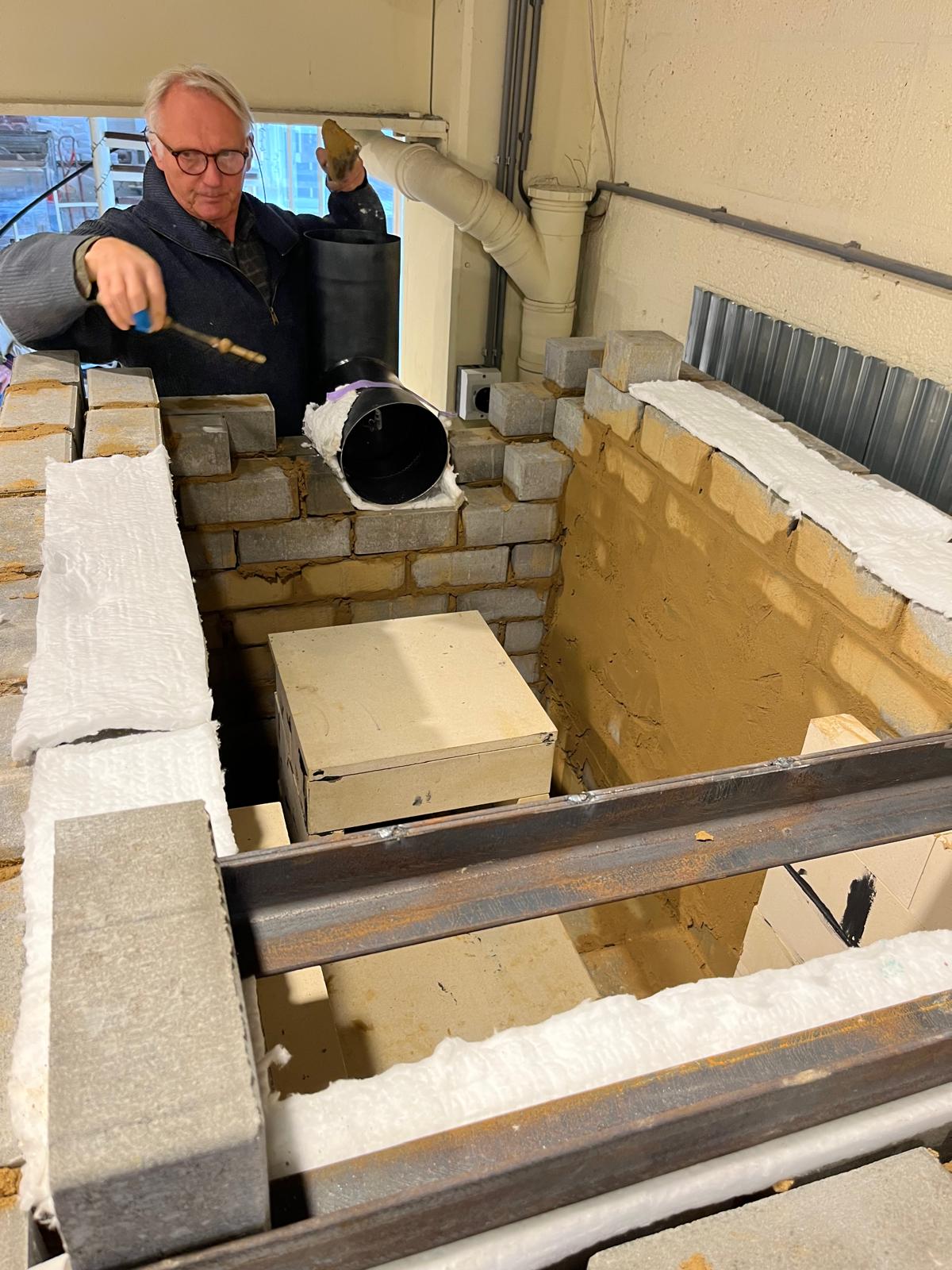
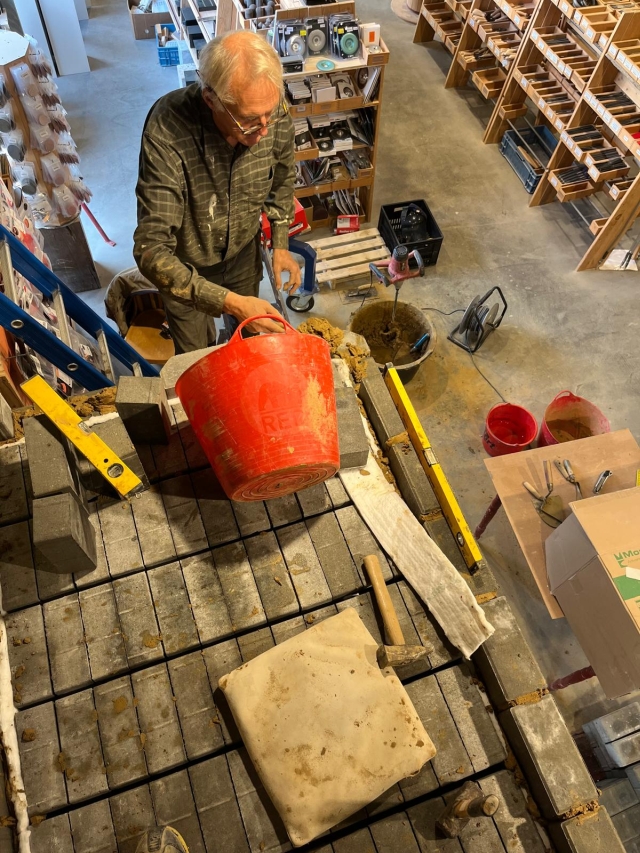
Because the rear side became somewhat difficult to access, the brick laying was also being done from the inside, following this picture.


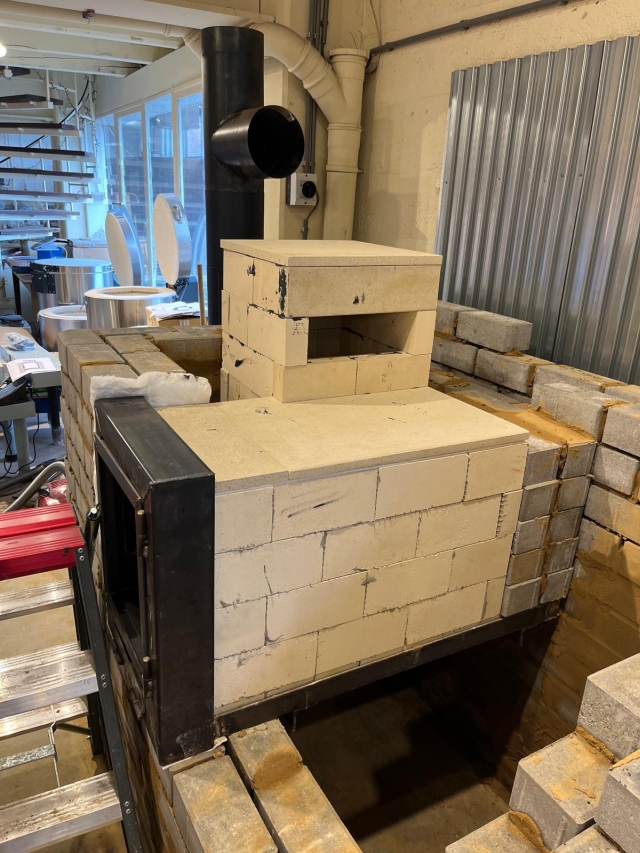
This was the time for the core support frame. Leave some slack, and ceramic felt around the resting ends, to allow for expansion of the steel.


And here the door frame was welded to the support frame. Everything is made of heavy steel; welding it at the rear lower sides is already sturdy enough for to keep the door frame in place.

More next time!
 
master rocket scientist
Posts: 6914
Location: latitude 47 N.W. montana zone 6A
3898
cat pig rocket stoves
  • Likes 10
  • Mark post as helpful
  • send pies
    Number of slices to send:
    Optional 'thank-you' note:
  • Quote
  • Report post to moderator
Great looking build, Peter!
Over four tons of mass! The gas bill and the hardwood use will plummet as soon as the new Shorty is dried out and heated up.

We estimated my six-inch double wall to be over three tons. I am still exploring its capabilities.
Compared with my single-wall builds, wood use is significantly reduced.
For the last month, our temperatures have been warmer than usual; it has stayed in the forties during the day and mid-thirties at night.
With two to three fires a day, the non-insulated studio/greenhouse is dropping less than 10 degrees overnight.
This coming week, temperatures are expected to drop to early winter levels, with highs not getting above freezing and lows in the teens. ( -8 °C)
I'm looking forward to seeing how she does!


Rocket Scientist
Posts: 1827
Location: Kaslo, BC
532
building solar woodworking rocket stoves wood heat greening the desert
  • Likes 7
  • Mark post as helpful
  • send pies
    Number of slices to send:
    Optional 'thank-you' note:
  • Quote
  • Report post to moderator
Thanks Peter for posting another one of your builds as we watch it come to life.
Several things in particular I like about this build are the high door and chamfered corner edges.
I'm assuming a steel plate was used to bridge the opening to the exhaust port?
Looking forward to seeing part 2 of the build.
 
Peter van den Berg
gardener
Posts: 1150
Location: +52° 1' 47.40", +4° 22' 57.80"
567
woodworking rocket stoves wood heat
  • Likes 7
  • Mark post as helpful
  • send pies
    Number of slices to send:
    Optional 'thank-you' note:
  • Quote
  • Report post to moderator

Gerry Parent wrote:Thanks Peter for posting another one of your builds as we watch it come to life.
Several things in particular I like about this build are the high door and chamfered corner edges.
I'm assuming a steel plate was used to bridge the opening to the exhaust port?
Looking forward to seeing part 2 of the build.


The idea was to plaster the whole of the heater, the top and rear being the exception. Hence the chamfered corner edges, those will be rounded when the heater will be plastered in late spring or summer.
The  opening to the exhaust port was bridged with four stainless steel rods, 10 mm thickness. The steel plate with the hole in it is situated one row higher, this is also part of the load-bearing structure.
Part two will be online tomorrow or the day after, lots of pictures to sift through.
 
rocket scientist
Posts: 203
Location: Sangre de Cristo Mountains, CO - Lat 38°14' - Zone 5b
173
hunting earthworks solar wood heat rocket stoves homestead
  • Likes 8
  • Mark post as helpful
  • send pies
    Number of slices to send:
    Optional 'thank-you' note:
  • Quote
  • Report post to moderator
Bravo Peter... another PvdB masterpiece in the making.

I really like the idea of the clinkers and then plastering over them. Also, love the firebox height, courtesy of the shorty core. I made mine as high as I could without making the total height too crazy due to the original core/riser design. The Shorty is a huge benefit in this regard.

My mass is similar to Tom's. Mine calculates to a bit under your designed, with mine coming in at 3.5 tons and will hold a skin temperature of 135 to 150F which makes a significant impact for the large space that we are heating. With over 4 tons of mass your customer will undoubtedly love it when its up and running. I think your store space calculation conversion to sq ft is incorrect. 30 sq meters = 322 sq ft. Considering this size space the heater perhaps they will be able to eliminate the gas heat all together.
 
Rocket Scientist
Posts: 329
128
  • Likes 8
  • Mark post as helpful
  • send pies
    Number of slices to send:
    Optional 'thank-you' note:
  • Quote
  • Report post to moderator
the way i am reading it ,is the shop floor is 30 meters square ---not 30m2 ----so its 30 m x 30m equates to 900m2   which is 9690 sq ft  
 
Glenn Littman
rocket scientist
Posts: 203
Location: Sangre de Cristo Mountains, CO - Lat 38°14' - Zone 5b
173
hunting earthworks solar wood heat rocket stoves homestead
  • Likes 6
  • Mark post as helpful
  • send pies
    Number of slices to send:
    Optional 'thank-you' note:
  • Quote
  • Report post to moderator

tony uljee wrote:the way i am reading it ,is the shop floor is 30 meters square ---not 30m2 ----so its 30 m x 30m equates to 900m2   which is 9690 sq ft  


Thank you for the clarification Tony. That makes more sense than the way I read it. That also makes sense now with that large of an area and to sizing the system to 200 mm.
 
pioneer
Posts: 994
Location: Inter Michigan-Superior Woodland Forest
170
6
transportation gear foraging trees food preservation bike building solar writing woodworking wood heat
  • Likes 6
  • Mark post as helpful
  • send pies
    Number of slices to send:
    Optional 'thank-you' note:
  • Quote
  • Report post to moderator
I'd like to know when Peter will be upgrading the Wheaton Labs classroom with one of these so I can start planning a trip to the workshop...
 
Peter van den Berg
gardener
Posts: 1150
Location: +52° 1' 47.40", +4° 22' 57.80"
567
woodworking rocket stoves wood heat
  • Likes 11
  • Mark post as helpful
  • send pies
    Number of slices to send:
    Optional 'thank-you' note:
  • Quote
  • Report post to moderator
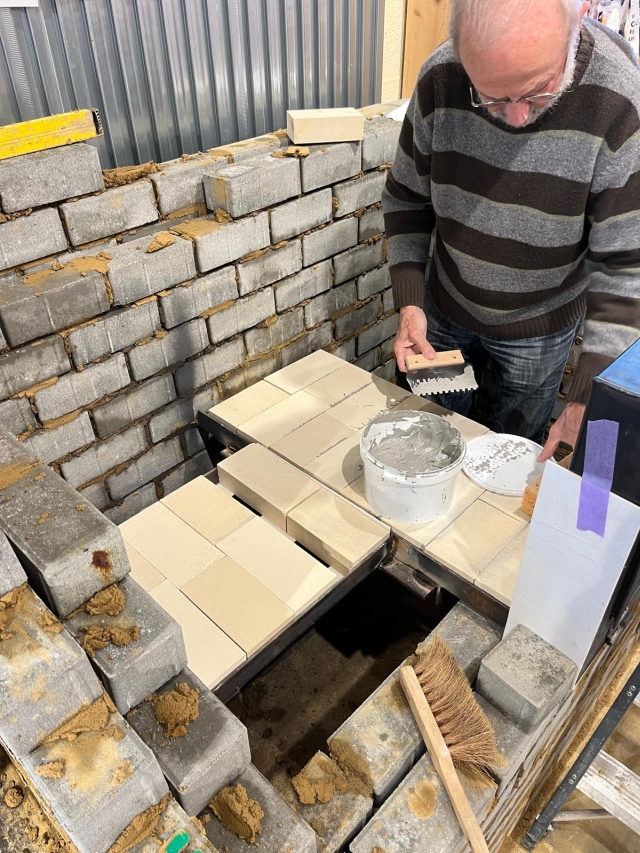
The next phase was building the core. The base was simple; the firebricks were sawn alternately to create a horizontal bond. Two millimeter of ceramic felt (or ceramic paper) was placed under the bricks to separate the steel from the bricks. This was also done at the side of the doorframe.


It turned out to be practically impossible to build the core from the outside. But because of the size, there was enough room to stand next to it. To prevent me from having to climb out constantly, someone was there to write down the measurements and pass them on to the guy who was cutting the bricks to size in another room. Quite a luxury, I must say.


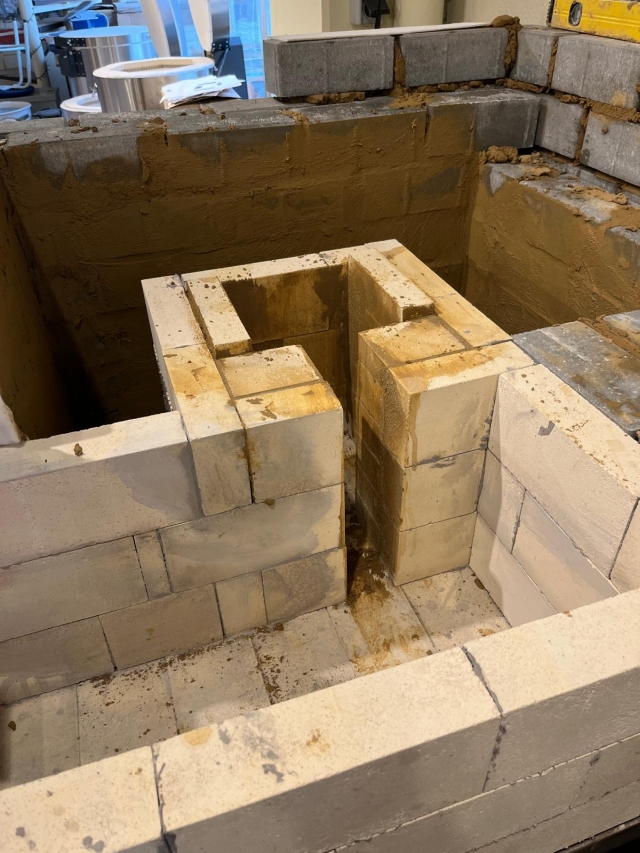
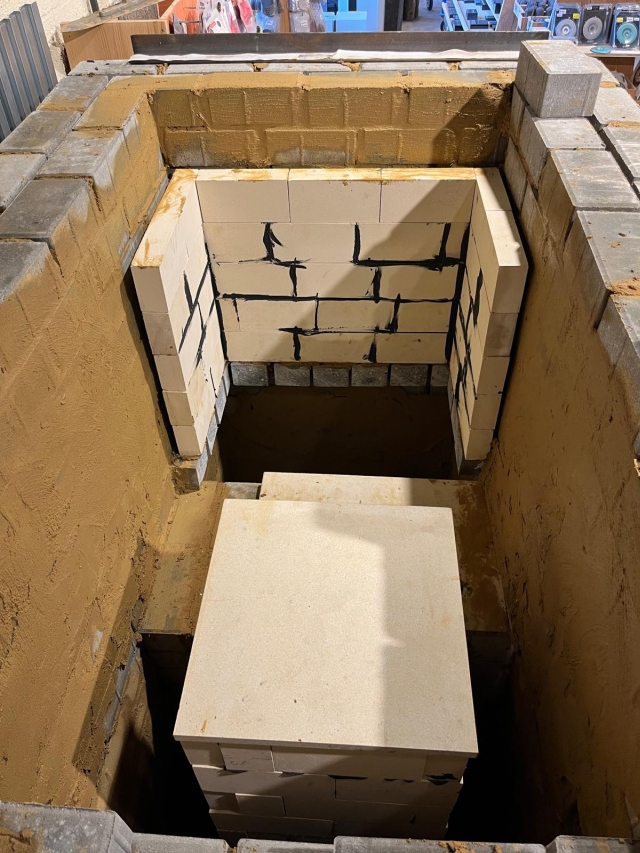
Here you can clearly see that the brickwork on the inner cavity wall had already progressed; the core was then level with the door. An additional section of wall was built against the back of the firebox, completely filling the space between the firebox and the inner cavity wall. This back wall is quite vulnerable; throwing in of large pieces of fuel could destroy it, especially if several people are keeping the stove running. Now there's no more room behind, and a huge weight is there to keep everything in place. Also, the core isn't insulated at all; making the structure user-friendly was more important.


Meanwhile, work continued on the bell; both the inner and outer cavity walls had been extended to the doorframe. The people working on it, myself included, were starting to enjoy it more and more. The top layer of the firebox was still ready on the table; at that moment, we were busy installing the lining in the riser box.


Neatly laid in a running bond.


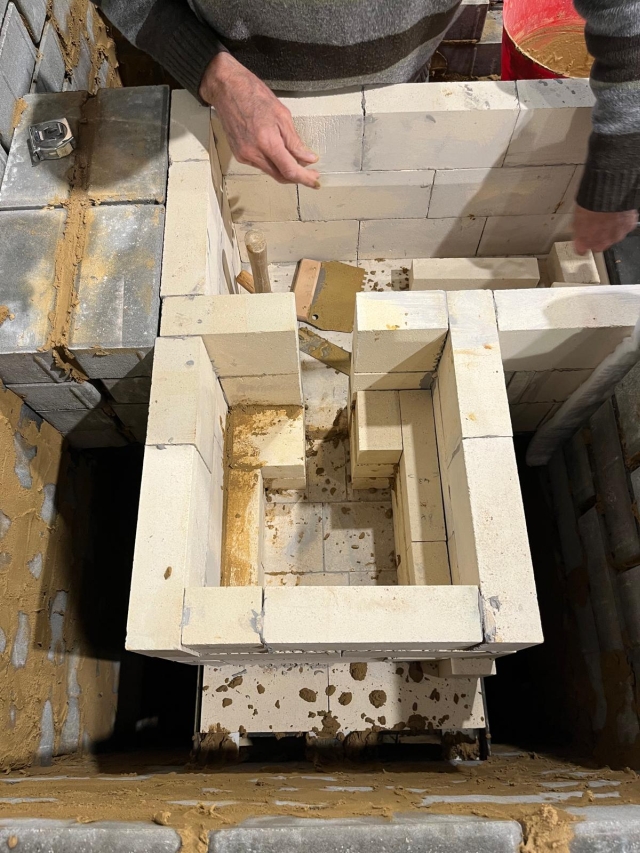
Here, the entire lining was (almost) finished. The loam/sand mortar was used intentionally. This was mainly because it's incredibly difficult to work with very small tolerances; sometimes the bricks could barely be inserted. So we made the tolerances a bit larger, combined with a heavier mortar.


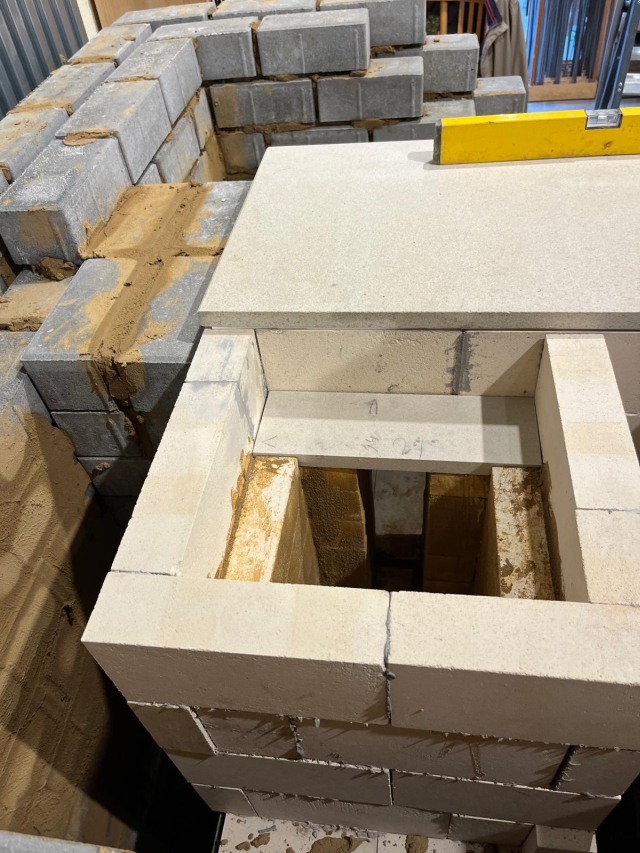
This photo shows how the last section of the lining is in place, so tightly that it could be done without mortar. The top layer of the firebox is also in place here, along with the firebox cover plate.


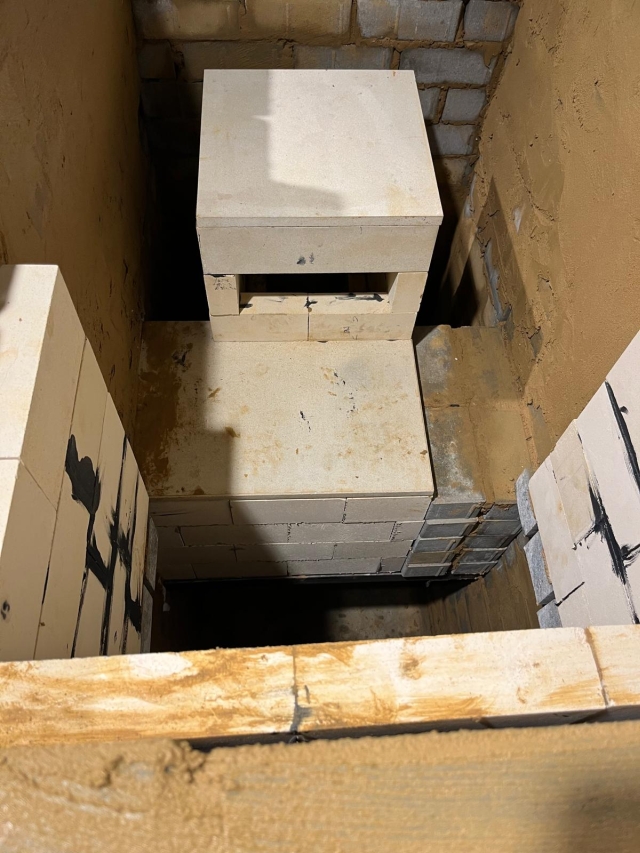
Here's the entire core complete. It's clearly visible that the short riser doesn't protrude much above the rest. Plus, how the exhaust outlet opens horizontally to the side.


Just a quick overview: the stovepipe with the bypass mounted in the T-piece is already waiting expectantly.


At this point, the right side of the bell had also been built up to the height of the door. On the far right, at the top edge of the brickwork, you can faintly see a layer of sawn-off bricks lying crosswise. These protruded at the inside so that an additional lining of firebricks could later be applied to the side. This is the wall that will be subjected to the greatest thermal stress.


Everything was above the door height at that point; from there on, it's all wall. That is, apart from the connection to the bypass T-piece.


Another overview, towards the entrance.


The next morning the men were back to work early. By the time I arrived at coffee time, the lintel was already in place. Not exactly my intention; that piece of concrete could easily have been a lot shorter. It doesn't really matter, every build has its own unique characteristics anyway.

Next time, the final part of this exciting construction project.
 
thomas rubino
master rocket scientist
Posts: 6914
Location: latitude 47 N.W. montana zone 6A
3898
cat pig rocket stoves
  • Likes 4
  • Mark post as helpful
  • send pies
    Number of slices to send:
    Optional 'thank-you' note:
  • Quote
  • Report post to moderator
Good Day, Peter;
Gerry and I are wondering what material your core roof is made of.
 
Posts: 785
Location: Sierra Nevada foothills, 350 m, USDA 8b, sunset zone 7
169
  • Likes 5
  • Mark post as helpful
  • send pies
    Number of slices to send:
    Optional 'thank-you' note:
  • Quote
  • Report post to moderator
Peter,

I have a few questions.

1. It looks like the original riser dimension was 300x300 mm and you lined it to get 200x200 mm. I understand that the port depth was increased from standard 50-65 mm (brick thickness) to 110 mm (or more). The back side of the riser was not lined. Was it intentional? If the back was also lined than the port depth would be reduced by the thickness of the lining.
When Thomas built his shorty he did not line the riser and it looks like it retained its 230x230 mm interior dimension. Is the lining a new development/improvement?

2. What bricks have you used for the firebox walls and for lining?

3. What is the size of the room the heater is located in. Is it 30 m2 or 30x30 m?
 
Peter van den Berg
gardener
Posts: 1150
Location: +52° 1' 47.40", +4° 22' 57.80"
567
woodworking rocket stoves wood heat
  • Likes 7
  • Mark post as helpful
  • send pies
    Number of slices to send:
    Optional 'thank-you' note:
  • Quote
  • Report post to moderator

Cristobal Cristo wrote:1. It looks like the original riser dimension was 300x300 mm and you lined it to get 200x200 mm. I understand that the port depth was increased from standard 50-65 mm (brick thickness) to 110 mm (or more). The back side of the riser was not lined. Was it intentional? If the back was also lined than the port depth would be reduced by the thickness of the lining.
When Thomas built his shorty he did not line the riser and it looks like it retained its 230x230 mm interior dimension. Is the lining a new development/improvement?


Yes, it was intentional, this was the single configuration that worked best during development. I tried everything I could think of, the liner all around was one of those. Mind you, the liner is reaching just a bit higher than the port, above that it's 290 mm square again. No, it isn't a new development, have a look at the relevant thread: https://permies.com/t/234638/Development-compact-batchrocket-core

I am so sorry, but...  you are mistaken about how Thomas built his Shorty core, there's a liner in there, exactly according to specifications.

Cristobal Cristo wrote:2. What bricks have you used for the firebox walls and for lining?


Hard firebricks, commonly called chamotte bricks over here.

Cristobal Cristo wrote:3. What is the size of the room the heater is located in. Is it 30 m2 or 30x30 m?


It's a shop space of about 30x30 m, together 900 m².
 
Peter van den Berg
gardener
Posts: 1150
Location: +52° 1' 47.40", +4° 22' 57.80"
567
woodworking rocket stoves wood heat
  • Likes 8
  • Mark post as helpful
  • send pies
    Number of slices to send:
    Optional 'thank-you' note:
  • Quote
  • Report post to moderator

thomas rubino wrote:Good Day, Peter;
Gerry and I are wondering what material your core roof is made of.


It's a shelf for a potter's kiln. The Sculpter's shop also sell small kilns and so on, shelfs for the same as well. So they used what was in-house anyway.
 
Peter van den Berg
gardener
Posts: 1150
Location: +52° 1' 47.40", +4° 22' 57.80"
567
woodworking rocket stoves wood heat
  • Likes 13
  • Mark post as helpful
  • send pies
    Number of slices to send:
    Optional 'thank-you' note:
  • Quote
  • Report post to moderator
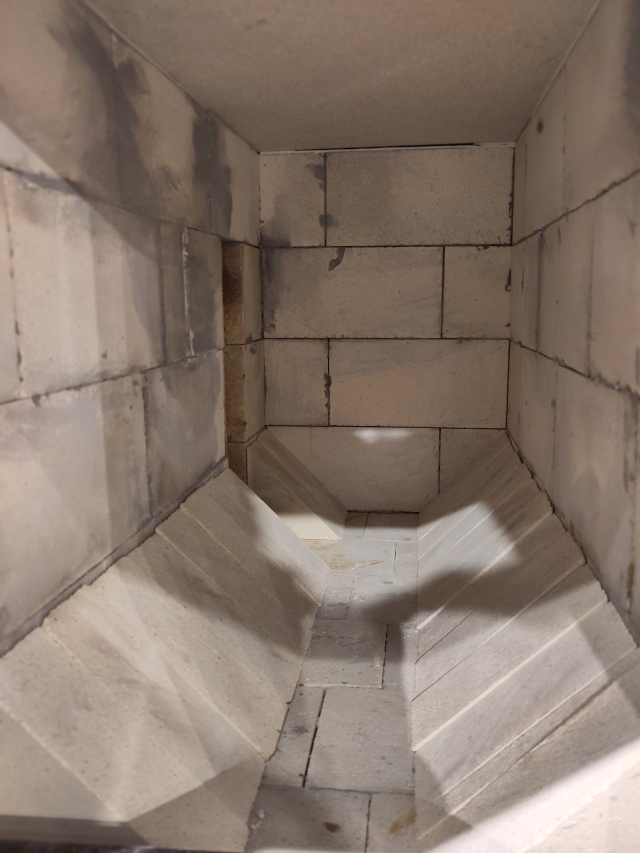
Above the core, construction speed got up, partly because the builders were gradually gaining more experience. First, a photo of the inside of the firebox.


The port is clearly visible on the left. The slanted firebricks aren't mortared in, which works very well because there always needs to be a layer of ash between those anyway.


The stove kept growing bigger all te time.


This is the ceiling height of the bell.


This is the lining on the inside of the bell. This is where the greatest thermal load is expected in the bell, hence the extra protection. As a hindsight, it could have been one brick higher... It's clearly visible that the firebricks are resting on a row of transverse concrete clinkers.


The ceiling height has been reached, and while bricklaying is still underway on one side, the first parts of the ceiling have already laid down on the other.


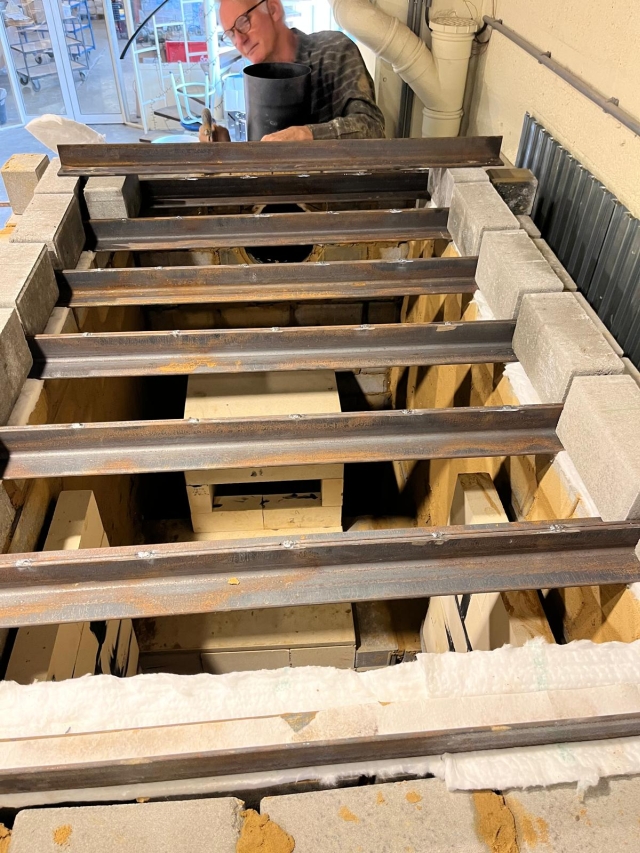
The supporting structure consists of two heavy gauge L-shaped profiles welded together back to back. The spacing between those was determined by the length of the concrete pavers.


The structure was considered strong enough to support not only many bricks but also the weight of a person.


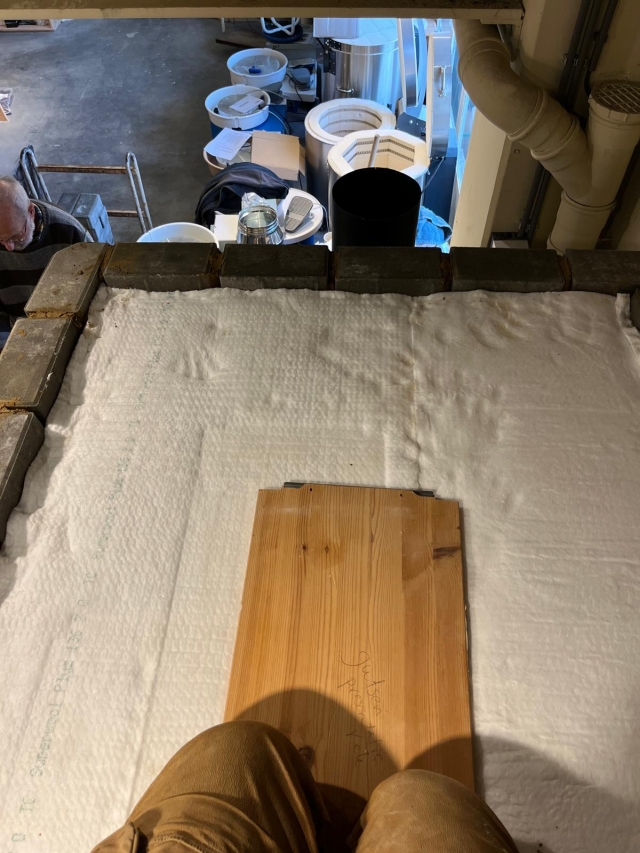
The entire ceiling layer consists of bricks laid on their sides. These do not rest directly on the steel; a thin layer of ceramic paper is placed between them to separate the steel from the bricks.


A double, overlapping layer of 13 mm superwool is placed on top for sealing. On top of the wool, another layer of paving bricks serves as ballast and a covering for the wool. The entire ceiling and covering layer are laid dry, without mortar.


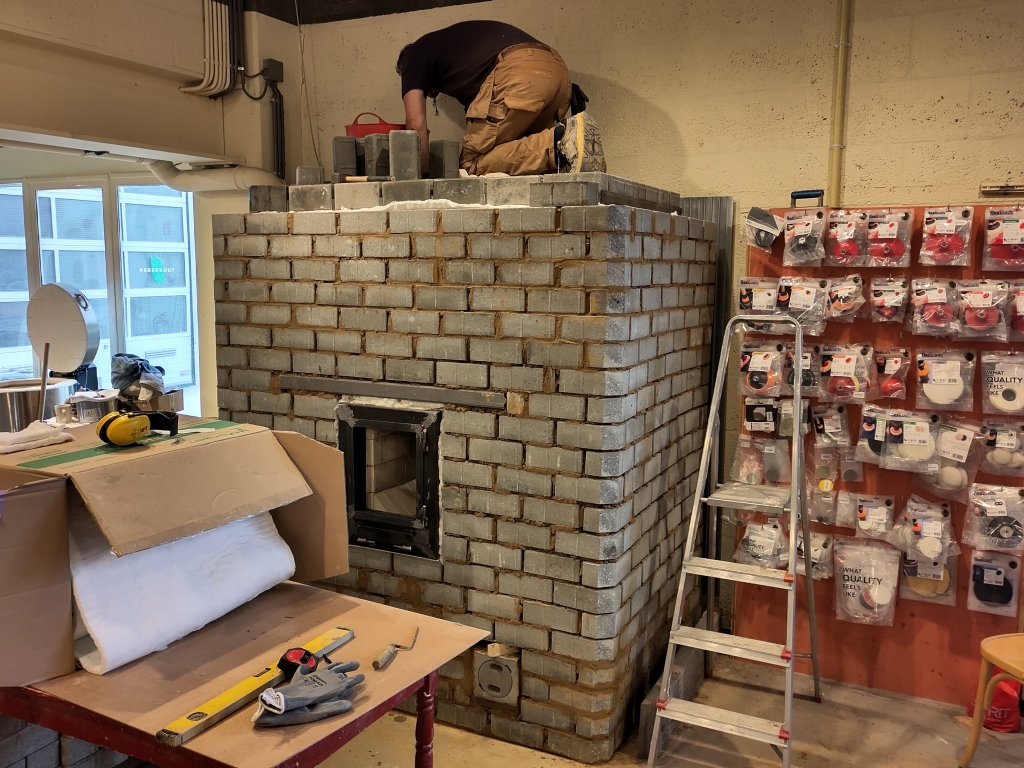
The last three layers of the outer shell complete the whole, so the entire ceiling structure is out of view.


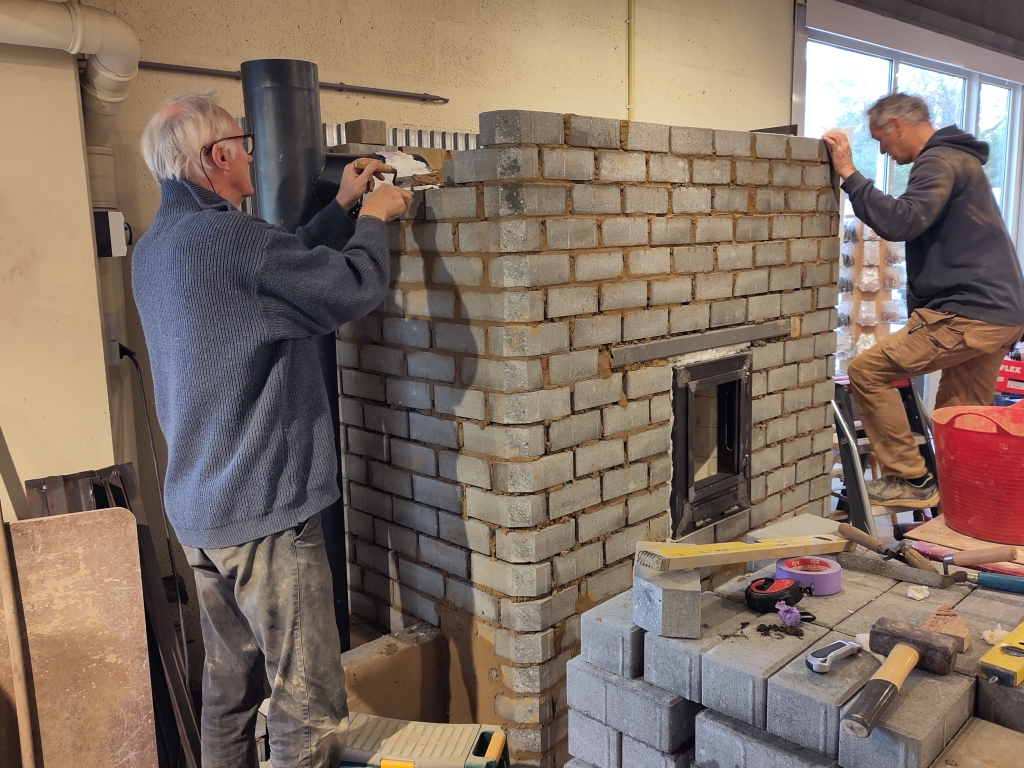
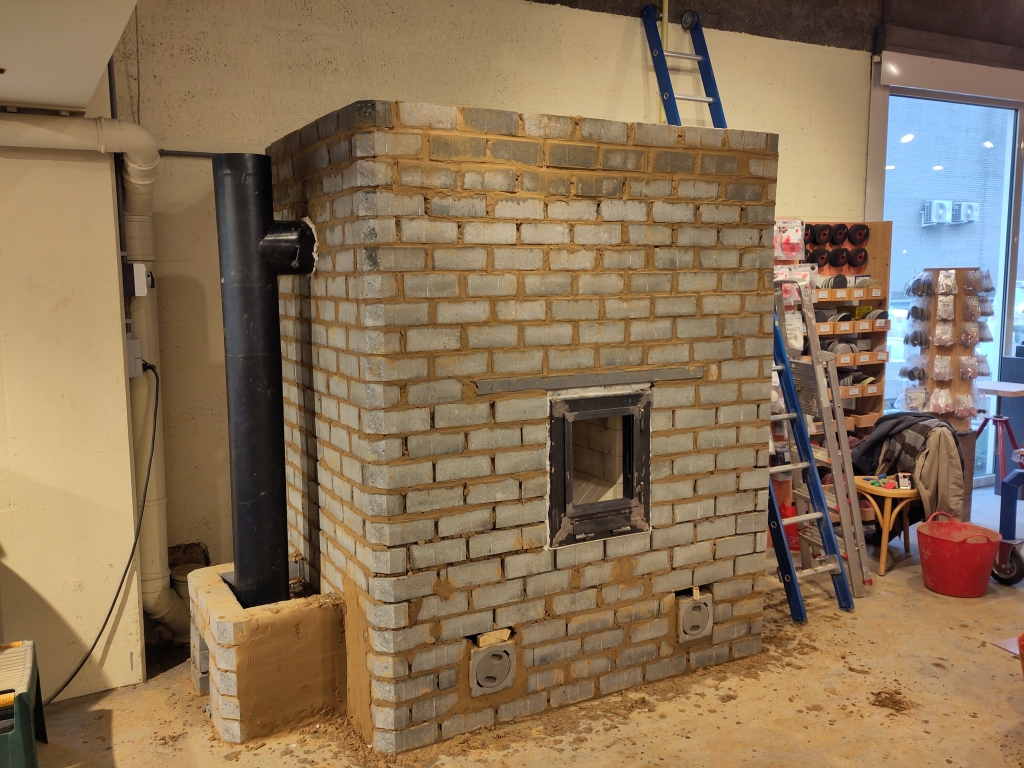
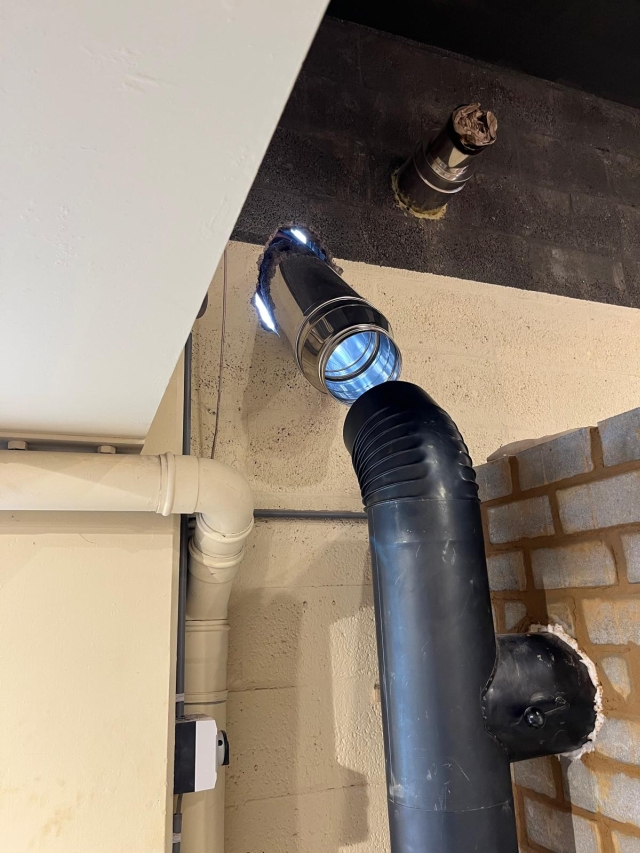
There was still a lot of pointing to be done, and the chimney hadn't been connected yet. It had to go through the wall and then up, above the parapet of the parking deck.


All the pointing was now finished, and the last cleaning hatch on the left was also in place.


The hole in the wall finished, the connection was next. The chimney of the iron stove will remain in place for a while, until a buyer shows up.


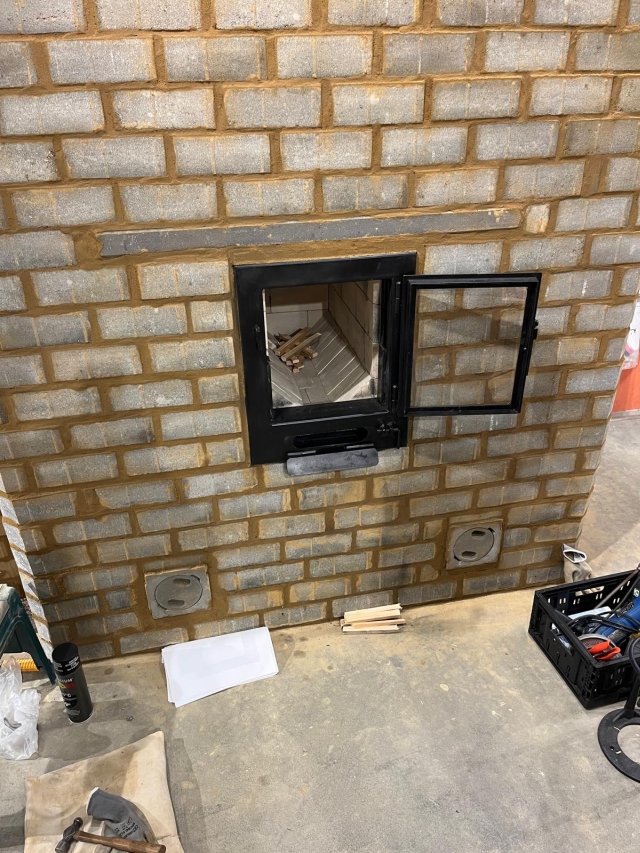
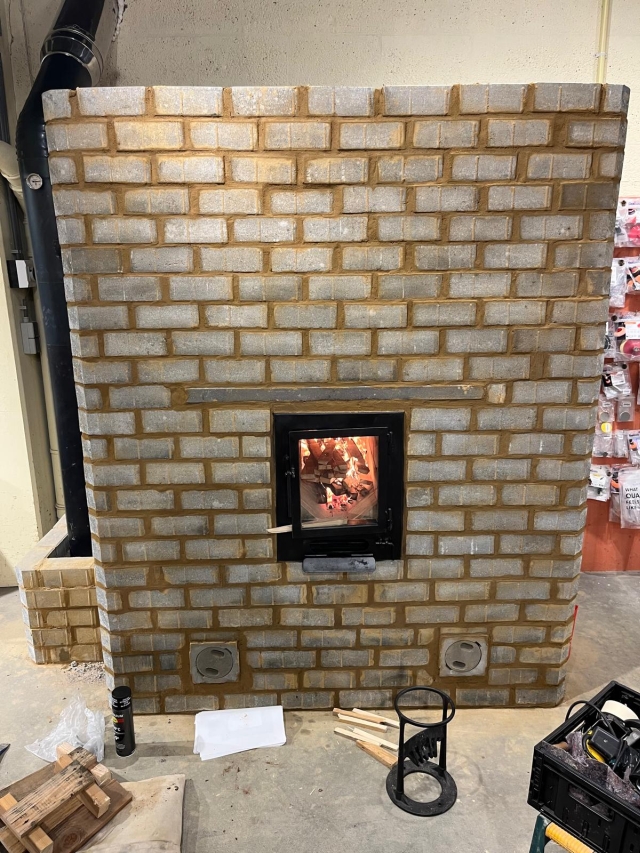
In this photo, the doorframe is finished, the whole thing has been sprayed black with heat-resistant paint, and the heat-resistant glass has been installed in the door. There's some small wood in the firebox, ready for the first fire!

https://youtube.com/shorts/sXPsvK_f2Ak [youtube]https://youtube.com/shorts/sXPsvK_f2Ak[/youtube]

Clearly, with the bypass open, not a speck of smoke coming out of the door.

https://youtube.com/shorts/qLbdnSiaaLE [youtube]https://youtube.com/shorts/qLbdnSiaaLE[/youtube]

That thing is truly outrageously large, there's simply no other word for it.


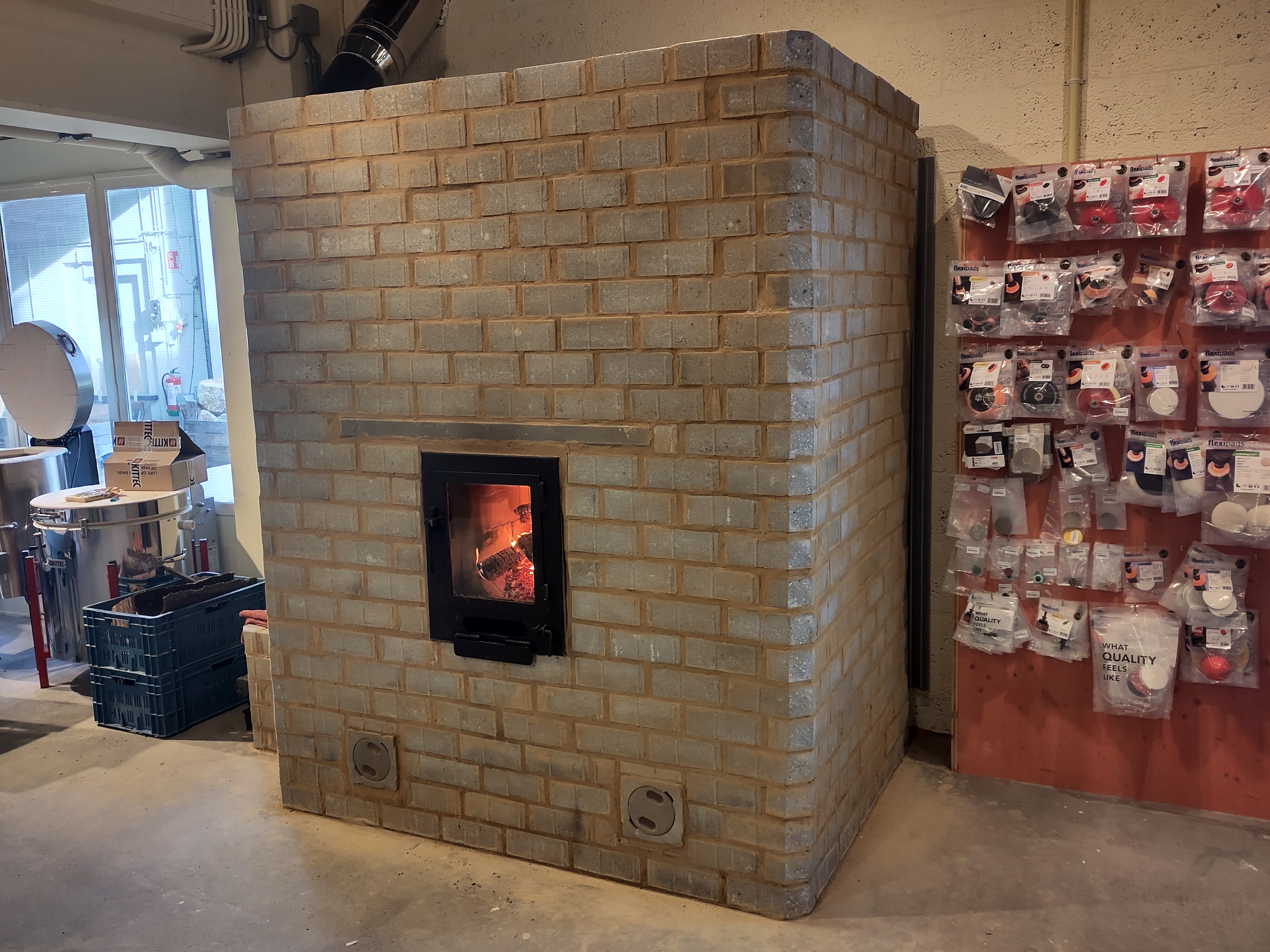
This photo was taken a bit later; here it's burning at full speed, made possible by the bypass. Everything was still very wet, clearly visible at the bottom, where most of the water is. Because the concrete pavers absorb little water, the drying process was over after just over a week. After that, everything went swimmingly well. It can burn with the door and bypass closed, and still only 90 to 110°C (194 to 230 ºF) in the pipe.


The stove is much drier here; almost all the joints are now much lighter in color. Whether it's big enough to actually keep the shop warm in frosty weather remains to be seen, but right now, they're very happy with it. Even the customers understand that it's something special; compliments and questions are coming in regularly.

Meanwhile, there's no smoke coming out of the chimney; there's only a slight smell outside for about five minutes after lighting, after which it disappears as well.

Although the chimney won't get dirty anytime soon, it still needs to be swept occasionally. The current design allows for sweeping from the parking deck without dismantling anything. Any debris that comes out can easily be removed through the sweeping hatch on the left, under the first piece of black pipe.

A few more figures: for the design, I calculated 1,150 concrete clinkers and 140 hard firebricks. Two firebricks and 27 clinkers remained. The clay/sand mortar weighs 300 kg (661 lbs). The dry clinkers weigh 3.8 kg (838 lbs) each, for a total weight of 4,267 kg (4.7 US tons). The firebricks weigh 2.8 kg (6.17 lbs) each, for a total weight of 386 kg (851 lbs). Plus some loose items, like hatches and steelwork, about 100 kg (220 lbs).

All together: 5053 kg (5.57 US tons). The remaining clinkers and bricks are now on top of the stove; there was the last remaining unused spot. Another 100 kg or so, 5153 kg (5.68 US tons).
And that's not all; the plan is to plaster the outside of the thing. Then there will be hundreds of kilograms of clay plaster added; we might soon be looking at a stove weighing 5.5 tons (6.06 US tons)!

Size of this heater: WxDxH: 175x125x215 cm (5.74' x 4.1' x 7.05'). No small feat (feet?), I dare say.

It was a wonderful project, with a very good result.
 
thomas rubino
master rocket scientist
Posts: 6914
Location: latitude 47 N.W. montana zone 6A
3898
cat pig rocket stoves
  • Likes 6
  • Mark post as helpful
  • send pies
    Number of slices to send:
    Optional 'thank-you' note:
  • Quote
  • Report post to moderator
Wow, Peter!
Shorty Core is sure strutting her stuff as the new kid on the block!
Another outstanding build!
Built to specs and worked right out of the box!
Your living room wall will soon be covered in photos of your builds!
 
Peter van den Berg
gardener
Posts: 1150
Location: +52° 1' 47.40", +4° 22' 57.80"
567
woodworking rocket stoves wood heat
  • Likes 7
  • Mark post as helpful
  • send pies
    Number of slices to send:
    Optional 'thank-you' note:
  • Quote
  • Report post to moderator

thomas rubino wrote:Wow, Peter!
Shorty Core is sure strutting her stuff as the new kid on the block!
Another outstanding build!
Built to specs and worked right out of the box!
Your living room wall will soon be covered in photos of your builds!


Thanks Thomas, my bedroom walls are already covered with compliments like yours! But... the love of my life do object to having pictures in the living room everywhere, she likes paintings a lot more.
 
Posts: 74
8
  • Likes 6
  • Mark post as helpful
  • send pies
    Number of slices to send:
    Optional 'thank-you' note:
  • Quote
  • Report post to moderator
Incredible result, congratulations Peter & helpers! Are they topping it up all day long to have sufficient heat output? Almost a pity to cover it in clay plaster!
 
Peter van den Berg
gardener
Posts: 1150
Location: +52° 1' 47.40", +4° 22' 57.80"
567
woodworking rocket stoves wood heat
  • Likes 6
  • Mark post as helpful
  • send pies
    Number of slices to send:
    Optional 'thank-you' note:
  • Quote
  • Report post to moderator

Julian Adam wrote:Incredible result, congratulations Peter & helpers! Are they topping it up all day long to have sufficient heat output? Almost a pity to cover it in clay plaster!


Yes, they are topping it up all day long. Which means it is refilled every 2hours or something like that. At the moment with soft wood fuel, since they have a lot of pallets and crates lying around. Normally, they have to pay for to get rid of the stuff, now it's generating heat. The formerly used cast iron stove couldn't really be run with soft wood at all, far too much hassle.
I agree about he plaster, there's a possibility they'll skip that eventually.
 
Cristobal Cristo
Posts: 785
Location: Sierra Nevada foothills, 350 m, USDA 8b, sunset zone 7
169
  • Likes 5
  • Mark post as helpful
  • send pies
    Number of slices to send:
    Optional 'thank-you' note:
  • Quote
  • Report post to moderator

Peter van den Berg wrote:I agree about he plaster, there's a possibility they'll skip that eventually.


I think the grey pavers plus cognac mortar combine into some Nordic/Central European aesthetic theme and look great. Also the dark color of the bell helps with faster heat radiating.
 
Gerry Parent
Rocket Scientist
Posts: 1827
Location: Kaslo, BC
532
building solar woodworking rocket stoves wood heat greening the desert
  • Likes 6
  • Mark post as helpful
  • send pies
    Number of slices to send:
    Optional 'thank-you' note:
  • Quote
  • Report post to moderator

Peter van den Berg wrote:This is the lining on the inside of the bell. This is where the greatest thermal load is expected in the bell, hence the extra protection. As a hindsight, it could have been one brick higher....


Splendid Peter! Thank you for documenting this build so that it can be a bookmark for future builders to reference...... and a delight for us that have worked on a similar contraption with the same enthusiasm.
Question: Curious why the ceiling of the bell had regular bricks instead of firebricks, especially right above the riser exhaust port?
Also, I noticed a latch on the door which appears to do something for the air inlet flapper. Is it to lock the flapper closed when the fire is out?
 
Glenn Littman
rocket scientist
Posts: 203
Location: Sangre de Cristo Mountains, CO - Lat 38°14' - Zone 5b
173
hunting earthworks solar wood heat rocket stoves homestead
  • Likes 6
  • Mark post as helpful
  • send pies
    Number of slices to send:
    Optional 'thank-you' note:
  • Quote
  • Report post to moderator
Magnificent Peter! Congrats on your efforts and creating another masterpiece. Has it been named yet? I'll toss out a few thoughts that come to mind... Godzilla or perhaps Gargantua.

I didn't see any mention in your build commentary... did you embed any thermocouples in the mass? It would be quite interesting to see what the inside skin temps are running. I actually find that monitoring my inside skin temps helps me to manage the external skin temps better as it will give an advanced idea of system temperature profile.

Once the system is fully dry it will be interesting to know the firing cycles to get it up to temperature and maintain it considering the enormous mass. It will also be interesting to see how it retains the heat over the 35-40 hours that the store is closed and the external temperature when they reopen on Monday.
 
Peter van den Berg
gardener
Posts: 1150
Location: +52° 1' 47.40", +4° 22' 57.80"
567
woodworking rocket stoves wood heat
  • Likes 8
  • Mark post as helpful
  • send pies
    Number of slices to send:
    Optional 'thank-you' note:
  • Quote
  • Report post to moderator

Cristobal Cristo wrote:Also the dark color of the bell helps with faster heat radiating.


Yes, it helps. But what helps a great deal more is the thermal conductivity coefficient in the concrete clinkers. This is about 2 to 2.5 times greater as compared to hard red brick. Which makes the heater relatively quick responding, despite such a huge mass.
 
Peter van den Berg
gardener
Posts: 1150
Location: +52° 1' 47.40", +4° 22' 57.80"
567
woodworking rocket stoves wood heat
  • Likes 7
  • Mark post as helpful
  • send pies
    Number of slices to send:
    Optional 'thank-you' note:
  • Quote
  • Report post to moderator

Gerry Parent wrote:Question: Curious why the ceiling of the bell had regular bricks instead of firebricks, especially right above the riser exhaust port?


The spot with the highest thermal stress is right opposite the exhaust opening. The ceiling is getting warm, yes, but not overly so. I reckon the surface temperature of the concrete won't get very high, the material sports a relatively high conduction rate. Remember, this is a large heater with lots of space inside. The heat will spread out fairly quickly, to date there is no report of loud BANG! noises, indicating bricks cracking up. The same goes for the small Pepper shaker in my workshop, no frightening noises. The inner wall of the large heater should be hotter than 520 ºC (968 ºF) before the quartz christals are breaking up.

Gerry Parent wrote:Also, I noticed a latch on the door which appears to do something for the air inlet flapper. Is it to lock the flapper closed when the fire is out?


The guy who did the welding rated the work on a decent flap as too complicated and choose to do something else. The latch is a quick bodge to close the flap. Simple, not sophisticated at all. As long as it works, not my choice but it'll be OK.
 
Peter van den Berg
gardener
Posts: 1150
Location: +52° 1' 47.40", +4° 22' 57.80"
567
woodworking rocket stoves wood heat
  • Likes 7
  • Mark post as helpful
  • send pies
    Number of slices to send:
    Optional 'thank-you' note:
  • Quote
  • Report post to moderator

Glenn Littman wrote:Magnificent Peter! Congrats on your efforts and creating another masterpiece. Has it been named yet? I'll toss out a few thoughts that come to mind... Godzilla or perhaps Gargantua.


No name so far, not sure it will come that far, to be honest.

Glenn Littman wrote:I didn't see any mention in your build commentary... did you embed any thermocouples in the mass? It would be quite interesting to see what the inside skin temps are running. I actually find that monitoring my inside skin temps helps me to manage the external skin temps better as it will give an advanced idea of system temperature profile.


Yes, that's true, but there aren't any thermocouples in the mass. Running the heater isn't a task of just one dedicated person. Everybody has their own work to do during opening hours, so every now and then somebody shoves a couple of fuel pieces in the firebox. This is how they do it now, that might change when frost kicks in.

Glenn Littman wrote:Once the system is fully dry it will be interesting to know the firing cycles to get it up to temperature and maintain it considering the enormous mass. It will also be interesting to see how it retains the heat over the 35-40 hours that the store is closed and the external temperature when they reopen on Monday.


At the moment, they use the clever thermostat of the gas heater as temperature gauge. It is able to show the temperature over each 24-hour period, hour by hour. So they'll know what temperature decline is going on during closed hours.
 
tony uljee
Rocket Scientist
Posts: 329
128
  • Likes 4
  • Mark post as helpful
  • send pies
    Number of slices to send:
    Optional 'thank-you' note:
  • Quote
  • Report post to moderator
i have only one complaint to make ----i was looking forwards to several weeks of interesting entertainment and the anticipation /expectation ----i could come in after a day/nights work ---fire up my stove and the permies forum ---make coffee and sit down ---each night to read and reread and look at pics several times----but i had only started getting into it and it was over----yes i can do a rerun of sorts but not the same ----so i can only hope that this will be noticed by other interested companies/customers----who can get Peter to build another stove ---or at least under his guidance-----thankyou  Peter.
 
Peter van den Berg
gardener
Posts: 1150
Location: +52° 1' 47.40", +4° 22' 57.80"
567
woodworking rocket stoves wood heat
  • Likes 6
  • Mark post as helpful
  • send pies
    Number of slices to send:
    Optional 'thank-you' note:
  • Quote
  • Report post to moderator

tony uljee wrote:so i can only hope that this will be noticed by other interested companies/customers----who can get Peter to build another stove ---or at least under his guidance-----thankyou  Peter.


Your welcome. Tony. In the mean time, there is a another heater built under my guidance, I am convinced you didn't miss that one. See the  following heater report, which obviously (or at least I hope it does!) bears my signature. This guy did the design himself, I only did steer him in the right direction a number of times.
https://permies.com/t/364721/Transforming-Fireplace-Splendid-Rocket-Mass
 
Posts: 364
Location: North East Iowa, USA
106
  • Likes 5
  • Mark post as helpful
  • send pies
    Number of slices to send:
    Optional 'thank-you' note:
  • Quote
  • Report post to moderator
[quote=Peter van den Berg

Glenn Littman wrote:Once the system is fully dry it will be interesting to know the firing cycles to get it up to temperature and maintain it considering the enormous mass. It will also be interesting to see how it retains the heat over the 35-40 hours that the store is closed and the external temperature when they reopen on Monday.


At the moment, they use the clever thermostat of the gas heater as temperature gauge. It is able to show the temperature over each 24-hour period, hour by hour. So they'll know what temperature decline is going on during closed hours.

The beauty of recording devices today, depending on what you want to spend, is that everything can be recorded and saved. As the stoves don't get really get sofisticated, the how to's and why for's really get interesting.   In my case, going into the third year, we are comparing heating up the mass 25 degrees warmer than in the past, having it cool down about the same % as always, but then with next day firing, get to the warmer level with about the same amount of wood,  while I don't have solid numbers yet, it would appear that we are "feeling more heat" with the same amount of wood, after day 2.  Part of the equation if you love the math, is that the exit flue temp went up 14 degrees on average vs the mass increase of 25 degrees..  Fun working the numbers.

Please read-  This is only my experince, I am not suggesting or implying your results will be the same.  But without gages, recording, and study, it would only be a great working warm stove.  now it is a on going experiment daily.  
 
Peter van den Berg
gardener
Posts: 1150
Location: +52° 1' 47.40", +4° 22' 57.80"
567
woodworking rocket stoves wood heat
  • Likes 7
  • Mark post as helpful
  • send pies
    Number of slices to send:
    Optional 'thank-you' note:
  • Quote
  • Report post to moderator

Scott Weinberg wrote:Please read-  This is only my experince, I am not suggesting or implying your results will be the same.  But without gages, recording, and study, it would only be a great working warm stove.  now it is a on going experiment daily.  


I fully agree. Point is, the guys and girls of the shop have other things to do than to try to get "the most out of it". The place isn't mine, the heater isn't mine, as soon as the work was done it was out of my eager hands. That said, I built up a lot of goodwill, and I am very welcome to bring visitors with me to show the heater, offer them coffee and a chair to "sit by the fire" with me as the proverbial storyteller...

gift
 
Rocket Mass Heater Manual
will be released to subscribers in: soon!
reply
    Bookmark Topic Watch Topic
  • New Topic