
• Post Reply Bookmark Topic Watch Topic
  • New Topic
permaculture forums growies critters building homesteading energy monies kitchen purity ungarbage community wilderness fiber arts art permaculture artisans regional education skip experiences global resources cider press projects digital market permies.com pie forums private forums all forums
this forum made possible by our volunteer staff, including ...
master stewards:
  • Carla Burke
  • Nancy Reading
  • John F Dean
  • r ransom
  • paul wheaton
  • Jay Angler
  • Timothy Norton
stewards:
  • Pearl Sutton
  • Tereza Okava
  • Nicole Alderman
master gardeners:
  • Christopher Weeks
gardeners:
  • M Ljin
  • Megan Palmer
  • Pete Podurgiel

Assisted forest migration

 
gardener
Posts: 1285
Location: France, Burgundy, parc naturel Morvan
662
forest garden trees food preservation medical herbs building woodworking
  • Likes 17
  • Mark post as helpful
  • send pies
    Number of slices to send:
    Optional 'thank-you' note:
  • Quote
  • Report post to moderator
The El Nino of 2026 has brought a lot of heat and drought to Europe especially France has been hit. So this is on top of climate change moving warmth north so quick that nature has trouble adapting.. Many alarms have rung and even government seems to be reacting. The plan is to tap into the groundwater and create megabassins. Those are giant agricultural open air swimming pools with outrageous evaporation levels and anti-algae chemicals to help out big industrial farmers spray their continuous monocrops. They're known for drying up all the natural springs and lowering groundwater to levels where forests can't keep up and die off. But... Money can be made, so lucky go happy for the happy few and bad luck for communities already struggling.
Instead of being angry at the bad guys we're planning ahead and our idea is to grow Mediterranean species of oaks, have them cross with local trees and create hybrid swarms of the future to be resistant to heat and drought, but cold as well. Because as some predict, the changing gulf streams might bring cold winters back to Europe and some speak of solar activity diminishing. I guess nobody knows the future really. But we're preparing.
I hope people here reading this might chime in with whatever comments to have their say. Or just read and spread the word to who needs to hear.Or maybe you are from around the mediterranean or similar climate and we can get some communication going in private about shipping seeds. I'm all ears.
mega-bassine-1.jpg
[mega-bassine-1.jpg]
 
master gardener
Posts: 6934
Location: Carlton County, Minnesota, USA: 3b; Dfb; sandy loam; in the woods
4361
8
forest garden trees books chicken food preservation cooking fiber arts seed woodworking homestead ungarbage
  • Likes 11
  • Mark post as helpful
  • send pies
    Number of slices to send:
    Optional 'thank-you' note:
  • Quote
  • Report post to moderator
There's a lot of momentum here behind "native" planting but I've decided to entirely disregard that because of the changing climate. The only way to stay ahead of these things is to embrace diversity and hope that something with the right set of survival traits for whatever is coming will come out of it. I think your oak idea is great!
 
master pollinator
Posts: 463
Location: UK
169
kids urban seed
  • Likes 13
  • Mark post as helpful
  • send pies
    Number of slices to send:
    Optional 'thank-you' note:
  • Quote
  • Report post to moderator
The native planting push makes sense in a stable climate but we are clearly not in one. Christopher is right about diversity being the hedge. I have been adding species that are currently common two or three climate zones south of me, on the theory that in 20 years they will just be normal here. Oaks especially seem worth the bet.
 
master steward
Posts: 16285
Location: Pacific Wet Coast
10781
duck books chicken cooking food preservation ungarbage
  • Likes 13
  • Mark post as helpful
  • send pies
    Number of slices to send:
    Optional 'thank-you' note:
  • Quote
  • Report post to moderator

Hugo Morvan wrote: ...Instead of being angry at the bad guys we're planning ahead and our idea is to grow Mediterranean species of oaks, have them cross with local trees and create hybrid swarms of the future to be resistant to heat and drought, but cold as well. Because as some predict, the changing gulf streams might bring cold winters back to Europe and some speak of solar activity diminishing. I guess nobody knows the future really. But we're preparing.


I have heard several reports that suggest there are more "forests" in Europe than there have been for hundreds of years. What they don't say, is are these actual "forests" or are they tree farm monocultures?

So I agree - plant for both heat and cold, and in particular plant a mixture of species as you would find in a natural forest, but don't sweat about whether they're "native" because "native" has changed radically over geological time, and I suspect, as you do, that we're heading towards a new radical shift.

However, there have also been serious forest fires in Europe this year. I would do some research for your area about which trees are fire resistant or re-sprout after being fire damaged. If there are trees which are known to help, rather than exhaust the water table, I'd lean that way as well.

I would hesitate to condemn any tree species, but choose the location with their tendencies in mind. This is just a thought. A big concern with forest fires is when they "ladder up" from being a ground fire into a crown fire. If you were to plant Black Walnut in the likely directions a fire might start and move from, they're known to not promote undergrowth, and in this instance that could be an asset.
 
steward
Posts: 19669
Location: USDA Zone 8a
4939
dog hunting food preservation cooking bee greening the desert
  • Likes 4
  • Mark post as helpful
  • send pies
    Number of slices to send:
    Optional 'thank-you' note:
  • Quote
  • Report post to moderator
I like your way of thinking.  Native trees are always my first thoughts.

When our fruit tree got apple rust, I tried to find a native tree to replace it with though the only nursery in the state of Texas that had one was just too far away and did not do online sales.
 
steward and tree herder
Posts: 14552
Location: Isle of Skye, Scotland. Nearly 70 inches rain a year
8240
6
transportation dog forest garden foraging trees books food preservation woodworking wood heat rocket stoves ungarbage
  • Likes 13
  • Mark post as helpful
  • send pies
    Number of slices to send:
    Optional 'thank-you' note:
  • Quote
  • Report post to moderator
I wonder how easily the oaks will cross?

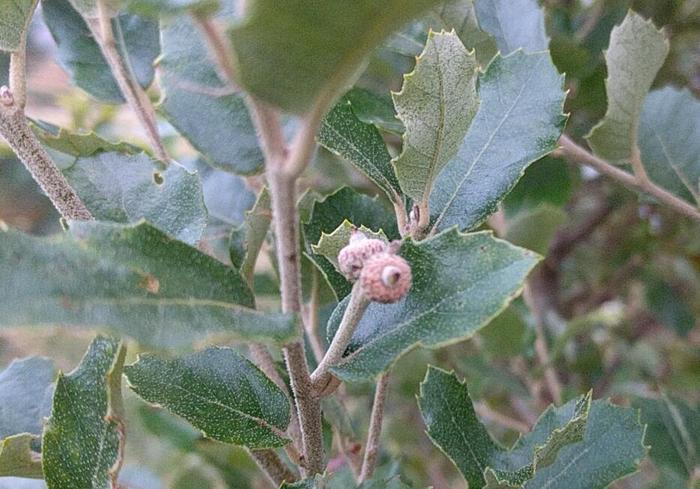
One of the trees I've had surprising success with here is the Holm oak (Quercus ilex). It is a mediteranean species and is supposed to have acorns that require less leaching to make them edible. I knew they were growing and spreading in the South of England, but they have been surprisingly good here too, growing at least as well as our native holly, and quicker than some of the common oaks I have planted. The only problem I have is because they are evergreen, one or two have suffered from windrock in the winter. I even have some flowers developing, although as yet have not seen mature acorns. I think we're likely still too cool for them here.

holmoak acorns
 
Hugo Morvan
gardener
Posts: 1285
Location: France, Burgundy, parc naturel Morvan
662
forest garden trees food preservation medical herbs building woodworking
  • Likes 14
  • Mark post as helpful
  • send pies
    Number of slices to send:
    Optional 'thank-you' note:
  • Quote
  • Report post to moderator
@Christopher Weeks. First off, this is not my idea, it is being done in several places already, i am taking action and spreading this idea, because i believe knowledge is power and that the more people adopt this way of thinking the higher chances are we're finding meaningful interspecific crosses to help nature adapt to rapid changes. This topic might reveal people who've done this and reveal seed sources. Usually people are happy to share surplus seeds.
The more diversity a population contains, the higher the chances for a lucky cross that combines sought after traits. It will not hurt to include  local varieties/species in a newly planted stand of oaks to act as a pollen donor or have a local variety surrounded by more drought and heat resistant varieties/species to take acorns later off the local variety/species and know who is mommy. Or plant southern varieties/species as rows in front of existing forest containing oaks. The observation of future hybrids only functions to speed up selection, but if there are no observers nature will have it's cause.
This has happened already during the last ice-ages in Mexico a collaborator told me, the moving south and back up north of forest let to many hybridization events and therefore Mexico now contains more than 200 differing oak species and new hybrids keep getting discovered regularly.

@Joao Winckler I agree with what you say. We are basicly landracing oak trees to come to resistant new strains adapted to all climate can throw at them, including cold as gulf streams might change. In Europe we didn't have many similar hybridization events like Mexico because the Pyrenees mountain is blocking off Spain from trees moving North-South That cork let to many forests losing diversity. Europe only has 22 species. I'm not aware of many hybrids appearing in Italy and Croatia and Greece and Turkey/Syria but simple economic disadvantage in research could play a big part.

@Jay Angler There is more forest because the country site gets more and more abandoned and people switch to fuel stoves for comfort. They will not be pleased with coming bills though although wood prices  have doubled in twenty years i live in the French country site as well. Most new forests are indeed monocropped Douglas fir plantations or Eucalypthus or whatever fast straight growing exotic they could use. A lot of local forests gets increasingly clearcut for these kind of plantations killing of wildlife and often lowering the watertables. Douglas fir sucks up water and grows straight trunks all year whereas decideous forest loses foliage, builds up soils and acts as a sponge. Douglas just kills whatever grows under it acidifying, no sounds of birds in there. There is no old growth forest left in France and it will take hundreds of years to reappear if they do not decide to cut it down because it makes superior quality toilet paper that doesn't tear. Not joking. In Spain a squirrel used to be able to jump from tree to tree from Malaga in the south to Barcelona up north without ever hitting the ground is a thing folks say. Now it's mostly monoculture orangeries and lemon orchards on the Mediterranean site the Portugal site is somewhat wilder, but fast desertification is a fact. The king of Spain had lots cut down to make boats for the armada and the Mores who occupied Spain for centuries burned down a lot when they were beaten back.
Europe's forest fires are relatively speaking small beer in compared to sparsely populated areas elsewhere on the planet but were very frequent this year and much further up north where people were completely surprised and totally unprepared for it. I was in a pickle myself and many people responded on Permies with tips. Thank you for your idea to research resprouting trees and to not create fire ladders and use alleopathic trees that resist undergrowth as fire blocks. Great points.

@Anne Miller yes local trees play a big role in hybridization and a bummer Texas shops were too far.

@Nancy Reading Good question about hybridization. One reason i love creating topics is because people raise questions i have no answers to which pushes me to look into the matter more. And they bring up side topics which complete pictures in my head, it's so exciting! Great growing, congrats.
It seems 4% at average is a viable interspecific cross. That is enormous thinking of the amounts of acorns an adult tree produces!! But pollination times must overlap. So the more you plant the easier that becomes. It could be your tree didn't get pollinated or that the tree is not strong/old enough yet to push out viable acorns.
The Lucomb oak is an English bred interspecific cross between Cork oak (quercus suber) and English oak ( qurqus robur) and there is the famous Turner oak (Quercus × turneri) which got brought back to Spain as well and naturalized there

Let's create many Quercus (insert your name) for future generations to profit of of.
 
pioneer
Posts: 526
142
cat trees urban
  • Likes 10
  • Mark post as helpful
  • send pies
    Number of slices to send:
    Optional 'thank-you' note:
  • Quote
  • Report post to moderator
I'm seeing suggestions that some species of oaks may not form significant numbers of acorns until they are 20 or more years old.  So your Holm oaks may just be a little young yet?
 
gardener
Posts: 3946
Location: Western Slope Colorado.
1072
5
goat dog food preservation medical herbs solar greening the desert
  • Likes 11
  • Mark post as helpful
  • send pies
    Number of slices to send:
    Optional 'thank-you' note:
  • Quote
  • Report post to moderator
Sorry to hear about those European mega-basins filled with deep ground water …. I guess it is time my bubble was burst.  I guess Europeans have as much right to make bad decisions as the usa does.  I just thought saner minds prevailed there, and in many respects they do.  

Lots of talk about oak trees.  Where I am from oak trees are slow growing.

I would like to mention the Siberian elm Ulmus pumila.  No acorns, but a fast growing hardwood, suitable for any uses for oak wood.  Lumber, timber, turning, firewood furniture….

It grows so readily some people call it a trash tree because of that.  But consider:

It flowers very early, providing the bees an early nectar source.

The tree in ideal conditions and beyond seedling and sapling phases can add growth rings 1.5 inches wide.  An additional 3 inch increase in diameter, every year!  That’s a lot of timber, and a lot of CO2 to make it.

The “fruit” is a samara.  Before it dries and blows away, it is a bright lime green, and is a very tasty field snack or addition to a salad.  The small seed in the center is tasty and nutty.  The way the seeds are placed on the branch it’s less than a minute to gather a handful!

The tree makes great goat forage.  I assume sheep would also convert to needed protein.

Grown in appropriately spaced groves, i bet it would grow straight and tall.

And, coming back to the willingness to grow:  it likes water, but grows in deserts.  Tolerates heat, tolerates freezing winters.  It tolerates alkaline soil.  I don’t know its preferences, I have seen it growing vigorously and untended in a broad range of conditions, some of them quite harsh.

I think in regions where we’re headed for desertification, Siberian elm is our friend.  It is harvesting CO2 out of the atmosphere at an incredible rate to grow that fast.  It makes wonderful shade.  And although there’s a lot currently being said about air conditioning as the only means to decrease heat death, I find that oversimplified and short sighted.  Getting shade tree canopies over urban hardscapes, and shading roads and bridges, is a good start.  

While we’re already doing everything else we can!
IMG_5463.jpeg
[Thumbnail for IMG_5463.jpeg]
IMG_5462.jpeg
[Thumbnail for IMG_5462.jpeg]
 
Thekla McDaniels
gardener
Posts: 3946
Location: Western Slope Colorado.
1072
5
goat dog food preservation medical herbs solar greening the desert
  • Likes 8
  • Mark post as helpful
  • send pies
    Number of slices to send:
    Optional 'thank-you' note:
  • Quote
  • Report post to moderator
Missed a photo
Siberian elm seeds
IMG_5461.jpeg
[Thumbnail for IMG_5461.jpeg]
 
Posts: 14
Location: PNW, Puget Sound / Skagit Valley
4
forest garden fungi homestead
  • Likes 10
  • Mark post as helpful
  • send pies
    Number of slices to send:
    Optional 'thank-you' note:
  • Quote
  • Report post to moderator
I have been doing a great deal of habitat restoration work on my property in the Pacific Northwest.  Here the red cedar is the apex tree but suffering when we have hotter, drier summers.  Sequoias support the same animals and insects but are more drought tolerant so being incorporated into my plans.  I am also incorporating plants that grow on the inland side of the cascade mountains as that area has hotter, drier summers and also colder winters. Examples are quaking aspen and service berry.  
 
Nancy Reading
steward and tree herder
Posts: 14552
Location: Isle of Skye, Scotland. Nearly 70 inches rain a year
8240
6
transportation dog forest garden foraging trees books food preservation woodworking wood heat rocket stoves ungarbage
  • Likes 6
  • Mark post as helpful
  • send pies
    Number of slices to send:
    Optional 'thank-you' note:
  • Quote
  • Report post to moderator

Larry Hart wrote:Sequoias support the same animals and insects but are more drought tolerant so being incorporated into my plans.


Great thought Larry! On a similar line, although at the moment I have fairly constant rain, as my soil is very shallow there is little resiliance when we do get dry spells. I have planted quite a bit of common alder as a pioneer species and for coppicing for firewood. A similar tree is Italian alder, also a Nitrogen fixer, but copes with drier spells. At the moment I have planted some on the areas that other trees struggled with - slopes where the water runs off rather than sitting, and they are establishing well. I suppose it isn't beyond the realms of possibility that they could cross with the common alder as Hugo hopes his oaks do.
 
pollinator
Posts: 321
Location: Oregon Coast Range Zone 8A
94
art purity forest garden fungi foraging trees books cooking bee medical herbs seed
  • Likes 6
  • Mark post as helpful
  • send pies
    Number of slices to send:
    Optional 'thank-you' note:
  • Quote
  • Report post to moderator
Hugo, thank you for starting this thread, I really appreciate it! And thank you to everyone else who is contributing, too.

I have been experimenting with assisted forest migration for many years. I have observed that the Douglas-firs that have been planted in the western third of Oregon as a monoculture crop are really starting to struggle with the climate crisis, including a massive die off that started several years ago in southwestern Oregon.

I have also observed that madrones, California black oaks and Oregon white oaks are drought tolerant and able to withstand the long droughts and vicious heat waves of the past decade.  They also resprout following forest fires. So I have been collecting seeds from these trees for many years from southernmost Oregon and planting them further north up in the central Coast Range and Calapooya Mountains. I plant some of the seeds directly in the soil, especially in burned areas during the spring morel season. The morels are placed in the same bag as the seeds, so their spores naturally inoculate the oak and madrone seeds before I plant them. I also plant madrone seeds and acorns in trays and transplant them in the following  winter or sell them as part of my permaculture mini nursery.

Just in case anyone is interested, I have a bunch of Oregon white oak seedlings for sale, as well as other seedling trees such as Silverleaf Chestnuts, Howard English walnuts, Yamhill filberts and Indian Freestone peaches. (Seedlings are more drought tolerant than grafted trees.) I can also deliver or you can pick them up here at Permaculture Nursery. Just purple mooseage me for more info.
 
I have always wanted to have a neighbor just like you - Fred Rogers. Tiny ad:
grow your own garden and build your own home in the gardening gardeners program
https://wheaton-labs.com/bootcamp
reply
    Bookmark Topic Watch Topic
  • New Topic