• Post Reply Bookmark Topic Watch Topic
  • New Topic
permaculture forums growies critters building homesteading energy monies kitchen purity ungarbage community wilderness fiber arts art permaculture artisans regional education skip experiences global resources cider press projects digital market permies.com pie forums private forums all forums
this forum made possible by our volunteer staff, including ...
master stewards:
  • Devaka Cooray
  • Carla Burke
  • John F Dean
  • Nancy Reading
  • Timothy Norton
  • r ranson
stewards:
  • Jay Angler
  • Pearl Sutton
  • paul wheaton
master gardeners:
  • Christopher Weeks
  • M Ljin
gardeners:
  • thomas rubino
  • Eino Kenttä
  • Jeremy VanGelder

Help me make my first good pickle - with Rutabaga

 
steward and tree herder
Posts: 11666
Location: Isle of Skye, Scotland. Nearly 70 inches rain a year
5751
5
transportation dog forest garden foraging trees books food preservation woodworking wood heat rocket stoves ungarbage
  • Likes 8
  • Mark post as helpful
  • send pies
    Number of slices to send:
    Optional 'thank-you' note:
  • Quote
  • Report post to moderator
I'd really like to be able to preserve vegetables by fermenting them - my harvest of 'neeps' (Rutabaga/Swede) includes lots of little ones that I think will be ideal for preserving this way. It's nice to have a way of storing them at ambient temperatures, rather than filling the freezer full of veg - and they won't keep whole like the bigger ones should, at least for a while.
I've tried to make sauerkraut a couple of times but have not yet got the hang of it. So can anyone help me get it right with these roots?

The first step I suppose is cleaning and cutting them up. Can I just use tap water? What size pieces should I make them? Do I need to peel them?
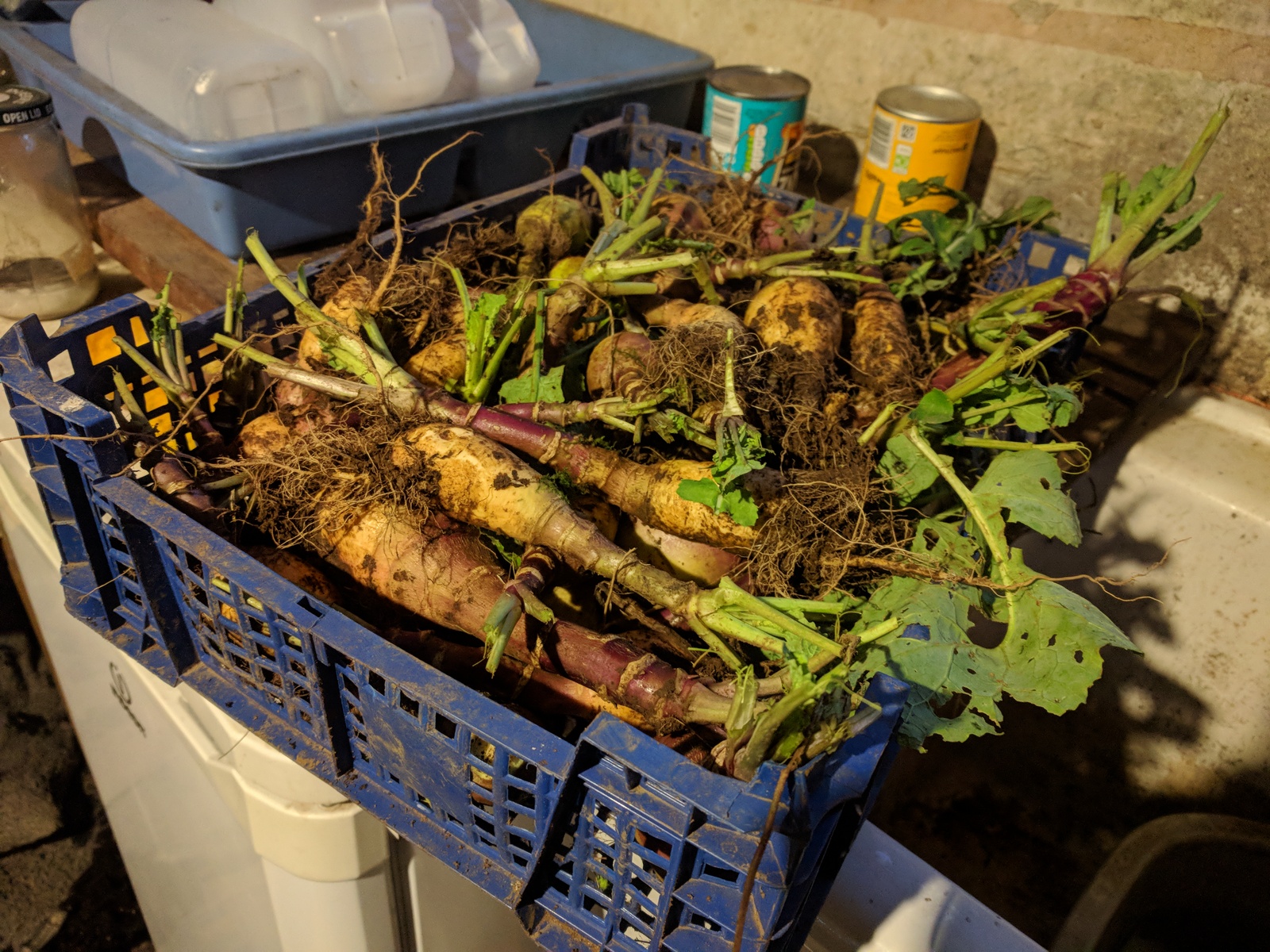
IMG_20251119_162603.jpg
Lots of little Neeps in a basket
 
master gardener
Posts: 5406
Location: Carlton County, Minnesota, USA: 3b; Dfb; sandy loam; in the woods
2967
7
forest garden trees books chicken food preservation cooking fiber arts seed woodworking homestead ungarbage
  • Likes 6
  • Mark post as helpful
  • send pies
    Number of slices to send:
    Optional 'thank-you' note:
  • Quote
  • Report post to moderator
What form-factor do you want them in for use? If you want a kraut, shred them with a grater. If you want rounds for snacking, slice them thick or thin. You can also ferment them whole, but they'd need to be immersed in brine or in a "solid state" medium like kraut.

Tap water will work fine. The skin will provide the healthiest starter culture of bacteria, but it probably isn't needed (especially if you're retaining those green tops to go into the ferment) so you can get rid of it if you expect it to be too tough to eat.

What equipment will you be using? Open-top ceramic crock? FIDO jar with bale-top and seal? Water-sealing crock? Something fancy?

What went wrong in the past?
 
Posts: 110
Location: Zone 4 Wisconsin
18
  • Likes 5
  • Mark post as helpful
  • send pies
    Number of slices to send:
    Optional 'thank-you' note:
  • Quote
  • Report post to moderator
My tap water is chlorinated so I make sure to leave it out overnight first so I don't kill off my little microbe buddies for these types of things. I don't know how much it matters but I do know that sometimes I can smell the chlorine in the water and sometimes I can't.
 
Christopher Weeks
master gardener
Posts: 5406
Location: Carlton County, Minnesota, USA: 3b; Dfb; sandy loam; in the woods
2967
7
forest garden trees books chicken food preservation cooking fiber arts seed woodworking homestead ungarbage
  • Likes 7
  • Mark post as helpful
  • send pies
    Number of slices to send:
    Optional 'thank-you' note:
  • Quote
  • Report post to moderator
On water: The first sixteen years that I was an avid fermenter I lived in town and had very hard, very chlorinated water. There was a nice natural spring two towns over where we filled carboys for our drinking water. As a matter of principle, I mixed brine with that spring water when we had it, but we were often out, and when that happened, I'd use tap water. I never, not once, observed any deleterious effect of using it. I understand the impulse and I'm glad to be on a sweet, clean well now, but I really don't think it causes much microbial inhibition in the food-fermenting context.

(I'd say the same thing about using iodized salt. It's not what I choose, but I've done it a bunch of times and it always worked.)
 
gardener
Posts: 3386
Location: Cascades of Oregon
880
  • Likes 5
  • Mark post as helpful
  • send pies
    Number of slices to send:
    Optional 'thank-you' note:
  • Quote
  • Report post to moderator
I have a couple of Harsh crocks and Chinese pickle jars that I use. My brine starts out at 5%. The silicone fermentation lids for wide mouth canning jars work well too. Into the brine and in a week the magic has happened.
 
steward
Posts: 3788
Location: Moved from south central WI to Portland, OR
1034
13
hugelkultur urban chicken food preservation bike bee
  • Likes 5
  • Mark post as helpful
  • send pies
    Number of slices to send:
    Optional 'thank-you' note:
  • Quote
  • Report post to moderator
You can use tap water to remove soil, but don't work too hard on cleaning. You want to use dechlorinated water for the brine.
If you are making chunky pickles (whole roots if they are small, sticks like carrot sticks would be my recommendation) you want to make a brine and then you just need to figure out how to keep the veggie chunks submerged.
 
pollinator
Posts: 1274
Location: Chicago
436
dog forest garden fish foraging urban cooking food preservation bike
  • Likes 5
  • Mark post as helpful
  • send pies
    Number of slices to send:
    Optional 'thank-you' note:
  • Quote
  • Report post to moderator
I love “torshi ” Lebanese-style pickled turnips and beets. Same technique would probably be good on rutabaga. It’s a basic salt brine (de chlorinated water and non-iodized salt for best results). Torshi usually includes garlic and hot pepper for flavor.  Might switch that up for the rutabagas, maybe caraway and mustard seed?

Needs to ferment about three weeks for best flavor in my opinion.
 
Nancy Reading
steward and tree herder
Posts: 11666
Location: Isle of Skye, Scotland. Nearly 70 inches rain a year
5751
5
transportation dog forest garden foraging trees books food preservation woodworking wood heat rocket stoves ungarbage
  • Likes 2
  • Mark post as helpful
  • send pies
    Number of slices to send:
    Optional 'thank-you' note:
  • Quote
  • Report post to moderator
Thanks for all the great answers, I've still got loads of questions! It seems there is not one right way of doing things, so I just need to find my right way.

So I think I'd like pickles as an accompaniment for my meals, maybe chopped small enough that they could go in a wrap perhaps. On a side note I need a way of describing the result that doesn't involve 'pickle' as that would make my husband think he won't like them......

Jars - Am I right in thinking that it would be better to have several smallish jars on the go rather than one big one? Do I need to exclude air while it is fermenting or do I need to let it breathe? I've got some 1 and 1 1/2 pint preserving jars that would probably do (or I may treat myself to a couple of new jars for 'xmas'). Is there an optimum size?

jar for fermenting vegetable pickle
these are the ones I sock inmy shop

image source


So 5% salt would be one teaspoon (5g) in about 2 pints water (1l) (that doesn't sound very salty at all!)

What about temperature? We're pretty cold here at the moment, but that means I have the kitchen stove on - so I can put them in a warmish place. Do they need to be consistently warm, or will it matter if they get a bit cold over night?
 
Christopher Weeks
master gardener
Posts: 5406
Location: Carlton County, Minnesota, USA: 3b; Dfb; sandy loam; in the woods
2967
7
forest garden trees books chicken food preservation cooking fiber arts seed woodworking homestead ungarbage
  • Likes 7
  • Mark post as helpful
  • send pies
    Number of slices to send:
    Optional 'thank-you' note:
  • Quote
  • Report post to moderator
Probably, the size doesn't matter much unless you want to do something like bury whole swedes among a kraut. *I* would ferment them all in a single crock for five weeks and then divide them into small jars to go into a fridge or cold cellar.

The ferment doesn't need to breathe and in fact you'll find an awful lot of people on the internet telling you must be entirely anaerobic, under an airlock, sealed in a vacuum or with argon, or whatever. That's all nonsense -- fermentation was probably done for thousands of years without the ability to do any of that. An open jar with cheesecloth tied over the top works fine. But like Julia mentioned, you have to keep the produce 100% under the level of the brine. Even tiny floaters will provide an anchorage for mold spores.

I discovered the wonderful Fido jars fifteen or twenty years ago and do most of my small-batch fermenting in those. After finding them, I thought any bale-top jars would be great, but none of the discount ones I've encountered have just the right gasket. The Fido jars' gasket prevents air from entering the jar, but when the CO2 pressure gets too great inside, it deflects and allows the pressure to equalize a bit. So you'll hear them hissing from time to time. I bought a crate of similar appearing jars from Ikea and they didn't work like that at all -- they just sealed things up and became timebombs. Another cheap brand that I bought didn't even really seal properly and let atmosphere mix too much. So I can't say how those specific jars you stock will work, but I'm doubtful. (But as mentioned, the sealing airlock is just a nice-to have feature, not an absolute necessity.)

Your cold environment is perfect! I mean, they only ferment (or later, degrade) slowly below 10C, but I assume your kitchen is warmer than that.

Two tablespoons of salt in a quart of water yields ~3.6% brine. That's what I'd recommend. Depends on the makeup of your salt and crystal size and stuff. A lot of people online will insist you use a scale instead and also weigh the produce, but it's up to you to treat this as a science or an art. If you just toss a fistful of salt into a jar of water and decide it tastes sort of like the ocean, you'll get pickles!

 
Christopher Weeks
master gardener
Posts: 5406
Location: Carlton County, Minnesota, USA: 3b; Dfb; sandy loam; in the woods
2967
7
forest garden trees books chicken food preservation cooking fiber arts seed woodworking homestead ungarbage
  • Likes 7
  • Mark post as helpful
  • send pies
    Number of slices to send:
    Optional 'thank-you' note:
  • Quote
  • Report post to moderator
There are a lot of tricks and equipment to help you keep the produce under the level of the brine. You might find a large outer cabbage leaf over your floating rutabaga chips below a cross of two wooden skewers sized to fit under the shoulder of your jar works. If using a straight-sided crock, a plate atop your swedes with a jar of water on top of that will do the trick if you size it right. You can buy stainless steel springs and glass weights and those things all work fine, but so does wrapping the produce in cheesecloth with some marbles. Sometimes I fit a small glass jar into the mouth of a large glass jar to keep the produce down and the brine up. And sometimes I ferment without worrying about floaties -- just stir it up twice a day and sure, mold spores land in there out of the air, but they never get to take hold because they're mixed into the acid brine where they fail to thrive.
 
Nancy Reading
steward and tree herder
Posts: 11666
Location: Isle of Skye, Scotland. Nearly 70 inches rain a year
5751
5
transportation dog forest garden foraging trees books food preservation woodworking wood heat rocket stoves ungarbage
  • Likes 2
  • Mark post as helpful
  • send pies
    Number of slices to send:
    Optional 'thank-you' note:
  • Quote
  • Report post to moderator
Great information Christopher!

Do I need to worry about timebombs? If I decide that the ferment is good, can I just seal the jar, or do I need to carry on 'burping' them every few days even in the cold?
 
Christopher Weeks
master gardener
Posts: 5406
Location: Carlton County, Minnesota, USA: 3b; Dfb; sandy loam; in the woods
2967
7
forest garden trees books chicken food preservation cooking fiber arts seed woodworking homestead ungarbage
  • Likes 7
  • Mark post as helpful
  • send pies
    Number of slices to send:
    Optional 'thank-you' note:
  • Quote
  • Report post to moderator
Depends how cold and how long. Once I put something in the fridge, I never burp it. In the cellar, which is quite a bit warmer, I've needed to sometimes. It also depends how much of the fermentation you get out of the way before you start thinking like that. But you'll find people telling you fermentation takes a week or two, and I tell folks five weeks is the baseline for when a vegetable counts as fermented and it's OK to leave it a year.
 
Robert Ray
gardener
Posts: 3386
Location: Cascades of Oregon
880
  • Likes 10
  • Mark post as helpful
  • send pies
    Number of slices to send:
    Optional 'thank-you' note:
  • Quote
  • Report post to moderator
One thing I have done is julienned carrots or daikon radishes in a ferment. If you are sneaking in pickles. Spicy dill julienned carrots replace relish on hotdogs.
The ferment might go a bit faster. with the smaller cut.
My wife can't take spicy so I have to allow for that when adding peppercorns or chilies to the brine. Spicing up the brine is something that is a personal taste thing but garlic, caraway, chives find their way into some of my ferments.
Keeping the pickle under the brine with weights, an onion or citrus round, cabbage leaf helps if I don't have an airlock of some kind.
Cheesecloth and a jar was my first ferment vessel.
 
Julia Winter
steward
Posts: 3788
Location: Moved from south central WI to Portland, OR
1034
13
hugelkultur urban chicken food preservation bike bee
  • Likes 11
  • Mark post as helpful
  • send pies
    Number of slices to send:
    Optional 'thank-you' note:
  • Quote
  • Report post to moderator
I use fresh grape leaves in between the cucumbers and the weights that push them under the surface of the brine. If you don't have weights designed for your container (I have a few that fit in a wide mouth quart mason jar and then I have a 2 gallon fermenting crock with a three piece weight set) you can use a ziplock bag full of water.
 
Nancy Reading
steward and tree herder
Posts: 11666
Location: Isle of Skye, Scotland. Nearly 70 inches rain a year
5751
5
transportation dog forest garden foraging trees books food preservation woodworking wood heat rocket stoves ungarbage
  • Likes 9
  • Mark post as helpful
  • send pies
    Number of slices to send:
    Optional 'thank-you' note:
  • Quote
  • Report post to moderator
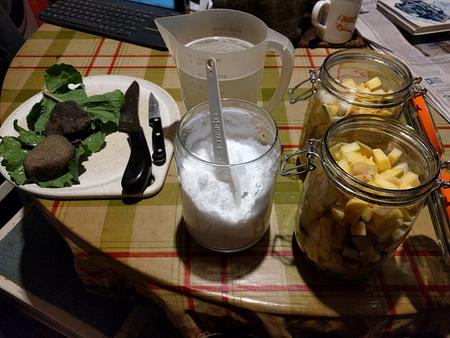
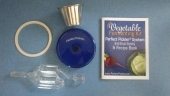
Well I've made a start! I washed and chopped the Rutabaga/neeps into slightly smaller than I would have to cook them. I put them into two new 1 litre jars and rinsed them.

ingredients for making a vegetable pickle
filled jars and making brine


My water is 'hill water' (completely untreated) and I used it straight from the tap to make 32 fluid ounces of brine. I think 32 ounces is a US quart (US and UK pint units are different) so I added 2 table spoons of sea salt to make the brine as suggested. I had an amusing thought - would sea water be the 'right' concentration for a brine? I live close enough that I could just get some from the Minch next time ....

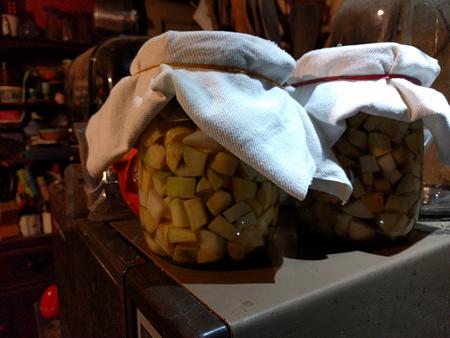
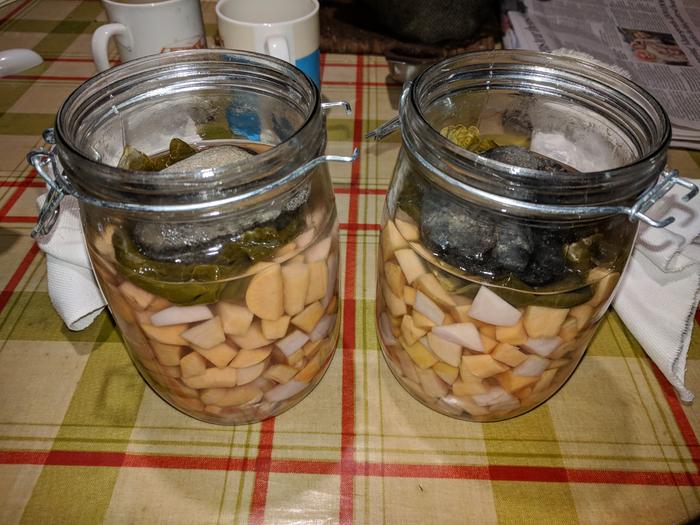
Having filled the jars, I covered the roots with a kale leaf and added a pebble from the river, that I had washed and rinsed with boiling water, to each jar. I took the wire sprung lid off the jars for the moment, and covered them with some cotton sheet held on by an elastic band. I had over filled the jars slightly, so I had to pour some of the liquid out to avoid getting the sheet continuously damp. I have put them near the stove on top of the microwave where they will hopefuly be as warm as is easy to get: I measured it at about 13 degrees Celsius (55 Fahrenheit) this morning and about 22 degrees C (71 Fahrenheit) this evening.

glass jars full of chopped vegetables covered with white cotton
Neeps in fermentation jars


So 24 hours later the vegetables have shrunk slightly, so the cabbage and pebble have sunk slightly in the jar. I guess the salty water has extracted moisture from the swede lumps and made them shrink slightly. I'm not noticing whether there has been any increase in bubbles around the vegetables as yet...

So far so good?
 
Christopher Weeks
master gardener
Posts: 5406
Location: Carlton County, Minnesota, USA: 3b; Dfb; sandy loam; in the woods
2967
7
forest garden trees books chicken food preservation cooking fiber arts seed woodworking homestead ungarbage
  • Likes 9
  • Mark post as helpful
  • send pies
    Number of slices to send:
    Optional 'thank-you' note:
  • Quote
  • Report post to moderator
Sounds great. Make sure, as things shift, that your produce stays under the brine. My visible bubble production varies widely — from a rolling froth to nothing visible. It’s fun to get bubbles but sometimes their only sign is air-pockets trapped between produce and glass. And yet, my produce always sours. So don’t get too hung up on bubbles.
 
gardener
Posts: 1585
Location: Zone 9A, 45S 168E, 329m Queenstown, NZ
792
dog fungi foraging chicken food preservation cooking fiber arts
  • Likes 12
  • Mark post as helpful
  • send pies
    Number of slices to send:
    Optional 'thank-you' note:
  • Quote
  • Report post to moderator
If you still have some swedes to use up, they dehydrate really well - I dice them up to add to soups and make picallili with them.

I soak all the vegetables for picallili in a brine and the swedes retain their crunch. I often use dehydrated carrots, cauliflower florets, marrow etc to make a batch of picallili, only the onions are normally fresh.

The turmeric disguises the slight discolouration of dehydrated cauliflower.
 
Nancy Reading
steward and tree herder
Posts: 11666
Location: Isle of Skye, Scotland. Nearly 70 inches rain a year
5751
5
transportation dog forest garden foraging trees books food preservation woodworking wood heat rocket stoves ungarbage
  • Likes 8
  • Mark post as helpful
  • send pies
    Number of slices to send:
    Optional 'thank-you' note:
  • Quote
  • Report post to moderator
Thanks Megan - I'll consider dehydration next year. The bigger roots should store pretty well in the workshop for at least a few weeks. I did have about a third of the smaller roots spare, but blanched and froze those....

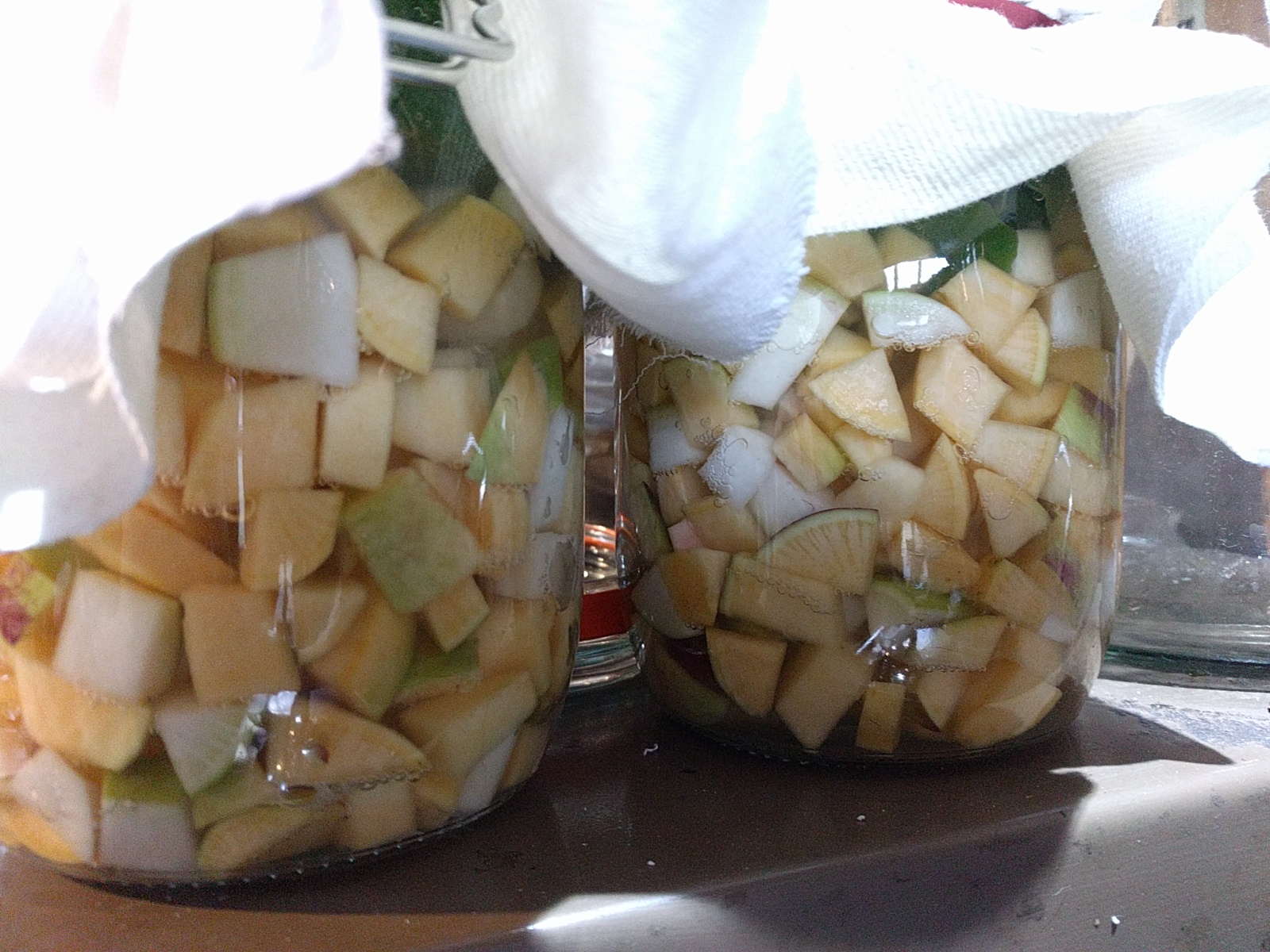
Update day 2: temp this morning 16 degrees, and about 21 degrees this evening. I can definitely see bubbles around the chunks, and maybe a slight cloudiness, so I think something is starting
IMG_20251124_130810.jpg
rutabaga ferment - bubbles on day 2
 
Nancy Reading
steward and tree herder
Posts: 11666
Location: Isle of Skye, Scotland. Nearly 70 inches rain a year
5751
5
transportation dog forest garden foraging trees books food preservation woodworking wood heat rocket stoves ungarbage
  • Likes 9
  • Mark post as helpful
  • send pies
    Number of slices to send:
    Optional 'thank-you' note:
  • Quote
  • Report post to moderator
Day three update:
Similar temperatures to yesterday. Definite bubbles around vegetable chunks and slight cloudiness. I checked on top and one (on right below) has some snotty looking stuff floating, and both have a bit of froth.
Edit - and they smell cabbagey!
IMG_20251125_202805.jpg
Day 3 vegetable ferment: froth on top
 
Christopher Weeks
master gardener
Posts: 5406
Location: Carlton County, Minnesota, USA: 3b; Dfb; sandy loam; in the woods
2967
7
forest garden trees books chicken food preservation cooking fiber arts seed woodworking homestead ungarbage
  • Likes 8
  • Mark post as helpful
  • send pies
    Number of slices to send:
    Optional 'thank-you' note:
  • Quote
  • Report post to moderator
Bubbles and froth are fine, but if some produce floats up or a waxy pelicle forms, mold is a likelihood, so I’d suggest spooning it off the top.

Also, if you’re comfortable disrupting the top, I always suggest to new fermenters that they should taste their produce every couple of days as it ferments, just to get a sense of how it’s developing.
 
Posts: 31
Location: Southeastern Norway, half coastal - half inland climate
8
  • Likes 11
  • Mark post as helpful
  • send pies
    Number of slices to send:
    Optional 'thank-you' note:
  • Quote
  • Report post to moderator
I haven't got anything useful to add, but I thought it might be worth mentioning that pickled rutabagas are a major part of the plot of a great Donald Duck story by Carl Barks. The villain is called McBrine, and wants to sabotage cucumber production - to enable him to sell a lot of pickled rutabaga. It does not end well for him.
 
Nancy Reading
steward and tree herder
Posts: 11666
Location: Isle of Skye, Scotland. Nearly 70 inches rain a year
5751
5
transportation dog forest garden foraging trees books food preservation woodworking wood heat rocket stoves ungarbage
  • Likes 5
  • Mark post as helpful
  • send pies
    Number of slices to send:
    Optional 'thank-you' note:
  • Quote
  • Report post to moderator
Day 4 update:
Temperatures still 16/22 deg C
The jars are still looking good, the one I removed the floaters from is not growing them back. The other had just a wee scummy patch which I scooped off.

I had a taste! The brine is getting sweeter and seems to be less salty, I could see this getting rather yummy! The rutabaga just taste like raw neeps still. Will they get less crunchy as they ferment? They are pretty firm in texture.
 
pollinator
Posts: 764
Location: West Yorkshire, UK
320
  • Likes 9
  • Mark post as helpful
  • send pies
    Number of slices to send:
    Optional 'thank-you' note:
  • Quote
  • Report post to moderator
I second the turnip/beet combo;  I cook my beets first but only use a little bit--I put in mainly turnip (raw).  And salt and water and that's it.  It's so good.  I haven't tried it with swede but I suspect it would be similarly amazing.  I have learned to cut my roots into thin slices or shreds, as they retain their crunch and eating them can be a real jaw workout.  A mandoline is good for this.

And if you find they aren't so fun to eat as is, add them to stews/curries/etc.  The husband went overboard on carrots in the Aldi Easter special (only 7p per kg!) this year and I ended up fermenting several kilos just to stop them going bad;  even though they were sour to eat, after cooking in a stew it was unnoticeable.  
 
Nancy Reading
steward and tree herder
Posts: 11666
Location: Isle of Skye, Scotland. Nearly 70 inches rain a year
5751
5
transportation dog forest garden foraging trees books food preservation woodworking wood heat rocket stoves ungarbage
  • Likes 4
  • Mark post as helpful
  • send pies
    Number of slices to send:
    Optional 'thank-you' note:
  • Quote
  • Report post to moderator
The last day or so the fermentation seems to have stopped. The jars look fine, but there are no more bubbles forming under the liquid - just some remaining at the top. The temperature still seem fairly reasonable. I'm assuming that things have just slowed because the initial nutrients have been used up.
Should I be worried, or is this normal?
 
Christopher Weeks
master gardener
Posts: 5406
Location: Carlton County, Minnesota, USA: 3b; Dfb; sandy loam; in the woods
2967
7
forest garden trees books chicken food preservation cooking fiber arts seed woodworking homestead ungarbage
  • Likes 4
  • Mark post as helpful
  • send pies
    Number of slices to send:
    Optional 'thank-you' note:
  • Quote
  • Report post to moderator
Perfectly normal and fermentation hasn’t stopped — different metabolic pathways, and different microbes, come online over time and do different things. If you have a pH meter you can track continuing acidification after you’re not seeing bubbles.
 
gardener
Posts: 2100
Location: Zone 6b
1288
forest garden fungi books chicken fiber arts ungarbage
  • Likes 7
  • Mark post as helpful
  • send pies
    Number of slices to send:
    Optional 'thank-you' note:
  • Quote
  • Report post to moderator
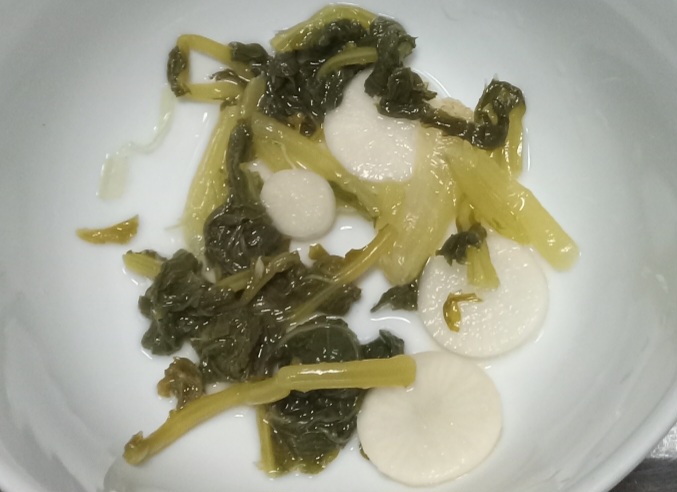
Do you see the color of cabbage or rutabaga skin changing? I fermented a couple whole daikon plants five days ago and it is still actively bubbling. Color has changed to olive green and tastes pleasantly sour, both the leaves and roots. Do you smell lactic acid when you open the jar?

Nov30daikon.jpg
Fermented daikon day 5
 
Nancy Reading
steward and tree herder
Posts: 11666
Location: Isle of Skye, Scotland. Nearly 70 inches rain a year
5751
5
transportation dog forest garden foraging trees books food preservation woodworking wood heat rocket stoves ungarbage
  • Likes 5
  • Mark post as helpful
  • send pies
    Number of slices to send:
    Optional 'thank-you' note:
  • Quote
  • Report post to moderator
Thanks May and Christopher for the comments - it helps me know my ferment is on the right track.

Two weeks on and I'm just starting to see some changes in the root pieces, the cabbage has definetly gone softer and darker in colour.I haven't tasted that though, as it was only selected to cover roots, not to eat. The liquid has quite a tang now! - one jar slightly more than the other. Only now are the actual root bits starting to taste a bit less like raw Swede/Rutabaga and getting a slight tang too. I think they need quite a bit longer yet. Probably if I had grated the roots then they would mature quicker - I may try that next time. But at least I think there will be a next time, it is going OK so far!
 
May Lotito
gardener
Posts: 2100
Location: Zone 6b
1288
forest garden fungi books chicken fiber arts ungarbage
  • Likes 2
  • Mark post as helpful
  • send pies
    Number of slices to send:
    Optional 'thank-you' note:
  • Quote
  • Report post to moderator
Good to know it's working. One difference in my jar is that the skins are on, where plenty of lactobacteria dwell on. Leaves of soil grown brassicas have healthy colonies of beneficial microbes too, so they lacto ferment spontaneously without any starter (just salt added to keep kahm yeast down). Maybe your cabbage leaves are from hydroponic farms and have lower LAB to kick start the fermentation? Do you still have some fresh leaves of rutabaga? Try those as if making sauerkraut and use them to kick start future pickling.
 
If we don't do the shopping, we won't have anything for dinner. And I've invited this tiny ad:
The new permaculture playing cards kickstarter is now live!
https://www.kickstarter.com/projects/paulwheaton/garden-cards
reply
    Bookmark Topic Watch Topic
  • New Topic