gift
PIP Magazine - Issue 19: Ideas and Inspiration for a Positive Future
will be released to subscribers in: soon!
  • Post Reply Bookmark Topic Watch Topic
  • New Topic
permaculture forums growies critters building homesteading energy monies kitchen purity ungarbage community wilderness fiber arts art permaculture artisans regional education skip experiences global resources cider press projects digital market permies.com pie forums private forums all forums
this forum made possible by our volunteer staff, including ...
master stewards:
  • Carla Burke
  • John F Dean
  • r ransom
  • Nancy Reading
  • Timothy Norton
  • Jay Angler
stewards:
  • paul wheaton
  • Pearl Sutton
  • Eric Hanson
master gardeners:
  • Christopher Weeks
  • M Ljin
gardeners:
  • thomas rubino
  • Megan Palmer
  • Benjamin Dinkel

can we come up with 20 alternatives to recycling glass?

 
steward
Posts: 6440
Location: United States
3135
transportation forest garden tiny house books urban greening the desert
  • Mark post as helpful
  • send pies
    Number of slices to send:
    Optional 'thank-you' note:
  • Quote
  • Report post to moderator
These are some pretty cool projects with glass!

 
Posts: 125
13
transportation tiny house books urban cooking fiber arts building solar writing woodworking greening the desert
  • Mark post as helpful
  • send pies
    Number of slices to send:
    Optional 'thank-you' note:
  • Quote
  • Report post to moderator
I'm not sure if I'm right because I only see it conceptually but a aquafier layer of crushed glass might be the solution to soil erosion on the Great Plains. Buried a foot under the present soil it would hold moisture and roots without adding salinity. ?
 
author and steward
Posts: 57563
Location: missoula, montana (zone 4)
hugelkultur trees chicken wofati bee woodworking
  • Likes 4
  • Mark post as helpful
  • send pies
    Number of slices to send:
    Optional 'thank-you' note:
  • Quote
  • Report post to moderator
We wrapped up the ATC here at my place, and we have one solution that is rock solid and another solution that is going to get wrapped up in the next week or two.

The solution that worked was to be able to put a tray of broken glass into a rocket mass heater:


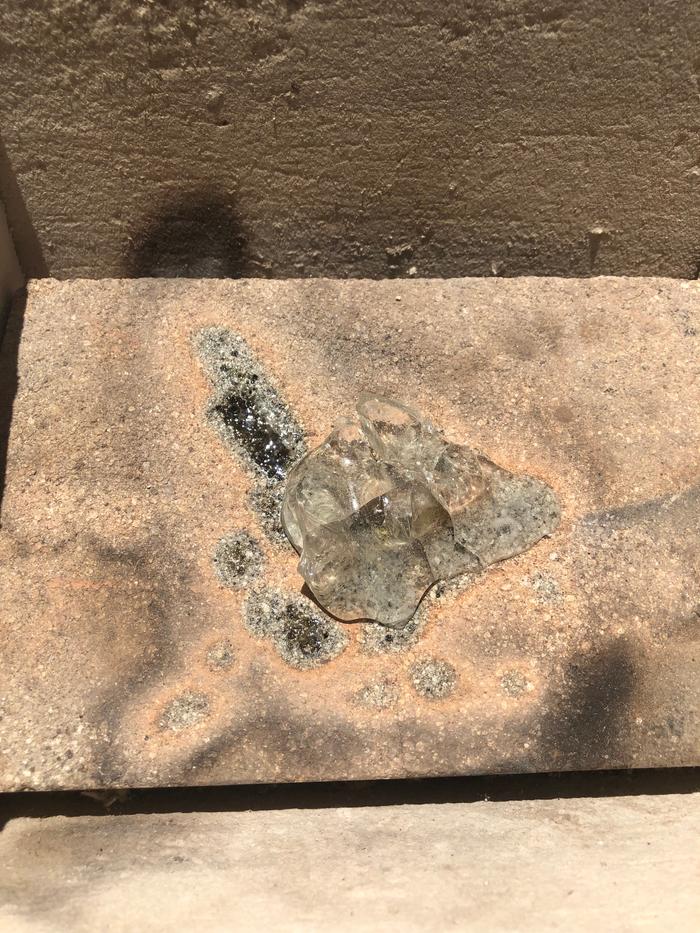
The second effort is to use a fresnel lens to melt glass.   (this might end up being called "fresnel lense glass melter (flegm)").

A stepping stone:


The new version is under construction:


Go Josiah Go!

 
steward
Posts: 6601
Location: Everett, WA (Western Washington State / Cascadia / Pacific NW)
2196
8
hugelkultur purity forest garden books food preservation
  • Likes 9
  • Mark post as helpful
  • send pies
    Number of slices to send:
    Optional 'thank-you' note:
  • Quote
  • Report post to moderator
On Monday, visiting a neighborhood in Missoula, Paul and I ran across this amazing gabion-style fence with glass bottles.

urbanite-glass-bottles-rock-gabion-fence-1.jpg
urbanite, glass bottles, and rock gabion-style fence in the Rattlesnake neighborhood of Missoula
urbanite-glass-bottles-rock-gabion-fence-2.jpg
urbanite, glass bottles, and rock gabion-style fence - long view
urbanite-glass-bottles-rock-gabion-fence-3.jpg
urbanite, glass bottles, and rock gabion-style fence - different color combo
urbanite-glass-bottles-rock-gabion-fence-4.jpg
urbanite, glass bottles, and rock gabion-style fence - mostly glass section near the back
 
Posts: 91
19
5
  • Likes 1
  • Mark post as helpful
  • send pies
    Number of slices to send:
    Optional 'thank-you' note:
  • Quote
  • Report post to moderator

Nick Kitchener wrote:Glass jars are the best for storing seed in the garden shed because the rats and mice can't chew through the container like they do with plastic.

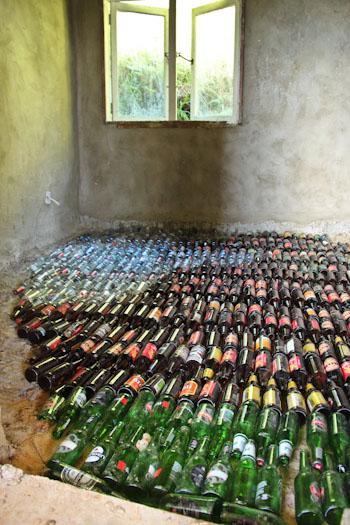
Then there is using old bottles as insulation in a concrete sub floor. It's an old technique but it seems to work well.


woah! this seems cool! so it is the air in the jars that acts as insulation?
 
gardener
Posts: 814
Location: Durham, NC
339
hugelkultur gear urban cooking building writing woodworking
  • Likes 3
  • Mark post as helpful
  • send pies
    Number of slices to send:
    Optional 'thank-you' note:
  • Quote
  • Report post to moderator

michael beyer wrote:

woah! this seems cool! so it is the air in the jars that acts as insulation?


Yes, it is. Insulation is actually a series of heat exchanges.  Hot air meets cold surface, some of the heat bleeds off.  Next air pocket, more heat loss.  That's why goose down is such a great insulator: millions of tiny "beer bottles" to trap the heat.  This bottle thing is even used by many to insulate the base of cob pizza ovens. I used wine bottles at the base of my oven which got to 900 degrees but i could put my hand on the base. However, it is not the best insulator to use because it only presents one heat exchange. So i worked straw and such into the cob to create more air pockets.  It's why insulated sleep pads for backpacking are so much better R value than non-insulated. This bottle floor is more like the latter. Still inspiring though.  
 
pollinator
Posts: 382
Location: 18° North, 97° West
140
kids trees books
  • Likes 3
  • Mark post as helpful
  • send pies
    Number of slices to send:
    Optional 'thank-you' note:
  • Quote
  • Report post to moderator
How can I cut a bottle like this?  I have a ton of succulents and this would make wonderful gifts.

reuse-glass-bottles-flower-succulent-mini-garden-planter-diy-decoration-ideas.jpg
[Thumbnail for reuse-glass-bottles-flower-succulent-mini-garden-planter-diy-decoration-ideas.jpg]
 
master steward
Posts: 8043
Location: southern Illinois, USA
3035
goat cat dog chicken composting toilet food preservation pig solar wood heat homestead composting
  • Mark post as helpful
  • send pies
    Number of slices to send:
    Optional 'thank-you' note:
  • Quote
  • Report post to moderator
Cut the bottoms off to tile a countertop.
 
Posts: 3
Location: Piedmont region, NC, USA
3
  • Mark post as helpful
  • send pies
    Number of slices to send:
    Optional 'thank-you' note:
  • Quote
  • Report post to moderator

Deb Stephens wrote:They say a picture is worth a thousand words, so this is going to be worth about a million by the time I get done. This is a subject near and dear to my heart! There are just too many ways to use bottles and jars to show all of them, but I will post a few good ones I've managed to collect. Mostly, they cover lighting, planters and vases, pavement and edging, decoration and useful storage, but there may be a few oddballs mixed in. Enjoy!


Okay, I'll stop! It's hard though because there are quite literally millions of ideas out there for ways to use re-bottles--no one should EVER send one to a landfill!!!


Great examples.  Someone spends a lot of time on Pintrest I'm guessing.  LOL
 
Posts: 24
Location: MT
3
tiny house greening the desert ungarbage
  • Mark post as helpful
  • send pies
    Number of slices to send:
    Optional 'thank-you' note:
  • Quote
  • Report post to moderator
Definitely a sign..

Nathanael Szobody wrote:The countertop is the sweetest thing ever, but wow that's a lot of epoxy...[/strike]

Funny story: while I was writing this my daughter dropped a glass on our concrete floor.

 
gardener
Posts: 1704
Location: Proebstel, Washington, USDA Zone 6B
1086
3
wheelbarrows and trailers kids trees earthworks woodworking
  • Likes 3
  • Mark post as helpful
  • send pies
    Number of slices to send:
    Optional 'thank-you' note:
  • Quote
  • Report post to moderator
I've started the list of zero-waste stores. Feel free to add any that you know about.
 
Jeremy VanGelder
gardener
Posts: 1704
Location: Proebstel, Washington, USDA Zone 6B
1086
3
wheelbarrows and trailers kids trees earthworks woodworking
  • Likes 3
  • Mark post as helpful
  • send pies
    Number of slices to send:
    Optional 'thank-you' note:
  • Quote
  • Report post to moderator

paul wheaton wrote:
#8 free shelf / free shed

Decades ago I saw a "glass exchange shed" in Eugene, Oregon.  A large shed that was just full of canning jars.  Apparently, anybody can drop off and anybody can pick up


That might have been at BRING Recycling. Now they operate a building materials reuse center like a Habitat for Humanity ReStore.
 
pollinator
Posts: 825
Location: Clemson, SC ("new" Zone 8a)
190
11
  • Likes 2
  • Mark post as helpful
  • send pies
    Number of slices to send:
    Optional 'thank-you' note:
  • Quote
  • Report post to moderator
A timely topic, considering that many US jurisdictions, including my own as of this year, no longer accept glass for recycling.  I'm sure they were unable to obtain a contract with a local recycler, probably because the local recyclers couldn't maintain profitability and closed!
 
pollinator
Posts: 282
Location: North FL, in the high sandhills
109
  • Likes 8
  • Mark post as helpful
  • send pies
    Number of slices to send:
    Optional 'thank-you' note:
  • Quote
  • Report post to moderator
I'll qualify what I'm going to say ...

I had a glassblowing studio from the late 1990s until the 2007/8 financial crash and did (and sometimes still do) a good bit of work on glass chemistry.
There's even a glass named after me, Brossphate, because I was able to sort the problems glassblowers had forever with getting phosphate glasses to melt smooth without chunks of crystals in the glass. Originally that was overcome with a high percentage of lead. My main desire in going deep on glass chemistry was to eliminate as many toxins like lead as possible.

https://www.davebross.com/GlassTech/whatarefurnacebeads.html

https://www.davebross.com/sitemap.html


Many furnace glassblowers have done production lines with recycled glass but it's difficult to work, requires additives,  and will never be "crystal" pretty as a clear glass.

A LOT of "third world" glassblowers use recycled glass and cooking/drain oil to heat the furnaces and tough it out with the difficult working characteristics.

In spite of all they're working against they make some awesomely creative stuff.

https://www.voanews.com/a/kenyan-company-turns-glass-waste-into-artisanal-products/7936413.html

The sea glass market was flooded years ago and selling it would be difficult.

It takes a LONG time to tumble out a load of glass. I used to finish my furnace glass beads that way and it was tedious.

One of the problems with glass and glass as concrete aggregate and the like is that it will devitrify and become fragile. Glass is sand, alkali and modifier, the modifier being lime, zinc, or a few other things.
If the glass was formulated without enough modifier (not uncommon) the alkali will dissolve out of the glass, leaving a fragile skeleton of silica that will crush easily. That escaped alkali would be a mess in concrete. You could make it work but every batch of glass would have to be tested for possibility of devitrification.

If you try melting glass don't do it in a graphite crucible like one of the vids here. At full melt temps it's likely to foam and boil over. Use clay crucibles which are available from mine supply and assay outfits.

On the positive side, recycled glass can be remelted for utility items a number of times.  The problem is the sheer volume of recycled glass out there.

I worked for a recycling outfit in Seattle in the 1990s and a good bit was able to be used by the Ball canning jar factory there if it was sorted correctly. The rest piled up until they had to landfill it.

The reason plastic took over from glass was shipping weight.

We could do worse than to put deposits back on glass bottles and mandate glass packaging. I think Oregon still does this.

I'm loving all the pics that were posted. Wonderful creativity!


Posts: 15
Location: Mid North Coast, New South Wales, Australia
3
  • Likes 1
  • Mark post as helpful
  • send pies
    Number of slices to send:
    Optional 'thank-you' note:
  • Quote
  • Report post to moderator
What a great set of ideas! Diverting anything from landfill that could be reused or recycled should be of high priority at all levels of society.
In Australia, most states and local government areas have a strong emphasis on reducing landfill quantities with different bins provided for weekly or fortnightly collection of different categories of recyclables.
In my region, window glass is currently not accepted as a recyclable so has to be diverted to landfill but all glass jars and bottles are ideal for turning into new containers.
Most glass consumer drink bottles have a 10c deposit included which is refunded when they are taken to a reverse vending machine. Aluminium and PET containers are also acceptable under this system. This scheme is very successful at removing beverage containers from landfill.
Recycling glass into new containers is preferable to making glass from virgin materials. Google told me:
“You can use up to 100% recycled glass (cullet) in new glass products, especially bottles and jars, because glass is infinitely recyclable without quality loss; high-quality, contaminant-free, color-sorted cullet allows for full replacement, reducing energy and virgin materials, though actual percentages vary by color and purity.
Key Factors for High Cullet Use:
Purity: The glass must be clean and free of contaminants like ceramics, metals, or plastics.
Color Sorting: Separating cullet into clear (flint), green, and amber streams allows for consistent color in new products.
Type of Glass: Container glass (bottles, jars) is ideal for closed-loop recycling into new containers.
Benefits of Using More Cullet:
Energy Savings: Melting cullet requires less energy than melting raw materials (sand, soda ash, limestone).
Resource Conservation: Reduces the need for virgin raw materials and landfill space.
Reduced Emissions: Lowers air pollutants like nitrogen oxides and sulfur oxides.
Practical Limits:
While 100% is possible, some processes or specific colors (like amber) might use slightly less if contamination is present or color matching is critical.
For example, amber glass might have a limit of 60% mixed cullet to maintain color consistency.
In essence, the maximum is often 100% when the system is efficient, making glass a truly sustainable material.”
I understand that glass recycling is not available in every region so by all means take on board the many great suggestions shown by other posters.
 
gardener
Posts: 3395
Location: Cascades of Oregon
883
  • Likes 1
  • Mark post as helpful
  • send pies
    Number of slices to send:
    Optional 'thank-you' note:
  • Quote
  • Report post to moderator
Grind it fine for frit in enamel work.  Probably too small scale to make a dent in all the bottles.
enamel-earing.jpg
[Thumbnail for enamel-earing.jpg]
 
pollinator
Posts: 1551
Location: zone 4b, sandy, Continental D
426
  • Likes 2
  • Mark post as helpful
  • send pies
    Number of slices to send:
    Optional 'thank-you' note:
  • Quote
  • Report post to moderator
There are many good ideas in this thread. All I can think of is mosaic. Embedded in plaster. You use cutting pliers to cut the glass to your liking then lay it in soft plaster. When it dries, it's really pretty. You don't reuse a lot of it that way, I'm afraid.
I very much like the idea of embedding bottles in a wall to add a lot of light to a wall but I fear that in a wall that was mostly composed of complete bottles, the walls might be quite weak. (The air in the bottle, perhaps the condensation hot/cold and perhaps there would have to be so much material between the bottles to make the wall solid enough that it may not be worth it? The only way I have seen them is with bottles lying on their side. I guess standing them up would not work as the wall would be too thin?
It's intriguing, though.
 
pollinator
Posts: 252
Location: Middlebury, Vermont zone 5a
77
  • Likes 4
  • Mark post as helpful
  • send pies
    Number of slices to send:
    Optional 'thank-you' note:
  • Quote
  • Report post to moderator
I used to work a bit with stained glass and now mainly work with enamels.  My old tabletop kiln died after ten years of hard work, and so, I needed to get a new one.  This one is much easier to program to do different mediums: enamel, glass fusing, metal clay, etc.  Because of that, I've been thinking about getting back into working with glass and doing some fusing.  There are many videos on line about how to recycle glass into molds or shapes or slumped into other shapes.  The interior of my kiln is only 8.5"x12" which limits what I can do, but I've been watching videos about making snowflakes and other window ornaments and small vases.  With the price of "new" glass, this is very intriguing to me; I could then sell them and perhaps save up enough to get a bigger kiln for just this purpose.  I have a glass smasher or frit maker in my cart as I type this!

https://www.amazon.com/Crusher-Prospecting-Breaker-Panning-Pulverizer/dp/B08BHHGV4Y/ref=pd_ci_mcx_mh_mcx_views_0_image?pd_rd_w=pweb2&content-id=amzn1.sym.679481c3-2bf4-4843-80c0-ffb319282e84%3Aamzn1.symc.c3d5766d-b606-46b8-ab07-1d9d1da0638a&pf_rd_p=679481c3-2bf4-4843-80c0-ffb319282e84&pf_rd_r=JRHC2XZZ8JAGQAJ9496E&pd_rd_wg=PgyHL&pd_rd_r=c575846b-26c0-4fef-b3fe-358e88d16ada&pd_rd_i=B08BHHGV4Y
 
Hey, check out my mega multi devastator cannon. It's wicked. It makes this tiny ad look weak:
Permaculture Voices 1, 2 and 3 - all 117 hours of video!
https://permies.com/t/voices123
reply
    Bookmark Topic Watch Topic
  • New Topic