I have been kicking around an idea regarding the barrel for a different reason, but we are about function stacking...
First my assumptions:
The primary reason of the exposed barrel is to allow a portion of the heater to directly radiate into the room.
The immediacy of heat from direct radiation of the barrel is a trade-off to the long-term benefit of heating a thermal mass.
A fully cobbed barrel would result in more heat being transferred into the thermal mass, but with a much longer lag in heating.
So what if an insulating blanket were attached to the barrel. If it were attached at the top, it is even conceiveable that it could be raised and lowered with the stove in operation.
The outside of the blanket could be nearly any color, pattern, or finish to suit the decor of the room and when the stove is not in use, the blanket would completely cover the barrel.
When the stove is in operation, it would be lifted up completely to allow for a quick heating of the room, and lowered as the room temperature rises to allow maximum heat transfer to the thermal mass.
It seems that this would improve the looks considerably as well as allowing much more control over the heating profile.
More great ideas!
That aluminum ceiling tile is something I'd been interested in before... I think you can also get copper (or copper-colored) stamped tiles.
The fire window is awesome, but not necessarily part of the barrel (there is a gap between barrel and burn tunnel, so it would take a double window to see the flames through the barrel itself) - but just below the barrel a flame adds immensely to the aesthetic appeal.
Regarding conductivity - I believe conductivity is not much of an asset, what is needed is efficiency at radiating heat away. I think 'emissivity' is the right term - here's a chart from the engineering toolbox folks:
It appears that, as a general rule, polished metals don't shed heat very efficiently, while 'weathered' (even rusted) surfaces are more effective at shedding heat. This might be due to microscopic surface textures acting like heat-transfer fins, or something like that. Anyway, you can see that polished copper is right down there at negligible levels, while stainless (weathered) actually does quite well.
Emissivity Coefficients of some common Materials
The radiation heat transfer emissivity coefficient of some common materials as aluminum, brass, glass and many more
The emissivity coefficient - ε - indicates the radiation of heat from a 'grey body' according the Stefan-Boltzmann Law, compared with the radiation of heat from a ideal 'black body' with the emissivity coefficient ε = 1.
The emissivity coefficient - ε - for some common materials can be found in the table below. Note that the emissivity coefficients for some products varies with the temperature. As a guideline the emmisivities below are based on temperature 300 K.
Erica, thanks for a quite interesting list, not just for the barrel, but for the mass too. For example, I wonder if the somewhat low emissivity of granite might make for a more slowly emitting heater.
If I did my research right, 300 kelvin is about 80F or 26.8C
Gani
Deb Stephens wrote:I have an idea, but instead of drawing it, I will just describe -- it is really too simple to bother with a drawing.
You know that sheet metal screening that you can buy in DIY places (or from fancy metal fabrication places online and elsewhere)? It is usually found as insets in large cabinets or in fireplace screens, etc. and comes in a variety of decorative patterns. Okay maybe a picture would be better... like this....
Anyway, here is my step by step. First paint your oil drum black (with stove paint) to make it less obvious. Then, fabricate a cylinder out of this decorative screening (brass would be nice). Make it slightly larger in diameter than your ugly oil drum and attach some sort of spacers on the inside of the screen cylinder to hold it half an inch or so away from the metal drum. (Ceramic insulators perhaps? Or just a few short bolts through the screen at regular intervals around the top and bottom of the cylinder?) Remove the stove pipe and slide the cylinder over the drum. Voila! Pretty cover up in no time and for relatively low cost. You could even add some decorative elements to that if you wanted. I'm picturing some metal dragonflies or butterflies or anything with fairly broad wings or fins -- to add even more metal surface area to the stove, but it could be anything.
Hmmmm... I think I may do this, now that I've thought of it.
EDIT -- I forgot to add that you can do clean outs and clean the metal mesh by just sliding it off the drum -- no doors needed. Or avoid having to lift off the cylinder altogether by making it in two pieces (longitudinally) and hinging it together. As a bonus, the mesh allows for air circulation naturally, without fans, etc. and allows you to see flames from any windows you may have in the drum.
I had a similar idea, but using wrought iron rather than metal screening, and with the cylinder painted a plain colour that coordinates with the decor so that the design of the wrought iron stands out. The design could vary to fit with the style of the home, and it may even be possible to mount coloured heat-proof glass or ceramic tiles in for some styles - I'm thinking gothic, art nouveau, art deco, etc.
Going with the request for a "flickering flame" design: the drum could be painted dark red, and around it a black steel or iron shell with a flame design cut out of the top third and gaps to draw in air at the bottom. Heat-proof flexible "flames" in yellow, orange and bright red would be mounted between the shell and the drum, fixed top and bottom but loose rather than taut, and would flicker as air is pulled in at the bottom and rises up as it is heated.
Another slightly more complex alternative would be a second wooden drum outside the normal one, with a fan-powered air intake at the bottom that draws air in from outside the home. The gap betwen the two drums acts as a heat exchanger, warming the air and pushing it upwards until it exits into a part of the home that might otherwise be cold, such as a bathroom or bedroom. The outer drum could then be decorated in any way you want, or left as plain wood, and would have the advantage of being cool to the touch. A suitably-sized oak barrel is one option for the outer drum. It should be possible to get some old oak barrels that are no longer water-tight, so unsuitable for making wine/beer/whisky/etc. The wooden barrel end (or top in this case) would probably have to be replaced by a steel plate, as I imagine that even with several inches of space it will get very hot! The thermal mass would then become the main source of heat for the area where the rocket stove is.
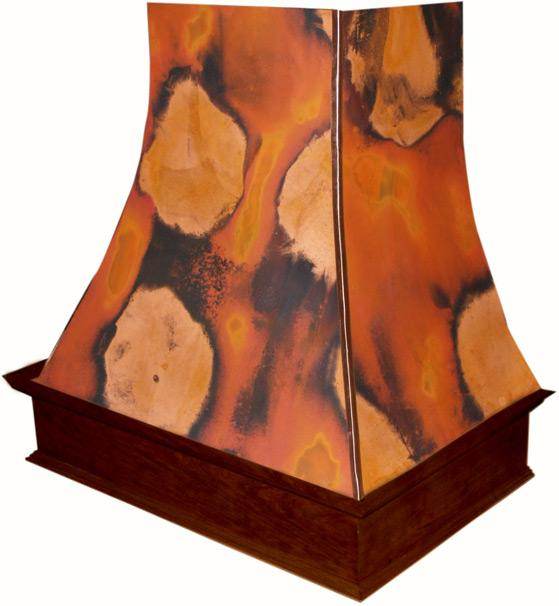
Well, since you're going to go all Martha Stewart, I thought of island range hoods, with a cap added. There's a nice transition from the base and the proportions are not as awkward as squat drums. Here's some inspiration for ya:
Also, does it have to be only one chamber? I thought you could cut pipe into (probably 3 of them) different heights, cap them, and gang them together in a bunch or in a line like organ pipes. It would be more sculptural. They could be welded together, or maybe banded together decoratively. This would be a cheaper alternative...
though i wouldnt nessacarily describe myself as a martha stewart guy lol i definately have put a RMH on the back burner until i see a good, aesthetic design, i liked some of the ideas on this thread so ill defnately be following along to see if anything good comes along, and add any ideas that i come up with, if any
If i may say something, around the oil drum, one could make a metalic sleeve, something like one or two inch away from the barrel, that sleeve would be raised of the same gap above cob level somehow, and open on top, to heat air via convection. The sleeve could be made with almost any material.
thats a decent idea, i know they now sell convection heaters that mount to the wall (electric) so this works pretty well and may work real great with a hot rmh, so then the trick is finding something that looks good...
Can be found in several sizes, and over here are somewhat cheap even new. Found a 200 litre for 129 euros ex tax. That 's about 185 dols full taxes where i live.
I just suppose and I am not sure....
They have thin walls.
I think they will brake with dry heat.
I have seen a stainless steal pot broken over a fire already.
And they are not expensive because they are not heavy, it's a matter of thickness.
Nicolas, absolutely no risk of craking. Have you ever see metal cracking with heat? I haven't! Steel deforms, expands and contract, melts, tears sometimes, but crack only with extreme cold.
We've had cheap stainless steel pans burn through on the top of a gas stove. I don't think I'd be inclined to trust a honey ripener above the riser of a rocket mass heater having seen the size of the hole that burned though. If I can still find it, I'll photograph it to show you what I mean.
Yes I have seen it!
A friend of mine has a sauna whose vapor is made outside with woodfire on a cob stove,
and the stainless steal pot (the big type for collective cooking) cracked just above the nivel of water.
As I see cob being presented as a viable covering for the drum, I wonder how much of a necessity the metal drum really is.
From other posts I understood that the main function of the barrel is to provide a steep negative heat-gradient to the inner
chimney pipe. Given materials with high emissivity like, for example, bricks, could the outer barrel not be replaced
by a nice, cleanly masoned, brick mantle topped with a metal plate? The plate could couple thermally with the
inner chimney, the bricks radiate gently and would substantially reduce the risk of inadvertently touching hot steel.
Not positive but I think you are basically proposing a masonry stove. They work great but are much more expensive. I'm again not positive but I think they take longer to get the house to temp.
Hans Pelleboer wrote:...I wonder how much of a necessity the metal drum really is.
Well,
I do not intend to violate the concept of the RMH, I was just wondering if a highly conductive metal plate
above the inner chimney would be sufficient to build up the required heat gradient, thereby eliminating
the need for a steel barrel. If that amounts to conversion to a masonry stove, then, yes. Trouble is,
I do not know what a masonry stove entails. Could you tell us some more?
It's a very clean burn and uses small sized pieces of wood and originated in Europe probably after they used up much of their forests. Easy to heat a house by coppicing a few trees - you get the right sized pieces and don't have to cut down large trees.
Better to google it so I don't mangle it up too much.
As I said, the downside is the expense, especially if you have to hire a mason. There are kits available but they are pricey as well. They are beautiful though, and you don't have an oil drum in your living room.
Xisca Nicolas wrote:Yes I have seen it!
A friend of mine has a sauna whose vapor is made outside with woodfire on a cob stove,
and the stainless steal pot (the big type for collective cooking) cracked just above the nivel of water.
Some people use stainless steel for the heat riser, which can bear some 1000C° and it would crack with only boiling water? Are you sure you're talking about stainless steel? And not some kind of aluminium aloy?
I'm pretty sure an honey ripener would stand the heat.
Don't know for the honey ripener.... and I am sure it was grande casserole inox de collectivité!! (which may come in various qualities)
it was not aluminium.
It did not come from boiling water but from the fact that it was not ALL boiling water. The crack happened above the level of water, where it was dry, and it needed several uses (less than a year) to rupture. The flames could reach that high on the sides of the pot.
And I think there was some pressure for closing it.
Stainless steel comes in different grades, some are pretty brittle.
What may have been the trouble is the temperature difference between the water inside
and the flames on the outside. How high up did the fire actually come?
I think they went high up, considering the sides where black, but I did not see it work. This is not important to know, just wanted to state that one should not be too confident as far as it comes to changing the use of any object. What is made for honey might work, but it might not because the design was not made for fire. And you point out well the difference of quality!
I just discovered this web site and am new to rocket stoves. Do you think it would be possible to seal a ceramic chimney pot so it could work for the combustion chamber? They come in all sizes and styles that would fit my decor better than an oil drum. Might they also be used to make the wood hole more attractive? The link below is just the first one that came up on google, but there are others. They are expensive, but I would be willing to pay for one that I woul enjoy seeing daily for the rest of my life, especially if it would give me something productive to do with all the dead branches that come down around here. Thanks.
Satamax Antone wrote:It could even be done with normal bricks Or even a "latice" of bricks, so there's gaps between theses.
Hi everybody.
Here's prety much what i meant. I mean the blockwork. That raised up to the top of the barrel, or a smidge higher. May be for thoses who don't cook on it, put a big stone or marble slab on top.
Just a thought but would the drum put off too much heat to wrap it with shelves? I hammered out a real basic drawing(having issues with a few settings in CAD or it would be nicer) just to show what I mean.
I like the idea!
Iron shelves for drying things...
(Sure, not for your books!)
This might be too big for most designs, if the drum is close to the wall, so I suggest the alternative of semi shelves.
They could also be fixed to the wall instead of the drum.
Anyway, this would hide enough to make it more esthetic.
Xisca Nicolas wrote:
This might be too big for most designs, if the drum is close to the wall, so I suggest the alternative of semi shelves.
They could also be fixed to the wall instead of the drum.
Anyway, this would hide enough to make it more esthetic.
If you're good with metal-working they could be as decorative as they would be functional, and depending on how you mount them to the wall they could be easily removed for maintenance.
Hello,
Not sure if this tread is still active. I worked in steel fabrication for years. You might find a sheet metal shop with a roller to do this job. Figure your diameter and what length Drum you want. The people at the shop will roll it for you and maybe weld the long seam and top for you. Ask them for a great job..meaning the drum will be round and the welding clean and polished. Have them weld handles on it so you can pull it off easy. Cook top?
Next go and buy some metal art..take that to the shop and they ask them to roll it to the diameter of the drum and have the welder tack the metal art on for you.....
Martha Stuart will be very proud of you...Remember you can go all out and use stainless steel for the drum, bring your extra check book.
somewhat low effort could be rustic scenes plasma cut from metal and rolled around the drum and tack welded on as a fascia. A friend of mine has one of these plasma tables though I do not have any plans of selling work for it, just an example of what is possible. Work could even be shipped flat and rolled and tack welded on site.
You can take a suitable size sheet metal, and using a projector have a custom design (or something nice found on the internet) projected on the surface. So if you are a artsy person, you could grind, scratch, weld, or scorch or paint the metal until you have your design on it real nice. Then have it veld up nice.
If you are more like a nerdy person, you could chemically etch your design in the metal. This is the stuff that is used when printed circuits are made. The design is transferred to the metal by a photo enamel and with the aid of the projector. (this process is not compatible with stainless, since it would resist most etching chemicals)
If someone is adventurous, one could also electro - plate a conducting object with various metals, such as copper, silver or gold. One paints a mask on the metal object, then apply a plating solution while a sufficient current is applied to the objects.
I would personally get a nice pattern from the net, mark it on my metal using the projector, then i would use an angle grinder to apply the pattern permanently.
Yes! I was wondering if those stamped 'faux tile' metal panels were still available.
I'd be a little concerned about aluminum - it should handle the routine barrel temps but it's at the upper end of aluminum's operating range. (I think it melts around 1100 F? so as long as it's not on the top of the barrel, the sides should be OK).
If it didn't shed heat fast enough, it could possibly raise the temperatures further, and show some permanent warping or sagging at the hottest spots.
Anyone care to test these?
Yours,
Erica W
Post by:autobot
professionalism is finding the perfect flavor of apathy --tiny ad
Looking for cold-climate growers to join a GOOF livestream panel (Missoula)