Forums Login/signup

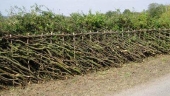
Obsessed with these beautiful English hedges (1940s England)

+Pie Number of slices to send: Send
We had cows when I was young on the farm , this live fence only worked on animals that were well feed & had lots of good grazing pasture. I like Joel Salatin fence for my animals, less work & never needs trimming.
I do understand many farmer worked with what they had, many had polycrops as well as lots of animals. The history is good, we may need it some day.
+Pie Number of slices to send: Send
Awesome technique! And ditto on seeing a woman out there learning and doing! Thanks for posting this.
(2 apples) 2
+Pie Number of slices to send: Send
There are scarce resources that I've found about traditional hedgelaying in North America, but this type of hedge is what was used, and likely from what I've heard even originated, in the USA in the Delaware region. Once there was a shortage of wood to make fences from after European settlement, people experimented with different techniques. By the way, a very good example of hedgelaying in action is in one of those historial farm documentaries put out by the BBC, though I can't recall which one or which episode.

I was recently talking to someone involved with trying to document and bring back this type of hedge in Ontario, Canada, and have a few details to share about this type of hedge in Eastern North America.

Species selection: here are some ideas that have a long history of working well:

For hedges intended to keep animals in (or out), and a long history as a primary species in the mix: hawthorn, osage orange. For a stock-proof fence, you'd likely want about 50% of these in the mix, because of their tendency to get thick and dense with thorns.

Others potentially good to keep animals in (or out): seabuckthorn, rose.

Others in the mix: hazels, chestnuts, serviceberries/juneberries, nanking cherry (careful - cherry leaves can apparently make some stock sick or dead from eating damp foliage), apples (especially thornier crabs), plums (again, thorny wilder ones), aronia, red ozier dogwood (might be a bit 'stringy' and leave places for stock to escape). Obviously this list is mostly targeted at species with multiple uses. There are other trees that were traditionally used. Note that with the most of these, you will be able to get crops most years, though likely not as much as if the the trees were allowed to grow to full size.

Worth experimenting with: autumn olive, elderberries, black locust - though I share the excitement about using black locust, I feel like it might be better served in a longer rotation where it is allowed to get larger, to take advantage of it's use as rot-proof posts, or very dense firewood on a 10-15 year coppice system. I would do testing before assuming it would work in this type of hedge, or find someone who has done it.

There are definitely other species appropriate, but I recommend trying to find out if someone else has used them successfully first, since this is a long-term project.

Starting one:


Documentaries often focus on the maintenance, or 'laying' of a hedge, not initial establishment. Here's the very basic technique I've had described to me:

Plant out the hedge with the trees fairly dense. Your first challenge will be protecting the young trees from rabbits, deers etc. I'm planning to use electric fence for this, but others will find different ways to solve that challenge. Unfortunately, I've not found definitive information about plant spacing as of yet, though the link at the bottom has some ideas on this. Maybe others can share their experience on that?
Let the trees grow up for a few years until they are about 4' tall, then do the hedgelaying technique shown in the video above, or other places.
Then let them grow up to about 4' again, and trim them to that annually.
An important note for long term health is every couple of years after that, add a couple of inches to the height you trim to. So, after a couple of years trim to 4'2", then a couple of years later, 4'4".

Don't take any of this as gospel, as I can't find my original notes at this time to confirm all details.

One of the only books I've found on the subject is a British book called Hedges and Hedgelaying by Murray Maclean. I've not read the whole book yet, but it's pretty good. More on the history and reasons why, but there are some technique things too. There are also plenty of websites, some with more info than others. This is one of the best I've found: https://www.motherearthnews.com/homesteading-and-livestock/sustainable-farming/living-fences-zmaz10onzraw

I'm planning a hedgerow of over 1000', but likely won't start it until next year or the year after. I'll have more to share after that, as I'll have had more conversations with the local researcher who has been working on hedges for years.

+Pie Number of slices to send: Send
I agree about hungry stock getting into this type of hedge, and in the case where that's your primary purpose, 75-100% osage orange or hawthorn is likely best. Also, some breeds of cattle are more browsers than grazers, and would go for even the super thorny stuff in theory. Goats would likely devour them. Sheep might do serious damage, especially when the trees are young.

Another hazard - I've heard that cattle that consume or try to consume Osage Orange fruit can choke on them and die.

All that said - based on what historians say, a lot of farmers in North America used to use these before barb-wire was invented and available, as their exclusive fences, especially if they lived somewhere with no trees available for wooden fences. They must have found solutions to these problems, and I'm sure we can too, if we desire this kind of fence.
+Pie Number of slices to send: Send

You can also see excellent video of how to lay and/or repair hedgerow in "Tales From The Green Valley" and either "Victorian Farm" or "Edwardian Farm" or both? It's been a while since I watched it.
2
+Pie Number of slices to send: Send
 

leila hamaya wrote:yeah i saw this when it was posted earlier. very cool little vid.

while everything about it is cool, watching them do this...one of my fave things about this video is the girl helper/intern.
now- it's more gender politics than i like to get into, but for the time and place i am happy to see sister helper there. and she kicks ass too =)


Did you hear the narrator called her a "land girl"? They went out into the countryside in WWII to replace the men gone to war...
https://en.wikipedia.org/wiki/Women%27s_Land_Army_(World_War_II)
+Pie Number of slices to send: Send
Good to see and know hard work hasn't shrunk from land work.
Honey locusts growing out dense on my East. Hope the roots haven't upset Septic.
Been here just a year on an acre +/-. Lots of work. Hope to rehab house with hempcrete.
Not enough growers of hemp yet. Admittedly, a damn Yankee. Folks around here sure look but do not talk. ☯
+Pie Number of slices to send: Send
That was a cool and useful video. I bought Osage orange seeds to make a living wall.
I have 29 seedlings growing now.
Does anyone know the maximum spacing to plant trees to create a live edge?
+Pie Number of slices to send: Send
I lived in the West Midlands for awhile where hedges and dry stonewalls made a beautiful patchwork quilt of the rolling countryside.  Dotted with white sheep, it'll brings tears to your eyes.
I bought books on both the art of the hedge and dry stonewalls, equally fascinating and inspiring.
(1 apple) 3
+Pie Number of slices to send: Send
At Wheaton Labs, they have a box labeled "Living Fence," with a dozen envelopes of seeds inside.

Josiah planted them recently: https://permies.com/p/1095637

He and Fred were also kind enough to share with me the species (my photo was so bad, everything but "Hornbeam" was illegible):

Hornbeam,
autumn olive,
jujube,
russian olive,
rosa rugosa,
black locust,
sea berry,
osage orange,
hazelnut,
black thorn
Hawthorn
Black Locust
+Pie Number of slices to send: Send
Absolutely love the old video! Perfect pace and Camera work to really see what he was doing.
I did a lot of research on Osage Orange and the thorns appeared to do more harm than good – some even puncturing tractor tires.
I settled on a mix of Washington Hawthorne and crabapple. I wanted the hedge to flower but also provide some thorns for deterrent. There is a planting article from Mother Earth News that shows the initial work. I didn’t follow those instructions and now my trees are fairly large but the hedge laying video makes it look like I could probably salvage them. Motivated to try now!
(1 apple) 2
+Pie Number of slices to send: Send
Since this is the most recent post regarding traditional fencing  methods, without starting a new thread I thought I'd ask if anyone has ever seen a modern application of a "HAHA"
Have y'all heard of a haha?? For keeping critters out/in? Lol


https://en.m.wikipedia.org/wiki/Ha-ha
1
+Pie Number of slices to send: Send
 

Jotham Bessey wrote:That was a cool and useful video. I bought Osage orange seeds to make a living wall.
I have 29 seedlings growing now.
Does anyone know the maximum spacing to plant trees to create a live edge?


I just put in 200 of them on a property line to start my living fence/hedgerow.  Osage orange is the outer row.  I put them in at 1 foot apart.  I don't know what the maximum is, but 1 foot is the traditional spacing for making a living fence from them.  It would depend on your goals I guess.  I want mine to be dog and stock proof.
I won't be laying them the way they did in the video.  I'm letting mine establish this year and next spring I'll bend the tops over and pin them to the ground so the branches grow up and can be woven together.

I walked the line of them yesterday and found that a half dozen or so of them had been snipped off barely above the ground by rabbits.  Hopefully they only cut off a few.  It took quite some time to plant 200 of them.

Other trees will be added inside the osage orange.  I have wild plum that are a food source and hiding place for birds and animals.  They have pretty good thorns on them as well.  I also have lots of ninebark, autumn olive, seaberry, honeyberry, lilac, hazelnut that I can take cuttings or seed from to add to the row.  It's a multi-year project and I'm sure many more species will be added and volunteer over time.  The hedgerow will be 30 or 40 feet wide eventually and should provide a wonderful habitat for birds and animals in addition to keeping my animals on the property.  The birds living in it should provide lots of volunteer plants and I like the idea that they can help plant their own living space.
(1 apple) 2
+Pie Number of slices to send: Send
If you’re interested in hedgerows…this is the book to read….absolutely delightful! And he’s a wonderful writer.
IMG_1027.jpeg
[Thumbnail for IMG_1027.jpeg]
+Pie Number of slices to send: Send
Ooh! Thankyou for that suggestion Gauri: of thorn and briar - sounds like a poem doesn't it?! I'm going to put that on my wish list!
Enjoy the full beauty of the english language. Embedded in this tiny ad:
The new permaculture playing cards kickstarter is now live!
https://www.kickstarter.com/projects/paulwheaton/garden-cards
rocket mass heater manual FREE! Sepp Holzer Desert or Paradise Documentary Green Living Book


reply
reply
This thread has been viewed 8320 times.
Similar Threads
Club style mallet - PEP BB roundwood.sand.club
All about Pollarding your trees
Plant a Living Fence
Help me design my living fence
Machete recommendations?
permaculture bootcamp - gardening gardeners; grow the food you eat and build your own home
permaculture thorns, A Book About Trying to Build Permaculture Community - draft eBook
Edible Landscaping With A Permaculture Twist/ Second Edition - Kickstarter
Support the Permaculture Bootcamp - Back the BEL
More...

All times above are in ranch (not your local) time.
The current ranch time is
Mar 11, 2026 02:35:41.