• Post Reply Bookmark Topic Watch Topic
  • New Topic
permaculture forums growies critters building homesteading energy monies kitchen purity ungarbage community wilderness fiber arts art permaculture artisans regional education skip experiences global resources cider press projects digital market permies.com pie forums private forums all forums
this forum made possible by our volunteer staff, including ...
master stewards:
  • Carla Burke
  • Nancy Reading
  • John F Dean
  • r ransom
  • Jay Angler
  • Timothy Norton
stewards:
  • paul wheaton
  • Pearl Sutton
  • Tereza Okava
master gardeners:
  • Christopher Weeks
  • M Ljin
gardeners:
  • thomas rubino
  • Jeremy VanGelder
  • Megan Palmer

The Constant Ferment in progress aka Perpetual Pickles Crock

 
steward
Posts: 18650
Location: USDA Zone 8a
4724
dog hunting food preservation cooking bee greening the desert
  • Likes 10
  • Mark post as helpful
  • send pies
    Number of slices to send:
    Optional 'thank-you' note:
  • Quote
  • Report post to moderator

Robert said, "A chinese pickle jar sits on the counter and is a constant ferment in progress. I have pickles ready all the time for a recipe potato salad, chicken salad whatever. Veggies go in during any meal prep excess vegetables get dropped in the jar.


https://permies.com/t/218870/radish#1877057

Let's talk about the Perpetual Pickles Crock.  Do you have one?
 
Rusticator
Posts: 9669
Location: Missouri Ozarks
5306
7
personal care gear foraging hunting rabbit chicken cooking food preservation fiber arts medical herbs homestead
  • Likes 3
  • Mark post as helpful
  • send pies
    Number of slices to send:
    Optional 'thank-you' note:
  • Quote
  • Report post to moderator
This is one of our plans, this year, but I didn't get any pickling cukes planted, and have been struggling to find them - even at the farm stands, so far.
 
master gardener
Posts: 6175
Location: Carlton County, Minnesota, USA: 3b; Dfb; sandy loam; in the woods
3641
8
forest garden trees books chicken food preservation cooking fiber arts seed woodworking homestead ungarbage
  • Likes 7
  • Mark post as helpful
  • send pies
    Number of slices to send:
    Optional 'thank-you' note:
  • Quote
  • Report post to moderator
I don't have a pao cai crock active right now, but I have for most of the last five(ish) years.

I suggest this video (which I now see the Robert you were quoting also referenced):


paoCai2.JPG
[Thumbnail for paoCai2.JPG]
paoCai.JPG
[Thumbnail for paoCai.JPG]
 
Christopher Weeks
master gardener
Posts: 6175
Location: Carlton County, Minnesota, USA: 3b; Dfb; sandy loam; in the woods
3641
8
forest garden trees books chicken food preservation cooking fiber arts seed woodworking homestead ungarbage
  • Likes 8
  • Mark post as helpful
  • send pies
    Number of slices to send:
    Optional 'thank-you' note:
  • Quote
  • Report post to moderator
Another kind of perpetual pickle crock is nukadoku/nukazuke -- pickling veggies in a fermenting medium of living wet toasted rice bran. You put stuff in, you take stuff out, things keep cycling through at various rates. My first nuka pot was based on Sandor Katz' explanation in Wild Fermentation, like fifteen years ago. It turns out that technique was a little non-traditional (mostly too wet) and I've since tried it three other ways. But honestly, I got the best results from the first batch. I also don't currently have a live pot of nukadoku.
nukaKioke.JPG
[Thumbnail for nukaKioke.JPG]
starterNuka.JPG
[Thumbnail for starterNuka.JPG]
nukazuke.jpg
[Thumbnail for nukazuke.jpg]
 
steward & manure connoisseur
Posts: 5017
Location: South of Capricorn
2994
dog rabbit urban cooking writing homestead ungarbage
  • Likes 13
  • Mark post as helpful
  • send pies
    Number of slices to send:
    Optional 'thank-you' note:
  • Quote
  • Report post to moderator
I almost always have a pot of sichuan pickles going, thanks (I think) to the first time that video was posted!!! That whole video series is an absolute delight.

I don't have a special crock, if you can keep your pickles under the brine you can use any container. I also keep it at room temp or refrigerate it depending on the weather and on the veg in question- here in the summer it's hot enough that overnight on the counter is generally enough and then it stays in the fridge. Now in the winter, the pickle can live on the countertop.

This post is where i got my general recipe from, it has a lot of good info
https://blog.themalamarket.com/sichuans-naturally-fermented-pickles-pao-cai/

As for the nuka pickles. I've tried it a bunch of times and frankly my results were similar-- gets too wet (or worse, moldy) and I have to throw it away, and komenuka is hard for me to get here. Instead I hoard old, nasty miso and use that for pickles...
 
Christopher Weeks
master gardener
Posts: 6175
Location: Carlton County, Minnesota, USA: 3b; Dfb; sandy loam; in the woods
3641
8
forest garden trees books chicken food preservation cooking fiber arts seed woodworking homestead ungarbage
  • Likes 11
  • Mark post as helpful
  • send pies
    Number of slices to send:
    Optional 'thank-you' note:
  • Quote
  • Report post to moderator
One more and then I'll step back. :)

This one is a little different, but I think it's closely enough related to lodge here. I ferment hot sauce every year. I have this idea to create a Solera (sort of like balsamic in a barrel set) for the hot sauce ingredients to differentially ferment and age and mix. Maybe I'd have five or six descending barrels and put stuff in them based on what I have to harvest or purchase and then move the product forward every month, producing a new 'vintage' sauce. A process like this is done in Norway for traditional ale, so why not live hot sauce?

I'm still just toying with this as an idea and trying to figure out if I want to learn enough coopering to make my own little casks, or just pony up for some custom ones.
 
Carla Burke
Rusticator
Posts: 9669
Location: Missouri Ozarks
5306
7
personal care gear foraging hunting rabbit chicken cooking food preservation fiber arts medical herbs homestead
  • Likes 4
  • Mark post as helpful
  • send pies
    Number of slices to send:
    Optional 'thank-you' note:
  • Quote
  • Report post to moderator
Wow, Christopher!! Fantastic video! What a great inspiration to broaden my fermentation horizons (not to mention an inspiration to renew my Mandarin lessons!). I've never seen that type of sugar, before. I wonder if there's a reasonable facsimile to be found, here. Considering most spices are imported anyway, I'll start looking for some of those - and the peppers Mr Ding accidentally brought home look to be very similar to some we can easily find. Oh, what a rabbit hole I'm about to push John into!! (He already does saur kraut & kim chi, so even if I trip him and/or shove him into it, he'll easily land on his feet, and happy!)
 
Christopher Weeks
master gardener
Posts: 6175
Location: Carlton County, Minnesota, USA: 3b; Dfb; sandy loam; in the woods
3641
8
forest garden trees books chicken food preservation cooking fiber arts seed woodworking homestead ungarbage
  • Likes 3
  • Mark post as helpful
  • send pies
    Number of slices to send:
    Optional 'thank-you' note:
  • Quote
  • Report post to moderator
Carla, I use maltose syrup that you can get in Asian markets or online. I think I got the idea to do that from Mara -- Sandor's guide in that video, but I'm not certain.
 
Carla Burke
Rusticator
Posts: 9669
Location: Missouri Ozarks
5306
7
personal care gear foraging hunting rabbit chicken cooking food preservation fiber arts medical herbs homestead
  • Mark post as helpful
  • send pies
    Number of slices to send:
    Optional 'thank-you' note:
  • Quote
  • Report post to moderator

Christopher Weeks wrote:Carla, I use maltose syrup that you can get in Asian markets or online. I think I got the idea to do that from Mara -- Sandor's guide in that video, but I'm not certain.


W00t! Thank you!!
 
gardener
Posts: 3435
Location: Cascades of Oregon
908
  • Likes 7
  • Mark post as helpful
  • send pies
    Number of slices to send:
    Optional 'thank-you' note:
  • Quote
  • Report post to moderator
You only have so much counter space but I was thinking I'd start a jar with a salsa base; Jalepenos, onions, peppers, garlic, cilantro. Them when I wanted fresh salsa, dice up tomatoes a spoonful of the salsa starter...voila.
 
steward & bricolagier
Posts: 15998
Location: SW Missouri
12179
2
goat cat fungi books chicken earthworks food preservation cooking building homestead ungarbage
  • Likes 5
  • Mark post as helpful
  • send pies
    Number of slices to send:
    Optional 'thank-you' note:
  • Quote
  • Report post to moderator

Robert Ray wrote:You only have so much counter space but I was thinking I'd start a jar with a salsa base; Jalepenos, onions, peppers, garlic, cilantro. Them when I wanted fresh salsa, dice up tomatoes a spoonful of the salsa starter...voila.


I used to have a running batch of pico de gallo starter, same effect. Worked really well!
 
pollinator
Posts: 152
Location: San Diego, California | Zone 10a Drylands (11" precip.)
102
3
urban chicken food preservation cooking composting toilet bike
  • Likes 8
  • Mark post as helpful
  • send pies
    Number of slices to send:
    Optional 'thank-you' note:
  • Quote
  • Report post to moderator
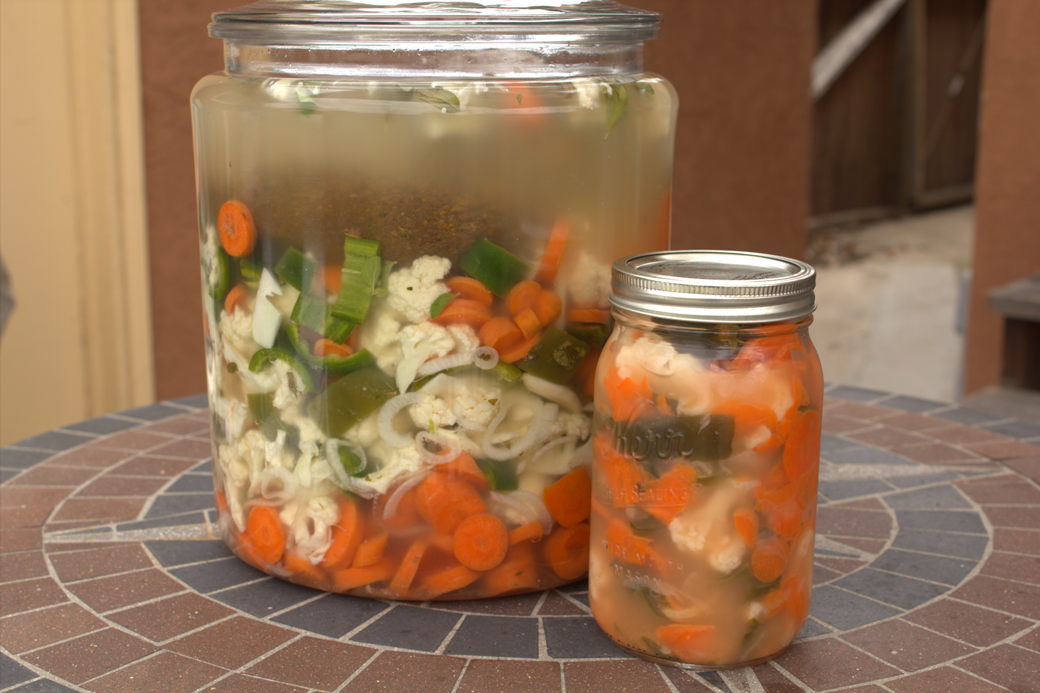
The closest thing I have to a "perpetual" pickle crock is a 5L glass "crock" for making escabeche (aka taco bar veggies).

I've let batches ferment at least 70 days, and they're very stable, flavor-wise. So that's more or less perpetual.

Of course, occasional maintenance is helpful when you're going that long on a ferment.


IMG_3994.png
large glass "crock" fermenting escabeche
File_001-(4).jpeg
5 L "crock" of escabeche
 
Christopher Weeks
master gardener
Posts: 6175
Location: Carlton County, Minnesota, USA: 3b; Dfb; sandy loam; in the woods
3641
8
forest garden trees books chicken food preservation cooking fiber arts seed woodworking homestead ungarbage
  • Likes 5
  • Mark post as helpful
  • send pies
    Number of slices to send:
    Optional 'thank-you' note:
  • Quote
  • Report post to moderator

Austin Durant wrote:The closest thing I have to a "perpetual" pickle crock is a 5L glass "crock" for making escabeche (aka taco bar veggies).


With that crock, do you continually draw veggies out and add more, letting them ferment a day or ten before eating the next ones, rather than just making full batches one after the next? I think that’s what the perpetual refers to. (I don’t see any reason you couldn’t be doing that, but I didn’t see that in the link.
 
pollinator
Posts: 149
Location: Southern Gulf islands, BC, Canada
62
  • Likes 7
  • Mark post as helpful
  • send pies
    Number of slices to send:
    Optional 'thank-you' note:
  • Quote
  • Report post to moderator
Not perpetual per se, but I do re-use my brine. For example, my garlic scapes brine, when used again adds delicious garlic flavour to the next batch.
 
Christopher Weeks
master gardener
Posts: 6175
Location: Carlton County, Minnesota, USA: 3b; Dfb; sandy loam; in the woods
3641
8
forest garden trees books chicken food preservation cooking fiber arts seed woodworking homestead ungarbage
  • Likes 5
  • Mark post as helpful
  • send pies
    Number of slices to send:
    Optional 'thank-you' note:
  • Quote
  • Report post to moderator
I want to cross-link in a post from another thread about Korean perpetual pickles based on sunchokes (pig potatoes!).
 
master gardener
Posts: 2152
Location: Zone 5
1184
ancestral skills forest garden foraging composting toilet fiber arts bike medical herbs seed writing ungarbage
  • Likes 6
  • Mark post as helpful
  • send pies
    Number of slices to send:
    Optional 'thank-you' note:
  • Quote
  • Report post to moderator
A bit over a week ago I started a perpetual pickle jar. Mostly I’ve been using it to make gundruk (Nepalese pickled dried greens, used for soup base or rehydrated as pickles) but last night put some turnip slices in. It ferments everything very quickly and so I tend to take things out after two or three days. I started it by adding miso and sauerkraut liquid, and have fed it vegetables and a little salt. The liquid has taken on a pigmented, greenish-reddish, thick appearance (the color comes mostly from chard). I’m glad that the fermentation is so quick because I use fermentation more for preparation than preservation. (Preservation has often had mixed results…) It’s good to have this low fuel way to prepare vegetables in a delicious way.

Edit: Originally I said the turnips were done today…that was an overstatement!
 
gardener
Posts: 1068
Location: SW Missouri • zone 6 • ~1400' elevation
493
2
fish trees chicken sheep seed woodworking
  • Likes 6
  • Mark post as helpful
  • send pies
    Number of slices to send:
    Optional 'thank-you' note:
  • Quote
  • Report post to moderator
I've done very little lactofermentation, but I'm hoping to start a perpetual jar for the sake of my gut health. I was planning to cut up some onions and carrots, put them in the jar first, cover with water, weigh, subtract the weight of the jar, and add salt equal to 2% of the weight. I was going to put in two cans of sauerkraut and a jar of kimchi  to bring some heat and flavor and to boost fermentation.

Of course I have some questions:
1) How is the plan so far? I can adjust for flavor down the line, but is this going to be safe and effective?
2) I know temperature affects speed. I even read that it's wise to add a little extra salt if it's hot. Should my jar be on the counter or in the fridge? If it's on the counter, how do I know when to put it in the fridge?
3) If it's on the counter, I plan to find and use my airlock. I don't trust my self discipline to loosen the lid and let it off-gas as frequently as I should. Since refrigerator fermentation is going to be a lot slower, should I use the airlock if it's in there, or will just opening it every day or two be enough?
4) The carrots and onions are what I have on hand right now that I think would be good for this. What would be good future additions? I know I'll have asparagus and garlic later. Sunchokes are probably available right now, if I cared to look for them. Waiting for them to grow out will make them easier to find. There may be cucumbers and or green beans later. What else do you folks recommend?
5) Is there any rule of thumb for knowing when each veggie is ready to eat, or is it just constant tasting and experimentation?
6) Searching online, I can ask a question and get any number of conflicting answers. I'd love to hear what resources you trust. I'm more likely to use websites, downloadable PDFs from colleges, free e-books, etc. But a hard copy book (though it's a fall-back position to me) could be helpful to someone reading this later, so let's hear about those too.
 
Christopher Weeks
master gardener
Posts: 6175
Location: Carlton County, Minnesota, USA: 3b; Dfb; sandy loam; in the woods
3641
8
forest garden trees books chicken food preservation cooking fiber arts seed woodworking homestead ungarbage
  • Likes 9
  • Mark post as helpful
  • send pies
    Number of slices to send:
    Optional 'thank-you' note:
  • Quote
  • Report post to moderator

T Melville wrote:I'm hoping to start a perpetual jar for the sake of my gut health. I was planning to cut up some onions and carrots, put them in the jar first, cover with water, weigh, subtract the weight of the jar, and add salt equal to 2% of the weight. I was going to put in two cans of sauerkraut and a jar of kimchi  to bring some heat and flavor and to boost fermentation.


So the first thing: "cans" of kraut have been pasteurized and won't bring any useful microbiota. You might want to for the flavor (though I don't care for it the way I do live kraut), but there's not going to be any probiotic benefit. The next thing with this plan: in general ferments are either like dill pickles where relatively large chunks are in brine (large chunks are easier to manage and keep submerged) OR they're moving toward "solid state" like kimchi. I've never mixed the two the way you're proposing. It might be great, but it sounds messy.

1) How is the plan so far? I can adjust for flavor down the line, but is this going to be safe and effective?


I think that's going to be safe(ish). Maybe it's light on salt, but I don't even measure most of the time, so I dunno.

2) I know temperature affects speed. I even read that it's wise to add a little extra salt if it's hot. Should my jar be on the counter or in the fridge? If it's on the counter, how do I know when to put it in the fridge?


If it's high enough salt, and your produce doesn't get too mushy, leave it out. Otherwise, leave it out to ferment and then move fermented produce to the fridge to halt fermentation. You won't get much in the way of microbial advancement once you move it to the fridge. But, some places are too hot to pursue some fermentation traditions, so it might be a try it and see situation. How hot is your kitchen in the summer?

3) If it's on the counter, I plan to find and use my airlock. I don't trust my self discipline to loosen the lid and let it off-gas as frequently as I should. Since refrigerator fermentation is going to be a lot slower, should I use the airlock if it's in there, or will just opening it every day or two be enough?


I wouldn't. An airlock is for situations where you're going to leave it alone for a long time and keeping the top of it blanketed in CO2 is a valuable mold preventative. The point of a perpetual crock is to take things out and add new things all the time. I'd try using a straight-sided crock and find a jar that almost fills it but allows you to weight the produce down to keep them under the brine.
4) The carrots and onions are what I have on hand right now that I think would be good for this. What would be good future additions? I know I'll have asparagus and garlic later. Sunchokes are probably available right now, if I cared to look for them. Waiting for them to grow out will make them easier to find. There may be cucumbers and or green beans later. What else do you folks recommend?


The only thing I've ever fermented and been sad about were delicate leaves -- lettuce and spinach. All the things you listed are great. Potatoes are great fermented in brine for a couple weeks and then fried. Whatever herbs you like will flavor everything else. You can't have too much chiles, garlic, and ginger in there.

5) Is there any rule of thumb for knowing when each veggie is ready to eat, or is it just constant tasting and experimentation?


Experiment. My goal is fun new flavors, so there's no right or wrong. Your gut-health goals might steer you differently, but I think in general, you just want them to have enough time. Maybe five weeks when you're first starting the crock and a few days once it's mature.

6) Searching online, I can ask a question and get any number of conflicting answers. I'd love to hear what resources you trust. I'm more likely to use websites, downloadable PDFs from colleges, free e-books, etc. But a hard copy book (though it's a fall-back position to me) could be helpful to someone reading this later, so let's hear about those too.


My advice would be not to particularly trust anyone who is being dogmatic. You can find a lot of fermenters who assert all kind of *must do* operations that are completely reasonable approaches but they only say that because that's how they were taught. I'd put the books of Sandor Katz first, and Pascal Baudar above most others, though I have maybe three dozen fermentation books.
 
T Melville
gardener
Posts: 1068
Location: SW Missouri • zone 6 • ~1400' elevation
493
2
fish trees chicken sheep seed woodworking
  • Likes 7
  • Mark post as helpful
  • send pies
    Number of slices to send:
    Optional 'thank-you' note:
  • Quote
  • Report post to moderator

Christopher Weeks wrote:I wouldn't. An airlock is for situations where you're going to leave it alone for a long time and keeping the top of it blanketed in CO2 is a valuable mold preventative. The point of a perpetual crock is to take things out and add new things all the time. I'd try using a straight-sided crock and find a jar that almost fills it but allows you to weight the produce down to keep them under the brine.


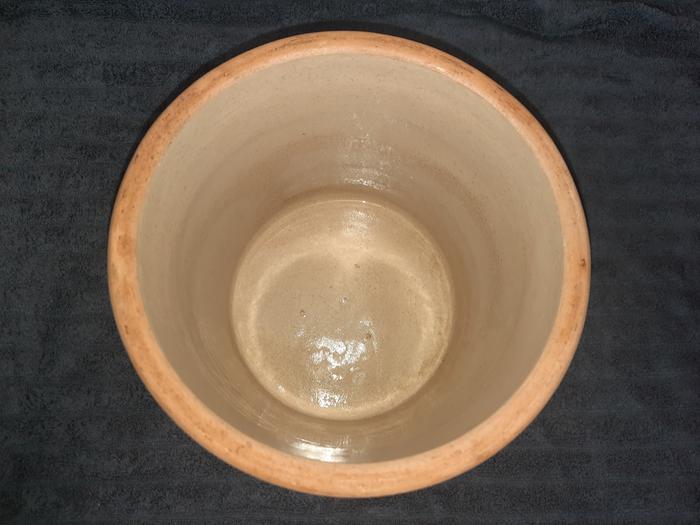
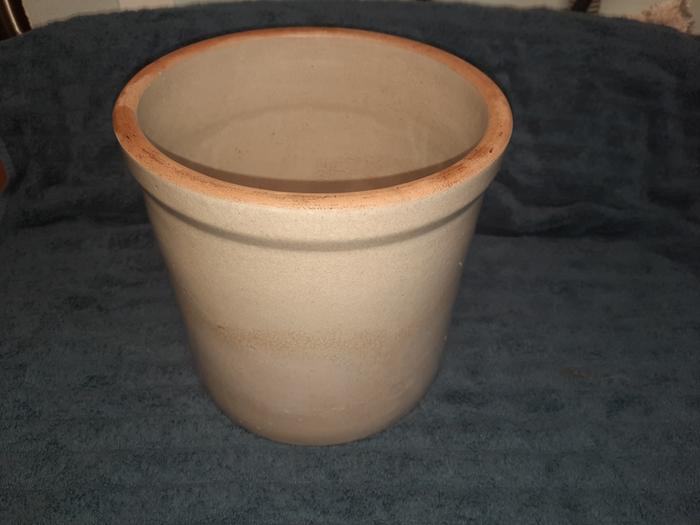
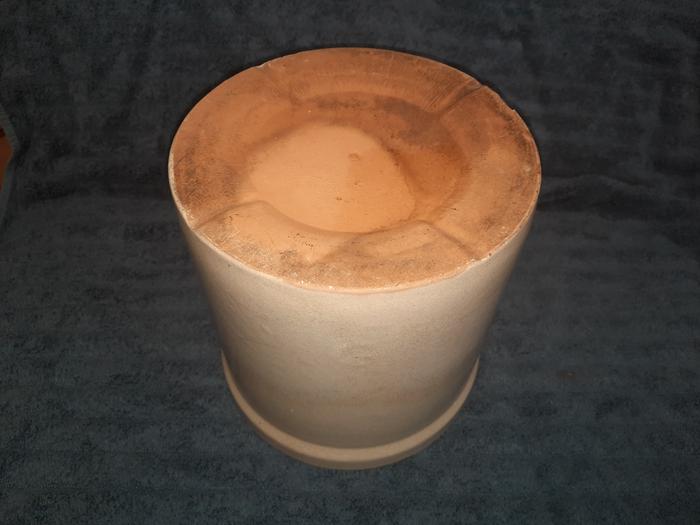
I saw this in the garage about 25(ish) years ago and kept it in mind. As I recall, I didn't know what it was for until I saw one in an antique shop. This is the crock you mentioned, right?

What a crock!
What a crock!


Bottoms up!
Bottoms up!


Guess I should look into it.


I washed it, but the garage is open. This hasn't been rained on, but it's been exposed to heat and cold, dust, and anything blowing in the wind. I don't want to use anything harsh on it. Would it be prudent to put it in a big pot and boil it, or bake it in the oven to sanitize it? It feels glazed, but I don't know how porous it is. If I put it in the oven, should I use a heat below boiling for a while to get out any water so it doesn't explode? Or put it in the dehydrator for a day or two?

Once the crock is ready, I'm getting the impression I just need all the food to be below the surface of the brine. Is that right? Is the jar you mentioned just used as a weight? (On Good Eats, I saw Alton Brown do something similar when he fermented pickles, but with a gallon ziploc bag of brine. He said you could use water, but if the bag leaked, it would dilute the brine and salinity would go down. With brine in the bag, if it leaks, you just have more brine.)
 
Christopher Weeks
master gardener
Posts: 6175
Location: Carlton County, Minnesota, USA: 3b; Dfb; sandy loam; in the woods
3641
8
forest garden trees books chicken food preservation cooking fiber arts seed woodworking homestead ungarbage
  • Likes 9
  • Mark post as helpful
  • send pies
    Number of slices to send:
    Optional 'thank-you' note:
  • Quote
  • Report post to moderator
That does look like a pickling crock -- hooray for free treasure! Do you know what the volume is? (The images don't have anything to provide a reference.)

I can't really fault you for being too careful, but I'd probably just scrub it in white vinegar and get going. Yeah, I think putting it in a very cool oven for a couple hours and then turning it up to 400 or whatever for another hour should sterilize it. I'd still scrub it out before or after.

A plastic bag can work and there are whole methods where a bag of water is used to keep all air out of a solid-state ferment, but for a brine ferment, I prefer a jar when I can find one that fits snugly. I have a crock that is perfectly fit by one-gallon pickle jars and a smaller crock that fits the smaller of our regular porcelain plates (so I can put a plate in the brine and a quart-jar of water atop that). If you use a bag, make sure that if it completely empties into your crock, it won't run over.
 
Tereza Okava
steward & manure connoisseur
Posts: 5017
Location: South of Capricorn
2994
dog rabbit urban cooking writing homestead ungarbage
  • Likes 12
  • Mark post as helpful
  • send pies
    Number of slices to send:
    Optional 'thank-you' note:
  • Quote
  • Report post to moderator
woot great find!!!
honestly i wouldn't go nuts with heroic measures to try to clean it. I would wash it with dish soap and let it dry. MAYBE if I were worried that mice have been peeing in it I might fill it with the same sanitizing mixture I'd use with my beermaking equipment after washing with soap, or maybe I'd just spray some peroxide on it. I would not try baking it, these crocks have an unfinished face, might have small cracks you can't see, who knows how old it is, it would be a shame if it broke.
My mother had several of these and I always wish desperately I could bring them home with me. They're such treasures!!
 
Carla Burke
Rusticator
Posts: 9669
Location: Missouri Ozarks
5306
7
personal care gear foraging hunting rabbit chicken cooking food preservation fiber arts medical herbs homestead
  • Likes 9
  • Mark post as helpful
  • send pies
    Number of slices to send:
    Optional 'thank-you' note:
  • Quote
  • Report post to moderator
Echoing Tereza. I wouldn't bake it. I'd probably scrub it with soap to clean it, then peroxide to sterilize it, then vinegar to make sure there's no residue of *anything* left behind.
 
T Melville
gardener
Posts: 1068
Location: SW Missouri • zone 6 • ~1400' elevation
493
2
fish trees chicken sheep seed woodworking
  • Likes 8
  • Mark post as helpful
  • send pies
    Number of slices to send:
    Optional 'thank-you' note:
  • Quote
  • Report post to moderator
I decided to combine your ideas read, then half remembered Carla Burke's post above. I sprayed it with peroxide, let it sit a while and rinsed with water. After it dried, I poured a little vinegar in the bottom, saturated paper towels in it, and draped the sides and rim. Later I'll rinse it out again and consider it ready.

Christopher Weeks wrote:Do you know what the volume is? (The images don't have anything to provide a reference.)
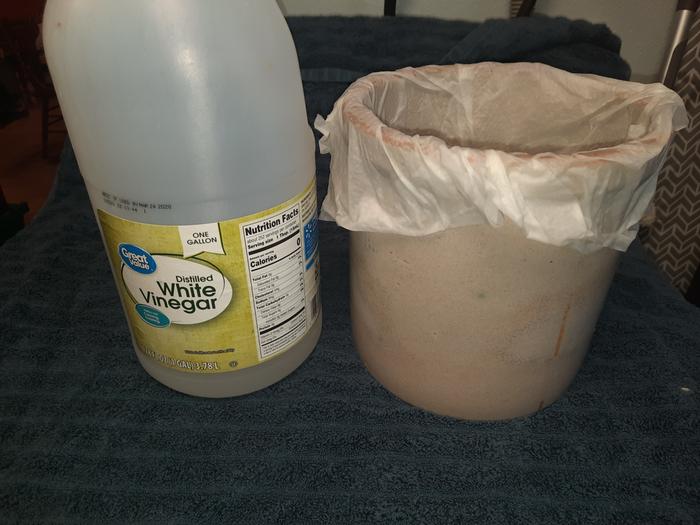
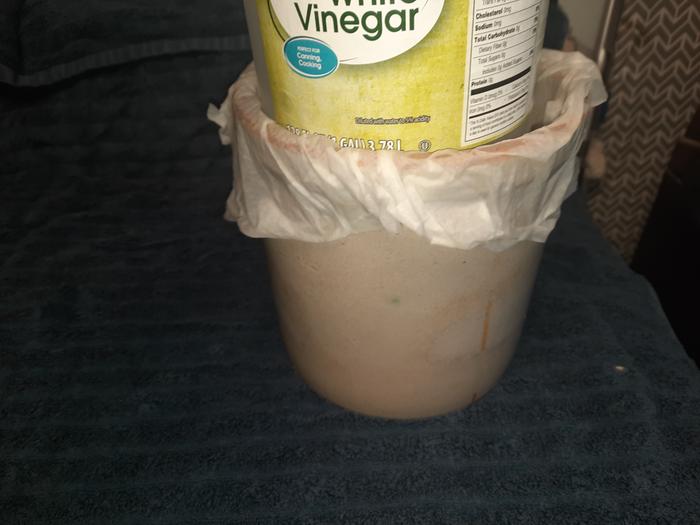

I also used the vinegar jug for scale. I'm guessing it's about a gallon to a gallon and a half.

Sanitizing with vinegar


Measuring - Vinegar Jug for Scale
 
T Melville
gardener
Posts: 1068
Location: SW Missouri • zone 6 • ~1400' elevation
493
2
fish trees chicken sheep seed woodworking
  • Likes 8
  • Mark post as helpful
  • send pies
    Number of slices to send:
    Optional 'thank-you' note:
  • Quote
  • Report post to moderator
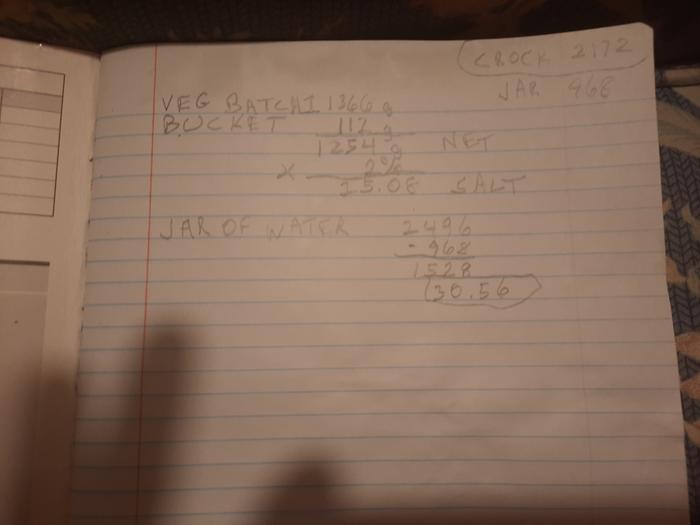
I sliced and weighed my veggies, did the math to figure out the salt (rounded up for safety), weighed out the salt.

Da Math!
Da Math!


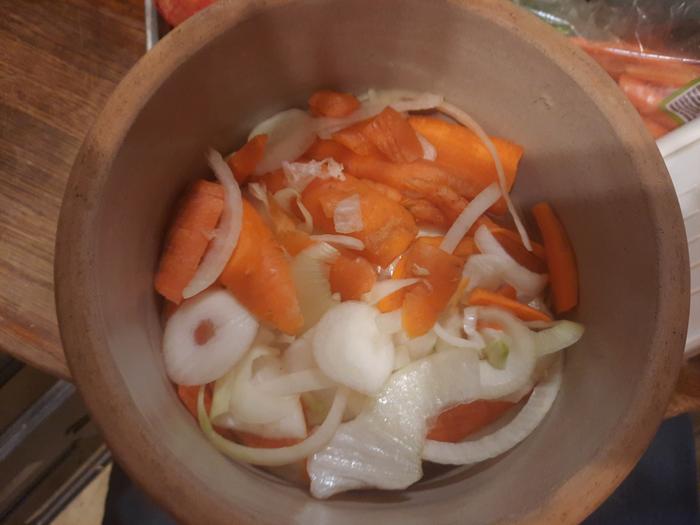
Then I placed a layer of veggies in the crock and sprinkled with some of the salt, repeated until all the veggies were in.

Sliced Carrots and Onions


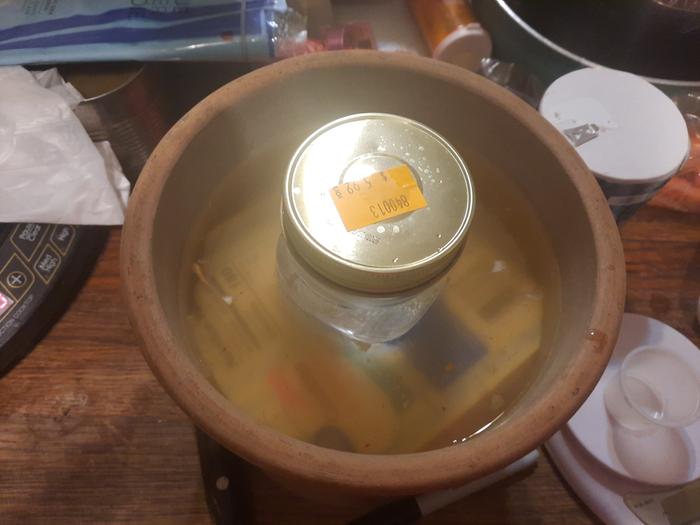
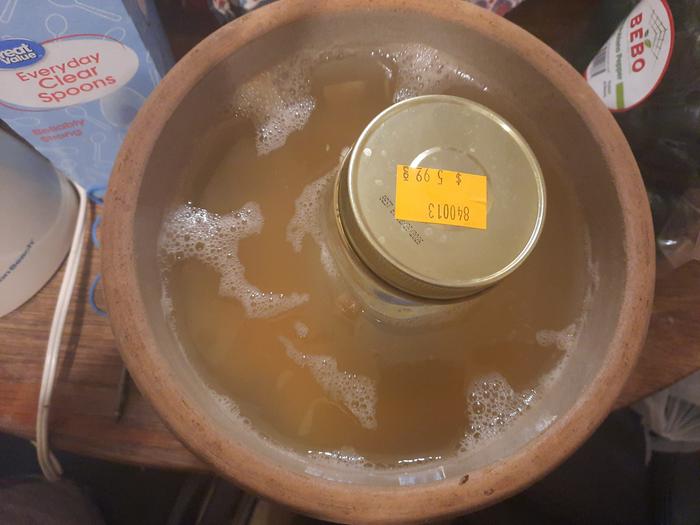
I no longer have the sauerkraut or kimchi, I got impatient and ate them. I did save the brine, that went in next. (Don't think it affected flavor, hopefully it boosts the ferment.) Then I filled a big jar with warm water and weighed it. I was going to use what I needed, weigh again and subtract to know what I used, then do the math and add additional salt for the water. It took all the water, so I added salt for all of it. Then I cut the lid of an ice cream bucket into a disk that just fit the crock. Weighed down the disk with the smallest canning jar I could find with hot water in it, leaving about an inch and a half of head space. Hopefully when the water cools and the air shrinks, it'll seal.

Plastic Submersion Disk and Jar Weight


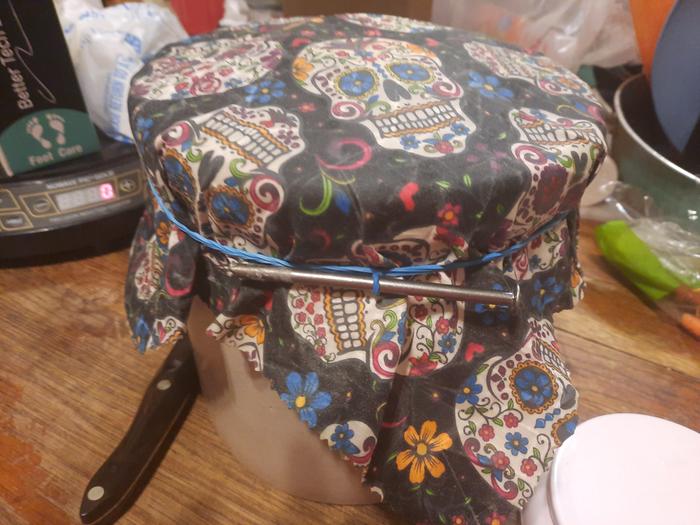
I don't want bugs or dust or cats to get in it, so I covered it with a wax wrap. Neither my hands nor the crock were especially warm, so the wrap hung pretty loose. I daisy chained some rubber bands and put them around, passing the last one through the first and putting a nail in it to hold it. I may hit it a little with a hair dryer so it conforms and I don't need to rubber band it. I don't think I've made it air tight, but I'm open to loosening or removing the wax wrap if folks think it's a bad idea.

Keeping out bugs, dust, and cats with a wax wrap


I think I'm gonna get and add some poblano or sweet banana peppers for a little mild heat. How often should I do things like inspect, clean, taste? The crock is in my kitchen, which is about 70° right now. (It varies. The air conditioning is broken in this part of the house, but we cool rooms on both sides and use fans to move cool air in here. The main heat is actually in this part.
 
T Melville
gardener
Posts: 1068
Location: SW Missouri • zone 6 • ~1400' elevation
493
2
fish trees chicken sheep seed woodworking
  • Likes 6
  • Mark post as helpful
  • send pies
    Number of slices to send:
    Optional 'thank-you' note:
  • Quote
  • Report post to moderator
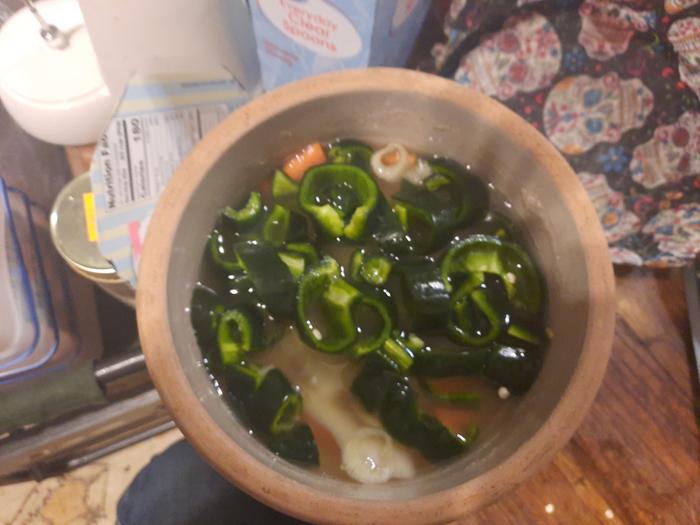
Two days in, opened up to check and to add two poblanos.

2 days in. Some bubbles, slight fermenty smell.


There were some bubbles and a slight fermenty smell. The carrots and onions are slightly softened and salty, and the onions no longer taste raw. Not much transformation yet, but it's still early. I sliced and added two poblanos.

Added 2 poblanos.
Added 2 poblanos.
 
Christopher Weeks
master gardener
Posts: 6175
Location: Carlton County, Minnesota, USA: 3b; Dfb; sandy loam; in the woods
3641
8
forest garden trees books chicken food preservation cooking fiber arts seed woodworking homestead ungarbage
  • Likes 3
  • Mark post as helpful
  • send pies
    Number of slices to send:
    Optional 'thank-you' note:
  • Quote
  • Report post to moderator

T Melville wrote:I covered it with a wax wrap...I don't think I've made it air tight, but I'm open to loosening or removing the wax wrap if folks think it's a bad idea.


It won't do any harm unless you're specifically counting on the introduction of airborne microbes. If you're going to be treating this like a perpetual pickle crock where you take some stuff out and add new stuff most every day, then it'll be getting microbial infusions from the produce you add. So I think it'll be fine.

T Melville wrote:How often should I do things like inspect, clean, taste? The crock is in my kitchen, which is about 70° right now.


With an open ferment, you can't do that kind of maintenance too much. Daily? Twice daily? Those would be fine. If you didn't want to do it except every three days, that's likely to work out if you're being careful about floaters or your plastic disc is actually sealing. If you want to go away for two weeks, put it in the fridge if you can. I think the good fermentation range is something like 60-75F. Cooler than that and it slows way down, which isn't a problem except for getting impatient. Warmer and you're likely to host microbes that don't do all the stuff you want and with their expanded metabolic pathways, you're likely to end up with mushy produce. But I'm mostly thinking about normal batch-style brine pickles and kraut(chi) type ferments. A perpetual pickle crock might work out fine at 80F because you only have to leave the produce in for a day or two once the brine is mature. Anyway I think your 70F is fine, but later in the summer if your cooling system doesn't keep up, it could be a thing to watch out for.
 
Tereza Okava
steward & manure connoisseur
Posts: 5017
Location: South of Capricorn
2994
dog rabbit urban cooking writing homestead ungarbage
  • Likes 5
  • Mark post as helpful
  • send pies
    Number of slices to send:
    Optional 'thank-you' note:
  • Quote
  • Report post to moderator

Christopher Weeks wrote:A perpetual pickle crock might work out fine at 80F because you only have to leave the produce in for a day or two once the brine is mature. Anyway I think your 70F is fine, but later in the summer if your cooling system doesn't keep up, it could be a thing to watch out for.


Here when it's above about 73F, I keep stuff in my Sichuan pickle perpetual gig overnight on the counter (11pm to 7AM) , then it has to go in the fridge. This for hard veg like chayote, carrots, and maybe cabbage-- anything else and it takes even less, and will quickly veer into mushy-and-squishy. Things like cucumber pickles, forgetaboutit, I don't even try to do them outside the winter because it's impossible. Even my sourdough bread, during summer it doesn't come out of the fridge.
If it's warm where you are, seek out a cool place in your house and keep a close eye out to avoid disaster.
 
I agree. Here's the link: http://stoves2.com
reply
    Bookmark Topic Watch Topic
  • New Topic