• Post Reply Bookmark Topic Watch Topic
  • New Topic
permaculture forums growies critters building homesteading energy monies kitchen purity ungarbage community wilderness fiber arts art permaculture artisans regional education skip experiences global resources cider press projects digital market permies.com pie forums private forums all forums
this forum made possible by our volunteer staff, including ...
master stewards:
  • paul wheaton
  • Anne Miller
  • Carla Burke
  • Nancy Reading
  • John F Dean
  • Timothy Norton
  • Jay Angler
stewards:
  • r ransom
  • Pearl Sutton
  • Tereza Okava
master gardeners:
  • Christopher Weeks
gardeners:
  • M Ljin
  • Megan Palmer
  • Kate Downham

Daily Sustenance from a Forest Garden?

 
Posts: 15
Location: Scotland, UK
10
cat forest garden books fiber arts bee composting
  • Likes 19
  • Mark post as helpful
  • send pies
    Number of slices to send:
    Optional 'thank-you' note:
  • Quote
  • Report post to moderator
I know I should probably post this in the cooking section, but I'm specifically seeking the views of temperate food foresters, so I hope this is okay.

I'm currently establishing a new (very small) forest garden, having previously started another and then had to move house. So I have some forest garden experience for the earlier and bleaker years/stages of food production.

What I am not, is a foodie, and this fact about myself disappoints me greatly. I find it really hard to pick five different fruits and berries in twos and threes, plus a fistful of novelty leaves, and work out how to turn that into a meal that my partner and I can enjoy after a hard day at work.

My new garden is now about 2 years old and I've reached the stage (again) of beginning to get small unpredictable harvests of fruit and the odd veg, but I'm struggling with how to weave this bounty into normal kitchen life.

Similarly, when I read or watch videos about established temperate forest gardens, I'm always struck by the huge quantity of apples, mostly, and wonder how they use them all or what else those people get to eat. Do they just quaff cider until they fall asleep? There seems little other than tubers with which to make up the satisfying bulk of a main meal, and there's only so much chutney anyone can handle, surely? What does it go with if not a meat eater? Plus, utilising unusual edible leaves etc. is great (I can really enjoy compiling a weird salad on a weekend), but how can these be incorporated into basic workday meals without being comparatively bitter or fibrous?

In short, can anyone point me to resources about how to actually EAT, in a real way, from a Forest Garden?

E.g. seasonal harvesting tips, simple versatile recipes for viable main meals etc. I bought Martin Crawford's book on this topic a few years ago, and much as I love my other book by him, I found this one disappointingly sparse on the daily work of eating ... It was mostly chutneys and cordials, once again. Nobody seems to tackle the art of combining annual veg, forest harvest, and maybe some shop produce for producing actual *dinner*.

Apologies if this already covered somewhere ... I keep searching for the holy grail of this issue intermittently, but never really seem to find what I'm looking for. A bit worried it's because it's maybe not a viable thing to do.

Thanks
 
out to pasture
Posts: 13450
Location: Portugal
4692
goat dog duck forest garden books wofati bee solar rocket stoves greening the desert
  • Likes 12
  • Mark post as helpful
  • send pies
    Number of slices to send:
    Optional 'thank-you' note:
  • Quote
  • Report post to moderator
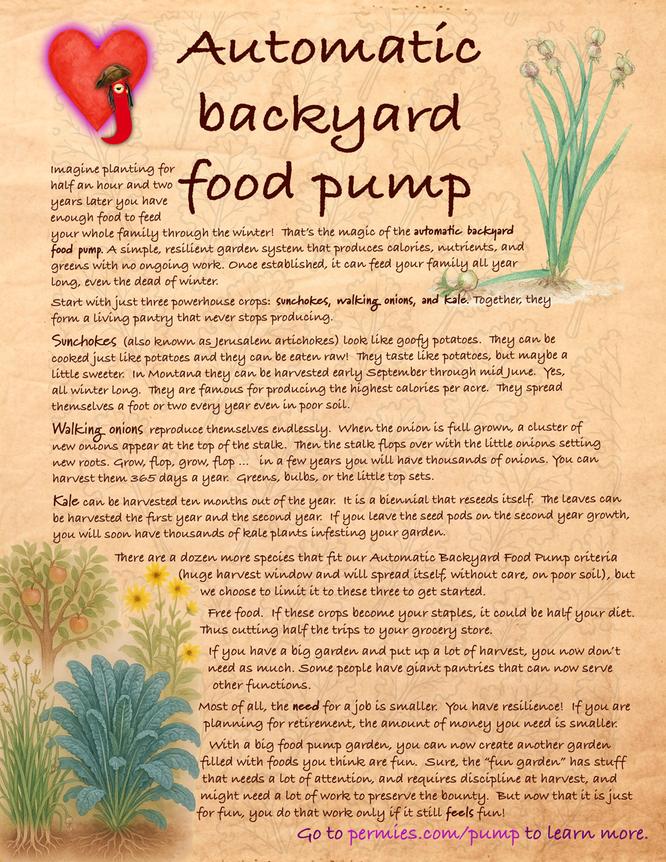
Maybe add some of the veggies used in the automatic backyard food pump. The three 'starter' plants are kale, walking onions and sunchokes.


There's a dedicated thread to the concept here, and a short video to show the idea in use.

 
Stina May
Posts: 15
Location: Scotland, UK
10
cat forest garden books fiber arts bee composting
  • Likes 6
  • Mark post as helpful
  • send pies
    Number of slices to send:
    Optional 'thank-you' note:
  • Quote
  • Report post to moderator
Thanks, that video was nice to see, and he made soup, which I guess is an often overlooked catch-all that I should get more into the habit of.

And you're right, I should focus on getting a set of staples together as a priority. Funny story: I have all those three already, but some local cows broke into my garden earlier this year and one of them bit the top off my baby walking onion just as it was about to flower, so I'll need to wait a whole extra year before that will proliferate as intended.

Meanwhile, my kale has been raising two of the most beautiful generations of cabbage whites you ever did see. That one's a me-fail with the netting. Busy year.

It still begs the question though ... I seek a diversity of plants in my FF, but don't know how to make good use of that diversity in my cooking without making some sort of jam or pickle out of everything. My partner gives me funny looks if I try to serve him raw Fuchsia berries with mash and gravy (not that I actually have, but he would).
 
steward and tree herder
Posts: 14625
Location: Isle of Skye, Scotland. Nearly 70 inches rain a year
8309
6
transportation dog forest garden foraging trees books food preservation woodworking wood heat rocket stoves ungarbage
  • Likes 13
  • Mark post as helpful
  • send pies
    Number of slices to send:
    Optional 'thank-you' note:
  • Quote
  • Report post to moderator
I feel your pain. The problem I have, even in a garden that is starting to produce is that because I'm not familiar with many perennial vegetables I'm not really sure what to do with them. The season is also quite short for some of them - the Japanese mountain vegetables grow quite well here, but just as I'm thinking 'ooh the Udo looks like it could be ready' and I look up a recipe, the Udo has grown up and away.
I still have several vegetables doing quite well that I need to harvest at the sweet spot and work out ways of using them. They all need to pass the 'husband test' too, or else they're only fit for sale or chutney (Which I eat loads of but he doesn't touch).
I do quite well with vegetables that produce steadily, like kale and small leaved lime. Or ones that stay in the ground till needed like jerusalem artichoke or Erythronium. Unfortunately tree crops don't do well here (I may get three apples this year..!) so a glut of those is to dream of. Soft fruit do well though, so playing to my strengths I can use raspberries instead of pomegranite fruit, and substitute in 'normal recipes'

Salad, soup, stew, stir fry.....
 
Burra Maluca
out to pasture
Posts: 13450
Location: Portugal
4692
goat dog duck forest garden books wofati bee solar rocket stoves greening the desert
  • Likes 10
  • Mark post as helpful
  • send pies
    Number of slices to send:
    Optional 'thank-you' note:
  • Quote
  • Report post to moderator
I'm not sure how much land you have - you said 'very small', which suggests to me that you won't have room to grow everything. Which means you'll likely still be buying basic essentials and using the forest garden to supplement. Which to be honest is pretty much what I do...

I buy in rice and beans. I often cook up a big batch of rice and lentils which is then pretty easy to pad out into a full meal with whatever I can pick from the garden.

I have a white mulberry tree, which I bought thinking it was a black mulberry but it turned out not to be. I does, however, grow  like a weed on speed. And the young leaves are very edible. And the more I cut it back, the more young leaves it keeps making for me. I seriously cannot keep up with the amount of greens it attempt to give me, and I grow perennial kale too which makes it even more difficult to eat my way through it all. I'm avowed to never have another goat but the amount of leaves that mulberry gives me I've been very tempted to go back on my word!

I'm experimenting with lovage this year, which is a bit like a hybrid between parsley and celery, only it grows six foot tall and lives for fifteen years. My plants are still babies so it will be another year before I can judge if it lives up to the hype, but so far I'm very impressed. I like something that gives that much from a plant that mostly just sits there looking pretty. Even the seeds are edible!

Most fruit can be turned into a crumble. And I mean, who doesn't love crumble? I like a lot of oats in mine and it makes a substantial addition to a meal. Again, a goat would help so I could add home-grown custard but I did promise Himself that I wouldn't...  I love chutney too, but it's not exactly a staple food. Or sometimes I make up a rice pudding and serve fresh or stewed fruit with that. A hay-box is really good for rice pudding, and for rice-and-lentils too.

 
gardener
Posts: 3073
Location: Zone 4b/5a
1827
ancestral skills forest garden foraging composting toilet fiber arts bike medical herbs seed writing ungarbage
  • Likes 8
  • Mark post as helpful
  • send pies
    Number of slices to send:
    Optional 'thank-you' note:
  • Quote
  • Report post to moderator
Nancy, if that udo is anything like American Spikenard—one of my favorite vegetables!—I would peel the shoots and eat them as is, or add the young leaves and shoots to a green soup.
 
pollinator
Posts: 102
Location: Haarlem, The Netherlands
80
forest garden fungi trees urban writing ungarbage
  • Likes 15
  • Mark post as helpful
  • send pies
    Number of slices to send:
    Optional 'thank-you' note:
  • Quote
  • Report post to moderator
Hi Stina,
I hear you! After all these years I still struggle with eating "new" foods.
I do love what Burra says: Start small, accept your limitations. Learn one thing at a time.

What works for me:
The national dish of the Netherlands is "stamppot". It is basically mashed potatoes with vegetables in it. There are some varieties. The three most famous are: with carrots and onions, with kale and last but not least with sauerkraut. Normally one adds  something sour on the side, like pickles, or in case of sauerkraut, something sweet. This is always a great base. I can replace any part with something else for variation. I think Burra's sunchokes and kale will mash well together and with pickled walking onions on the side would be close to the original dish! This way I can introduce something new (sunchokes) into something old. Everybody (in the netherlands) recognises this dish and would give it a try. That way they will be introduced to sunchokes. Now I can replace every part of that dish with something else as a whole or partially. For example the pickled onions with apple sauce, and the kale with any leafy green that needs cooking. Just one step at a time. In only three meals, the dish has changed completely. You don't need to be a foody to do this (I am not).

Soup and stirr-fry are another way to add new flavors and textures by the way, and Kale makes great sauerkraut.

Once flavors are familiar, I can prepair them in a different way: like diced sunchokes in a stirr-fry for example. Before I know it, eating sunchokes is normal in my family.

Occasionally, if I have a lot of one vegetable, I try a more unusual recepy for variation, for example Burra's kale: use large leavea as a wrap or find a recipe for delicious kale pie. And once you can cook kale in a different way for every day of the week, replace the kale in the recipy with another leafy green.

One last thing: don't eat only your dinner from the garden. Fruit is easy to include in breakfast, lunch and snacking.

Good luck Stina, and let us know how it works out for you! Happy tasting!
 
Posts: 5
Location: SE England
3
forest garden cooking fiber arts
  • Likes 13
  • Mark post as helpful
  • send pies
    Number of slices to send:
    Optional 'thank-you' note:
  • Quote
  • Report post to moderator
Hello! Another new person here. I would completely agree with using it to supplement what you buy in, and also, as Nancy said, play to your strengths and the strengths of the land you have.

I have a good-sized garden, but am also a renter, so can’t plant much stuff actually in the ground. This means there are a lot of containers, but the yields are somewhat limited. I also have an allotment, but I work almost full time so I can’t spend every day tending to it. I have to take FF elements and slot them in where I can, adapting to my needs and the situation.

The hot weather in SE UK stymied a lot of things this year, too. Good job I still have fruit in the freezer from last year!

You’re right, a lot of jam is involved… Also, I really enjoyed the expression “novelty leaves”!
 
M Ljin
gardener
Posts: 3073
Location: Zone 4b/5a
1827
ancestral skills forest garden foraging composting toilet fiber arts bike medical herbs seed writing ungarbage
  • Likes 12
  • Mark post as helpful
  • send pies
    Number of slices to send:
    Optional 'thank-you' note:
  • Quote
  • Report post to moderator
I’ve subsisted for days at a time on stewed applesauce and enjoyed every bit of it!

One thing you could do is to start planting some nut trees. Oak trees are a lovely source of food, if you have a few minutes in the morning and evening every day for a week to boil a batch. They definitely take a while to cook (leach) but when they are done they are nutritious and healthy.

For more of a quick answer, I recommend seeing if you can carve out a little potato patch. I’ve mostly planted potatoes this year, and some squash. With the whole rest of the place being a source of fertility, or especially if you start humanure composting, an annual vegetable garden (hopefully with some polyculture!) can be an integral part of the system. To be honest I haven’t seen much in terms of root vegetables growing in the forest, at least practical ones, except for ramps (similar to your bear garlic or ramsons). So you may want to plant one or both…

Or perhaps chickens would work? Eggs are an easy, filling, tasty meal.

In my climate (and so I hear, many others) parsnips are very wild, so they could be a good option. They like to be dug year after year, like sunchokes. There is also talk of skirret being very delicious, but I haven’t gotten ahold of plants or seeds yet. I do however know of a patch of native water parsnip, their close relative…

One thing I do is make green soup—boil together a few different kinds of greens for ten to twenty minutes, add salt or miso and include some beans or acorns or potatoes, something starchy. It is delicious.
 
Stina May
Posts: 15
Location: Scotland, UK
10
cat forest garden books fiber arts bee composting
  • Likes 12
  • Mark post as helpful
  • send pies
    Number of slices to send:
    Optional 'thank-you' note:
  • Quote
  • Report post to moderator

Nancy Reading wrote:The problem I have, even in a garden that is starting to produce is that because I'm not familiar with many perennial vegetables I'm not really sure what to do with them. The season is also quite short for some of them - the Japanese mountain vegetables grow quite well here, but just as I'm thinking 'ooh the Udo looks like it could be ready' and I look up a recipe, the Udo has grown up and away.


Exactly this! So reassured that I'm not alone. I already have a diversity of plants in various stages of establishment - the gardening aspect is comparatively easy for me - but the frequency with which I miss a key moment to try something new is, well, more routine than not.  But also, If I'm to include unusual plant foods in my daily diet, then I need easy ways to incorporate them into standard meals. Then it's much easier to do the quick bit of research about harvest time, parts and prep without the added faff of "now I need to start candying stems" or whatever, when what we actually need is a hot dinner after a long day infront of a computer screen.

Burra Maluca wrote:I'm not sure how much land you have - you said 'very small', which suggests to me that you won't have room to grow everything. Which means you'll likely still be buying basic essentials and using the forest garden to supplement. Which to be honest is pretty much what I do...


Yes, absolutely doing this. We have 0.2 acres *including* the cottage we live in, so space is very tight, and also very awkwardly shaped/situated in places though I do benefit from a range of interesting aspects. I famously overplant everything though, so I already have hundreds of species dotted around, but that means tiny quantities of each thing. I'm trying to change my ways on this, but it's hard. I love plants!

Burra Maluca wrote:I'm experimenting with lovage this year, which is a bit like a hybrid between parsley and celery, only it grows six foot tall and lives for fifteen years. My plants are still babies so it will be another year before I can judge if it lives up to the hype, but so far I'm very impressed. I like something that gives that much from a plant that mostly just sits there looking pretty. Even the seeds are edible!


This is a good example. I assume you mean Levisticum officinale? Although I've never seen one reach six foot in the UK. I adore the smell of lovage (to me, and almost no-one else, it smells like cardamom), but I've never successfully eaten it as a standard vegetable. I've only used it for flavouring. Which parts do you use? When? How? ...I find the leaves become tough quite early in the season so, though I've wanted to use it more, it never seemed all that amenable to it.

M Ljin wrote:if that udo is anything like American Spikenard—one of my favorite vegetables!—I would peel the shoots and eat them as is


*heads off to garden to try nibbling the tiny, long-suffering and already rabbit-chewed Udo baby* ...Omg, that's so palatable even at this time of year (UK autumn). Fibrous, but eatable fibrousness - doesn't get stuck in the teeth!. And a lovely fresh flavour. Maybe I need another one of these🤔

To respond to your other post - not enough space for most of it sadly. I'd love to have ducks one day, but it's dependent on convincing our neighbours to sell us their field AND finding willing duck carers for when we go away. I do have potatoes and annual veg, but all on a very small scale. I also do have a Skirret! It's still in its first year, but I nabbed a little rootlet the other week and it was very tasty. Can't wait for that to settle in and be ready for a proper harvest. Green soup sounds good! Cooking with acorns would definitely be a new one for me.

Nynke Muller wrote:The national dish of the Netherlands is "stamppot". It is basically mashed potatoes with vegetables in it. There are some varieties.


Thank you Nynke - this is a perfect suggestion to add to my repertoire and exactly the sort of super simple but versatile idea I was hoping for (and shows you how unimaginative I am on the cooking front). We have similar traditional things in the UK, but I never thought of it because I'm a bit divorced from the native food culture. But mashed potato would actually work as a base for many of the things I struggle with. E.g. a small handful of aromatic leaves from various plants, plus a few milder brassica leaves, say, would mean a different flavour combo with every mouthful, and less risk of the fibrousness overpowering the meal. Potentially similar with some of the more savoury berries too. I will need to stock up on normal potatoes (I only grew fancy ones) and eat mash more often - what could be nicer as autumn draws in?!
 
master steward
Posts: 16328
Location: Pacific Wet Coast
10829
duck books chicken cooking food preservation ungarbage
  • Likes 12
  • Mark post as helpful
  • send pies
    Number of slices to send:
    Optional 'thank-you' note:
  • Quote
  • Report post to moderator
Stina wrote:

I famously overplant everything though, so I already have hundreds of species dotted around, but that means tiny quantities of each thing. I'm trying to change my ways on this, but it's hard. I love plants!


I recall Toby Hemenway (Gaia's Garden author) saying something like - most small gardens will focus on a handful of basic, reliable crops. Your love of plants may be making your job of eating from your land, much harder.

I am currently reading Patrick Whitefield's, How to make a Forest Garden. He's further south than you, but the book would be well worth reading. His Chapter 9 is all about what he calls "the vegetable layer" and he's referring to the ground level understory plants. He spends a whole column on "Good King Henry" Chenopodium bonus-henricus, and recommends a large patch of it. He spends another column on varieties of Chard and its relatives in the Beta vulgaris family. Again, mentioning that you need to plant enough of it, for continuing harvesting. He then moves on to the cabbage family - one of the longer lived members has been mentioned by Burra Maluca and possibly Nancy too. The point is - he's recommending heavy reliance on the ground level, understory plants for everyday eating. I'm not sure that is stressed enough when people wax poetic about 'food forests' which most people equate with "trees and shrubs".

This spring, my friend took 4 large planters and put a sprouting potato in each. I only had space for 1. Mine produced enough for 2 meals in the summer, which I picked from the edges of the pot without disturbing the plant too badly. This fall, I thoroughly searched through and got enough for another 4 meals. This is from a potato I couldn't eat in the first place... and it didn't take up much space. Being in a pot, I didn't have to worry about disturbing the roots of a tree or other plants. It did require that I stay on top of watering it.

Hopefully this helps a bit.
 
Stina May
Posts: 15
Location: Scotland, UK
10
cat forest garden books fiber arts bee composting
  • Likes 13
  • Mark post as helpful
  • send pies
    Number of slices to send:
    Optional 'thank-you' note:
  • Quote
  • Report post to moderator
You're absolutely right that I'm making the job harder for myself with the diversity of plants I grow, but I view this a little differently: If I grew only 3 veg types, the task would be comparatively easy (and maybe a bit boring?), but we know that we currently utilise less than 6% of edible vascular plant species as actual foods, yet global food security is low. Consequently a key interest of mine is in discovering all those hidden and underutilised species. Some may legitimately be regarded as famine foods and not really be worth the time unless pushed, but many are amazing and just forgotten, like the Skirret mentioned earlier. Most, for me, are in fact herbaceous perennials as I have very little room for nearly the number of trees or shrubs that I would like, but the downside of that is an abundance of flat (and sometimes fibrous) leaves and very little "bulk".

I suppose what I'm saying is that I'm less seeking 50 different ways I can reliably eat potato on an evening, and more seeking 1  (or more) ways I can reliably prepare 50 different plants in varying combos and quantities.... or something like that.

Namely, a handful of tried and true recipes that can be used to make actual meals from a diversity of bits and bobs found in the garden. Soups, stews and stir fries are obvious choices, and then I really like the mash suggestion above too as it would work better for things that aren't so good as soup (leaves again).

After that I find I lack the traditional kitchen skills needed to deal imaginatively with unpredictable harvests. I feel like purees and pates should be an option, but I'm not sure of the dos and donts of that unless I have a singular and highly prescriptive recipe for a specific plant.

I'd love a recipe that went more like "grab two mixed bunches of mild flavoured leaves, a fistful of aromatic ones, and an apple. Stick them in a blender with x ml water and y cloves garlic. Blend. Hey Presto: gourmet mixed leaf puree that goes with anything". That kind of recipe? Is it a thing? I feel like this is almost how many people cook naturally, but not me 😔.
 
Burra Maluca
out to pasture
Posts: 13450
Location: Portugal
4692
goat dog duck forest garden books wofati bee solar rocket stoves greening the desert
  • Likes 6
  • Mark post as helpful
  • send pies
    Number of slices to send:
    Optional 'thank-you' note:
  • Quote
  • Report post to moderator
I wonder if a book like The Permaculture Kitchen would help?
 
Nancy Reading
steward and tree herder
Posts: 14625
Location: Isle of Skye, Scotland. Nearly 70 inches rain a year
8309
6
transportation dog forest garden foraging trees books food preservation woodworking wood heat rocket stoves ungarbage
  • Likes 12
  • Mark post as helpful
  • send pies
    Number of slices to send:
    Optional 'thank-you' note:
  • Quote
  • Report post to moderator

Stina May wrote:You're absolutely right that I'm making the job harder for myself with the diversity of plants I grow, but I view this a little differently: If I grew only 3 veg types, the task would be comparatively easy (and maybe a bit boring?), but we know that we currently utilise less than 6% of edible vascular plant species as actual foods, yet global food security is low. Consequently a key interest of mine is in discovering all those hidden and underutilised species. Some may legitimately be regarded as famine foods and not really be worth the time unless pushed, but many are amazing and just forgotten,


Are you my twin?! I also find that once established, the perennial veg are great for just carrying on growing - if I miss the harvest this year, I can try again next year.

Stina May wrote:I'd love a recipe that went more like "grab two mixed bunches of mild flavoured leaves, a fistful of aromatic ones, and an apple. Stick them in a blender with x ml water and y cloves garlic. Blend. Hey Presto: gourmet mixed leaf puree that goes with anything". That kind of recipe? Is it a thing?


Sounds very like the original pesto and indeed would work well (although maybe with oil rather than water?).

Another thing that might be worth a try is quiche. blind bake a pastry case, stir fry some veg, put in case and add milky egg, grate some cheese on top bake 35 mins and hey presto dinners ready (and looks conventional enough to serve to your Dad)! I did something like this with some of my skirret and it worked really well. But I suspect many greens could be cooked this way too.
 
master steward
Posts: 19740
Location: USDA Zone 8a
4954
dog hunting food preservation cooking bee greening the desert
  • Likes 2
  • Mark post as helpful
  • send pies
    Number of slices to send:
    Optional 'thank-you' note:
  • Quote
  • Report post to moderator
The problem I have with a food forest or a forest garden is that most vegetables are perennial.

I love the idea of perennial vegetables though I have never eaten them.

I am scared that I will not like the taste of them and for sure dear hubby would never consider tasting them.  Very picky eater, he is worse than a child.

So I always recommend folks plant what they like to eat and eat what they plant5.

One year I planted egg plant because it is a meat substitute and I had eaten it as a child.  I could not find a way to cook it that I liked.

I love summer squash though hubby complains that he hates the smell of it cooking so I quit planting it.

If you are having problems with cooking skills I would recommend "The Joy  of Cooking"  by Irma Rombauer and Nourishing Traditions by Sally Fallon.

Of interest:

https://permies.com/t/86750/learn-cook

https://permies.com/wiki/2711/Nourishing-Traditions-Sally-Fallon
 
Clairey Allen
Posts: 5
Location: SE England
3
forest garden cooking fiber arts
  • Likes 4
  • Mark post as helpful
  • send pies
    Number of slices to send:
    Optional 'thank-you' note:
  • Quote
  • Report post to moderator

Anne Miller wrote:So I always recommend folks plant what they like to eat and eat what they plant.


Absolutely this!
 
pollinator
Posts: 1717
Location: Milwaukie Oregon, USA zone 8b
218
  • Likes 14
  • Mark post as helpful
  • send pies
    Number of slices to send:
    Optional 'thank-you' note:
  • Quote
  • Report post to moderator

A trick I learnt from M, if plants are too bitter for you and partner to have in salads, consider cooking them, whether in sauteys, stir fries or soups depending on the plant.  Great example is dandylion leaves, my husband hates them in salads, but he tollerates them sauteyed with other veg.  So this is what we do with bitter things generally, except for that bitter wild lettuce, haven't figured out how to make that one palletable for us yet.
 
Stina May
Posts: 15
Location: Scotland, UK
10
cat forest garden books fiber arts bee composting
  • Likes 13
  • Mark post as helpful
  • send pies
    Number of slices to send:
    Optional 'thank-you' note:
  • Quote
  • Report post to moderator

Burra Maluca wrote:I wonder if a book like The Permaculture Kitchen would help?


Thanks SO much Burra - I have found and ordered this book. I'm not sure how I haven't come across it before when I've searched so many times, but I very much look forward to it arriving. I read your review, and the earlier sections sound far too basic even for me (I can cook very well with a recipe, just lack organisation/imagination to "invent") , but you describe EXACTLY the approach I've been looking for. Something that builds up a repertoire to be able to dabble with what's available. I'm feeling hopeful.

Nancy Reading wrote:Are you my twin?! I also find that once established, the perennial veg are great for just carrying on growing - if I miss the harvest this year, I can try again next year.


Oh gosh! Is it a Scotland thing d'you think? The season's so short we see it coming, blink out of excitement, and miss it?
I spend half my life trying to find ways to extend the edible season of plants I already like. But, like you, I also LOVE seeing my carefully grown annual veg flowering so beautifully. The Celtuce and Artichokes put on stunning shows for the bees this year.

Nancy Reading wrote:Sounds very like the original pesto and indeed would work well (although maybe with oil rather than water?).
[...]
Another thing that might be worth a try is quiche.


Haha, yeah, probably oil would be better there. I made a moderately pleasant "pistachio and shrubbery" pesto this spring. Was quite edible for the most part, but still not a perfect vehicle for consuming Hawthorn leaves. Research is ongoing. As for quiche - it's true. I have friends who bake anything into a delicious quiche and I'm envious. For me, I have one recipe-based one that I adore and make well, but then if I go rogue with the garden stuff it all falls apart one way or another. Must try harder.

Anne Miller wrote:I love the idea of perennial vegetables though I have never eaten them. I am scared that I will not like the taste of them and for sure dear hubby would never consider tasting them.  
[...]
Of interest:
https://permies.com/t/86750/learn-cook
https://permies.com/wiki/2711/Nourishing-Traditions-Sally-Fallon


Don't fear a vegetable just because it's perennial! Asparagus is perennial and still well known and loved. My revelation in the last couple of years has been Hostas. The young shoots of those can be steamed or sauteed in butter and eaten just like asparagus. They're not at all bitter and have a beatiful taste (at least mine do) somewhere between asparagus and artichoke, but with a hint of banana occasionally. If you need super palatable stuff, then I think that would be a good place to start. The season's short though - I keep missing most of it despite waiting for it excitedly.

Thank you for linking those threads. I've checked the first so far and it does look interesting. Will read through both.
 
M Ljin
gardener
Posts: 3073
Location: Zone 4b/5a
1827
ancestral skills forest garden foraging composting toilet fiber arts bike medical herbs seed writing ungarbage
  • Likes 7
  • Mark post as helpful
  • send pies
    Number of slices to send:
    Optional 'thank-you' note:
  • Quote
  • Report post to moderator
I find that a huge part of eating perennial vegetables is being picky enough to only eat the smaller, younger, shinier leaves that are sufficiently tender. I’ve been finally eating dandelion greens almost every day because of this, and it helps with comfrey too (though only from certain plants—others have bitterer leaves). Some you can get away with older leaves, like mallow, but those are an annual, at least my sort. Pick them at the wrong stage and suddenly you lose your appetite!
 
Nancy Reading
steward and tree herder
Posts: 14625
Location: Isle of Skye, Scotland. Nearly 70 inches rain a year
8309
6
transportation dog forest garden foraging trees books food preservation woodworking wood heat rocket stoves ungarbage
  • Likes 7
  • Mark post as helpful
  • send pies
    Number of slices to send:
    Optional 'thank-you' note:
  • Quote
  • Report post to moderator

M Ljin wrote:I find that a huge part of eating perennial vegetables is being picky enough to only eat the smaller, younger, shinier leaves that are sufficiently tender.


That's certainly the case I've found with small leaved lime - pick when still shiny and young and they make a perfectly nice bland salad leaf. It may be that cooked the older leaves would be fine too though. I never get on with beech leaves which some people seem to really like. I just find them tough and rather bitter even when really young. it may be down to variation or growing conditions?
 
Stina May
Posts: 15
Location: Scotland, UK
10
cat forest garden books fiber arts bee composting
  • Likes 7
  • Mark post as helpful
  • send pies
    Number of slices to send:
    Optional 'thank-you' note:
  • Quote
  • Report post to moderator

M Ljin wrote:I find that a huge part of eating perennial vegetables is being picky enough to only eat the smaller, younger, shinier leaves that are sufficiently tender.


And how does it work for you after that?
Do you find that if you keep picking frequently enough, most things continue to produce tender edible leaves, or do you find you hit a hard stop on perennial vegetables somewhere between mid-spring and summer?

If it's the latter, then what do you eat instead? Do you switch to annual vegetables?

I kept up with the ground elder better than ever before this year, thanks to it being a much more major "resource" in my new place than anywhere else I've lived, but then I had one full-on week at work, missed cutting them, and the next time I looked they were all dark green, spotty and adulty, so that was the end of that.
 
M Ljin
gardener
Posts: 3073
Location: Zone 4b/5a
1827
ancestral skills forest garden foraging composting toilet fiber arts bike medical herbs seed writing ungarbage
  • Likes 8
  • Mark post as helpful
  • send pies
    Number of slices to send:
    Optional 'thank-you' note:
  • Quote
  • Report post to moderator
Ground elder! I mean, I could keep eating them up through June. But do I want to—absolutely not, unless they’re from the right patch

Another element of it is picking them in the right habitat. I find ground elder in shade and good soil palatable—in sunnier, poorer areas, not at all or only as a small nibble. They may be abundant but I don’t like them in the sorts of quantities they grow.

Dandelions, comfrey, mallow have been consistent greens through the whole summer, so too with curly dock. I think that when the soil fertility is good, they do keep growing and making good leaves the whole summer long. But neither do I spurn annual greens—squash makes lovely greens, so does kale. Seasonality is part of it. I don’t eat every green in every season. Garlic mustard and dame’s rocket also taste best in winter so I eat more of them then. And so on. If something I’ve been eating doesn’t taste good now, I move on and find something that does. It may just mean my body has had enough of it as well. I think it’s typically harmful to force myself to eat something that my body rejects.

Some comfrey plants are sweet and nourishing, others bitter and raggedy—I like the former and avoid the latter.
 
pollinator
Posts: 333
Location: Middlebury, Vermont zone 5a
117
forest garden books food preservation fiber arts medical herbs homestead
  • Likes 12
  • Mark post as helpful
  • send pies
    Number of slices to send:
    Optional 'thank-you' note:
  • Quote
  • Report post to moderator
Perennial: I grow asparagus (I have 50+ crowns). I eat it almost every day for months starting in May and I also pickle it.  I can also make asparagus soup or have it with eggs or on buttered toast.  Love it. I have a friend who froze some that I gave her, and then used it in a quiche. She brought me a piece and I wasn't able to tell that it wasn't fresh, so that was a good thing to realize.  She said that she didn't even blanch it.  I will definitely try that.

I grow basil like a crop. I think I have about 15-20 plants which allowed me to have all that I could possibly use, and be able to give bags full to many, many people.  I make batches of pesto and freeze it in cup amounts which is perfect for a box of pasta or stirred into a pot of rice. You can add tomatoes, chicken, whatever. I pick enough of the leaves to make two to six batches at once and use one and freeze five or however many are left.  Because I'm out of freezer space, I have a pile of leaves in the dehydrator and can use them throughout the winter without taking up much space at all. While it's not a perennial, it is a work horse that doesn't take up much space at all. I started the seeds indoors and then planted them out when it was warm enough.  I've made pesto with parsley, as well.  There are all sorts of pesto recipes, and having it made and in the freezer makes meals pretty instant!
🌿 WINTER BASIL (FOR PESTO)
o 3/4 cup dried/dehydrated Basil
o 1/2 cup Walnuts (Toast first!)
o 1/2 tsp Garlic Granules or 3-4 cloves
o 1/2 cup EVOO + 1/2 cup Water
o 1/2 tsp Salt + Pepper
o Optional: 1 tsp Lemon Juice (at the end for brightness)

I don't know if you can at all, but I have a peach tree that provided me with so much fruit.  (My friends are all very happy!) Along with canning straight 40 quarts of peaches, I also make a lot of Peach Salsa.  I use it as a side dish usually, but, again, with rice, it could be a substantial part of a meal.  Salsa can be made with many different fruits and vegetables...tomato being the most common. A meal can be as simple as salsa mixed with cottage cheese or with eggs...all sorts of possibilities.

I also grow wine cap mushrooms, which is a very Permie thing to do! They have two large flushes a year: spring and fall. I end up sauteing them, letting them cool and then popping them in the freezer.  I saute them first because they release a lot of water and it brings the sheer quantity down to a reasonable amount of space.  I also freeze-dry them, but not everyone has a freeze-dryer.  Mushrooms are a no fuss thing to grow.  In the fall I "feed" them leaves that have fallen on the lawn.  They digest them, so it's a pretty neat cycle.  Mushrooms on toast, mixed in with pasta, cream of mushroom soup, stuffed...so many options again.

I hope some of these ideas help.

 
Posts: 150
Location: Nuevo Mexico, Alta California, upland New York, aiming Andalucia
26
forest garden trees greening the desert
  • Likes 8
  • Mark post as helpful
  • send pies
    Number of slices to send:
    Optional 'thank-you' note:
  • Quote
  • Report post to moderator
We have a mix of our "forest garden" harvest, bi-weekly CSA box, back-filled with extra veg & fruit we occasionally buy at our distant Co-op or nearest supermarket, sometimes we go to our local growers markets for specialty items & specific sources.  

I'd say: with olive oil, butter, onion, garlic, chile, black pepper, salt, No Salt Seasoning, broth, miso, shoyu, apple cider or balsamic vinegar, + whole dry cumin, coriander, greek oregano, fennel, clove, cardamom, fenugreek, + bulk ground berebere spice, + fresh ginger & turmeric, one can cook up an exciting version of just about anything.  

We cycle through pulses & greens, roots & tubers, brassicas & alliums, in that priority, with all the fruits & nuts as snacks & desserts.  I'm vegetarian but my family aren't.
 
Posts: 60
Location: Missouri
17
  • Likes 10
  • Mark post as helpful
  • send pies
    Number of slices to send:
    Optional 'thank-you' note:
  • Quote
  • Report post to moderator

M Ljin wrote:Nancy, if that udo is anything like American Spikenard—one of my favorite vegetables!—I would peel the shoots and eat them as is, or add the young leaves and shoots to a green soup.


Is aralia spinosa a suitable vegetable as well? I was picking the seeds but i have no experience with it other than an native ornamental
 
M Ljin
gardener
Posts: 3073
Location: Zone 4b/5a
1827
ancestral skills forest garden foraging composting toilet fiber arts bike medical herbs seed writing ungarbage
  • Likes 5
  • Mark post as helpful
  • send pies
    Number of slices to send:
    Optional 'thank-you' note:
  • Quote
  • Report post to moderator

Martin Mikulcik wrote:

Is aralia spinosa a suitable vegetable as well? I was picking the seeds but i have no experience with it other than an native ornamental


Aralias are all very different. Some are shrubs, like Aralia spinosa or Aralia elata. Some are gigantic herbs, like the spikenard group which includes udo and American spikenards. Others, like wild sarsaparilla (A. nudicaulis) are creeping subshrubs that look just like a low herbaceous layer except that they have little fingers poking up from the duff in winter. All of them are edible as far as I know, and Plants for a Future lists A. elata leaves as edible, but I’d recommend checking on the species for yourself before deciding to eat them.
 
Simplicity is the ultimate sophistication. - Leonardo da Vinci / tiny ad
Infographic to consider the best heat - all costs
https://permies.com/w/heat
reply
    Bookmark Topic Watch Topic
  • New Topic