• Post Reply Bookmark Topic Watch Topic
  • New Topic
permaculture forums growies critters building homesteading energy monies kitchen purity ungarbage community wilderness fiber arts art permaculture artisans regional education skip experiences global resources cider press projects digital market permies.com pie forums private forums all forums
this forum made possible by our volunteer staff, including ...
master stewards:
  • Carla Burke
  • John F Dean
  • r ransom
  • Nancy Reading
  • Timothy Norton
  • Jay Angler
stewards:
  • paul wheaton
  • Pearl Sutton
  • Eric Hanson
master gardeners:
  • Christopher Weeks
  • M Ljin
gardeners:
  • thomas rubino
  • Megan Palmer
  • Benjamin Dinkel

Automatic Backyard Food Pump

 
rocket scientist
Posts: 445
Location: in the Middle Earth of France (18), zone 8a-8b
251
2
hugelkultur dog tiny house chicken composting toilet cooking building sheep rocket stoves homestead composting
  • Likes 5
  • Mark post as helpful
  • send pies
    Number of slices to send:
    Optional 'thank-you' note:
  • Quote
  • Report post to moderator
Great thread!
I'd add Swiss chard to the "sow once and walk away"-list. It's not calorie-dense, but a great green for the diversity in the garden and kitchen.
It readily goes to seed and self-sows...a bit like salad

I'd love to know how to prepare sunchokes properly. I love the taste but get horrible bellyache+ from eating it.
Burra says long, slow cook. Like in a slowcooker with meat or something like that?

Thanks everyone!
 
Posts: 34
11
  • Likes 6
  • Mark post as helpful
  • send pies
    Number of slices to send:
    Optional 'thank-you' note:
  • Quote
  • Report post to moderator
I like your approach, Inge!! I have self-seeded chard, parsnip, Schwarzwürzel (salsify??), Lambs Lettuce, lettuce, onions, garlic, herbs in various places. Many herbs just keep going. I get frost from October, maybe through to May, but many things dont care, and it rarely goes below -10C and even then never for long.

I grew "fodder beets" (Fütterrüben) this year and they outperformed my red beetroot. The leaves are good too, just like chard. Sweeter, but one must peel them! I prefer the pink to the yellow. The British call them "Mangelwurzels" I don't know what they are in the US. I tried the Füttermöhren (fodder carrots) too, but like most carrots in my garden, they grow too slowly to be a 2nd crop, I will try them next year in a spring planting.

I have a few self-seeded field beans / fava beans, but generally they just rot if I leave them standing.

I was going to let my leeks self-seed but some of this years seem to have got rust, so I dont know that the next generation will survive that.

Winter (Spanish black) radish also survives through to self seeding, and is just about acceptable peeled and roasted. I wonder if fermenting would tame it?

 
pollinator
Posts: 189
Location: Schofields, NSW. Australia. Zone 9-11 Temperate to Sub Tropical
97
forest garden fungi books medical herbs bee seed
  • Likes 5
  • Mark post as helpful
  • send pies
    Number of slices to send:
    Optional 'thank-you' note:
  • Quote
  • Report post to moderator

Anne Miller wrote:Neat idea.  Some thoughts ...

I have not grown sunchokes because some folks say they cause gas.

My walking onions spread the first year doubling the amount of onions.

I did not have good luck with kale one the temperatures warm up the plants were attacked by aphids.  That was before I knew about using a soap spray and killing the ants farming them with vinegar.  I knew about vinegar just didn't know that ants farm aphids.


Anne, an easy way to stop the gas production. Par-boil your chokes then tip out the water and refill with new water. This will get rid of most of the chemical (inulin - a soluble fiber that causes fermentation in the gut of some people) that causes gas and bloating for some. You can then continue to boil or bake as usual.
 
Posts: 26
Location: Thurso, Scotland, UK
7
  • Likes 1
  • Mark post as helpful
  • send pies
    Number of slices to send:
    Optional 'thank-you' note:
  • Quote
  • Report post to moderator

paul wheaton wrote:

Anne Miller wrote:I have not grown sunchokes because some folks say they cause gas.


I have heard the same thing.  And I have learned three very important things:

THING-1:   I have eaten sunchokes about 50 times and had gas only once.  But it was sooooo good, I ate way, way, way more than i should have.  

THING-2:  my understanding is that you need to build up the ability to thoroughly digest sunchokes.  Start small.

THING-3:  apparently, if you harvest after the first hard frost, there will be less digestive issues.


Here's a thing?  Ferment sunchokes so they're partially digested prior to consumption to reduce gas.  
How to Ferment Jerusalem Artichokes - The Backyard Larder https://backyardlarder.co.uk/2020/12/how-to-ferment-jerusalem-artichokes/

 
steward and tree herder
Posts: 11827
Location: Isle of Skye, Scotland. Nearly 70 inches rain a year
5942
5
transportation dog forest garden foraging trees books food preservation woodworking wood heat rocket stoves ungarbage
  • Likes 7
  • Mark post as helpful
  • send pies
    Number of slices to send:
    Optional 'thank-you' note:
  • Quote
  • Report post to moderator
I think we're getting a little distracted -

Lots on growing sunroots on the 'big thread' here

Maybe this one for improving digestibility discussions.
 
author and steward
Posts: 57500
Location: missoula, montana (zone 4)
hugelkultur trees chicken wofati bee woodworking
  • Likes 8
  • Mark post as helpful
  • send pies
    Number of slices to send:
    Optional 'thank-you' note:
  • Quote
  • Report post to moderator
I think it is good to note which things get chomped by deer, but I also think that getting chomped by deer does not excludesit from "the top 3".  

I have a fenced area.  And a lot of unfenced area.  And a LOT of deer pressure.  

The deer eventually chomp the kale and the sunchokes.  But I can still get a big kale harvest before they chomp it.  And the sunchokes tolerate some chomping late in the season.   So kale is mostly grown in the fenced area.  

The deer do not chomp the onions.  


Everybody is going to have different zones and challenges.  Some people have zero deer problems.  

There are thousands of gardening books where people talk about growing gardens and there is zero mention of deer.  

And thousands of gardening books growing stuff that will not grow in a tropical climate and they have zero mention of citrus, bananas, etc.  

I mention all this because I appreciate the discussion of challenges ("grow in a fenced area" or "the deer don't seem to want it") but some of the wording seems dark to me because it seems to discourage anybody trying due to challenges.
 
paul wheaton
author and steward
Posts: 57500
Location: missoula, montana (zone 4)
hugelkultur trees chicken wofati bee woodworking
  • Mark post as helpful
  • send pies
    Number of slices to send:
    Optional 'thank-you' note:
  • Quote
  • Report post to moderator

S. Glass wrote:Fairy potatoes: grows wild in many climates, entire plant is edible, no real maintenance necessary


Can you harvest in winter?
 
paul wheaton
author and steward
Posts: 57500
Location: missoula, montana (zone 4)
hugelkultur trees chicken wofati bee woodworking
  • Mark post as helpful
  • send pies
    Number of slices to send:
    Optional 'thank-you' note:
  • Quote
  • Report post to moderator

Cassie Martin wrote:I don't know if they do this everywhere, but potatoes are tenacious where I live. If you miss just one or two little potatoes, they grow big, healthy plants next year. There are potatoes growing in the lawn areas where we had garden beds years ago. They could hypothetically be harvested any time, you would just need to know where they were in the winter.


I have never tried to harvest potatoes in winter.

I asked google and google said

Any potatoes left in the ground would have already frozen solid during the colder months. The freezing process ruptures the potato's cell walls, turning the flesh gray or reddish-brown. When thawed, the potatoes would become a mushy, inedible mess.

 
Nancy Reading
steward and tree herder
Posts: 11827
Location: Isle of Skye, Scotland. Nearly 70 inches rain a year
5942
5
transportation dog forest garden foraging trees books food preservation woodworking wood heat rocket stoves ungarbage
  • Likes 5
  • Mark post as helpful
  • send pies
    Number of slices to send:
    Optional 'thank-you' note:
  • Quote
  • Report post to moderator

paul wheaton wrote:I asked google and google said

Any potatoes left in the ground would have already frozen solid during the colder months. The freezing process ruptures the potato's cell walls, turning the flesh gray or reddish-brown. When thawed, the potatoes would become a mushy, inedible mess.


Google obviously doesn't live in a mild area! They overwinter quite happily here too.
 
master gardener
Posts: 5503
Location: Carlton County, Minnesota, USA: 3b; Dfb; sandy loam; in the woods
3066
7
forest garden trees books chicken food preservation cooking fiber arts seed woodworking homestead ungarbage
  • Likes 5
  • Mark post as helpful
  • send pies
    Number of slices to send:
    Optional 'thank-you' note:
  • Quote
  • Report post to moderator

Nancy Reading wrote:

paul wheaton wrote:I asked google and google said

Any potatoes left in the ground would have already frozen solid during the colder months. The freezing process ruptures the potato's cell walls, turning the flesh gray or reddish-brown. When thawed, the potatoes would become a mushy, inedible mess.


Google obviously doesn't live in a mild area! They overwinter quite happily here too.


Or a very harsh area! We occasionally hit -40 C/F and potatoes overwinter for me too, but it depends on the variety. A theory I'd been playing with is that our sand allows all water to drain away from the tubers, but I've also seen people on clay say taters overwinter for them as well. So I guess genetics is my current best theory.
 
Posts: 38
Location: Eastern Tennessee
10
goat dog homestead
  • Likes 5
  • Mark post as helpful
  • send pies
    Number of slices to send:
    Optional 'thank-you' note:
  • Quote
  • Report post to moderator


Or a very harsh area! We occasionally hit -40 C/F and potatoes overwinter for me too, but it depends on the variety. A theory I'd been playing with is that our sand allows all water to drain away from the tubers, but I've also seen people on clay say taters overwinter for them as well. So I guess genetics is my current best theory.


That being said, it may be interesting to find out what type of potatoes have overwintered well, types of soil and region grown. For me, that information could really help - I'd love to be able to have a plot of spuds that can reproduce themselves, overwinter and still be edible, etc. Mom eats a LOT of potatoes, and growing our own is the safest way to ensure quality.

For reference, we are in Eastern TN, and our 'soil' can be mostly clay, mostly shale or a combination. We have plenty of livestock too, to create an amazing compost that really helps.
 
Steve Marquis
Posts: 26
Location: Thurso, Scotland, UK
7
  • Likes 3
  • Mark post as helpful
  • send pies
    Number of slices to send:
    Optional 'thank-you' note:
  • Quote
  • Report post to moderator

paul wheaton wrote:I think it is good to note which things get chomped by deer, but I also think that getting chomped by deer does not excludesit from "the top 3".  

I have a fenced area.  And a lot of unfenced area.  And a LOT of deer pressure.  

The deer eventually chomp the kale and the sunchokes.  But I can still get a big kale harvest before they chomp it.  And the sunchokes tolerate some chomping late in the season.   So kale is mostly grown in the fenced area.  

The deer do not chomp the onions.  


Everybody is going to have different zones and challenges.  Some people have zero deer problems.  

There are thousands of gardening books where people talk about growing gardens and there is zero mention of deer.  

And thousands of gardening books growing stuff that will not grow in a tropical climate and they have zero mention of citrus, bananas, etc.  

I mention all this because I appreciate the discussion of challenges ("grow in a fenced area" or "the deer don't seem to want it") but some of the wording seems dark to me because it seems to discourage anybody trying due to challenges.


I think Matt Powers hid his edibles from deer with tall plants/ grasses to make a visual barrier.  Ohh, I've just found the piece he did...

 
pollinator
Posts: 122
Location: Willamette Valley, OR
42
5
  • Likes 3
  • Mark post as helpful
  • send pies
    Number of slices to send:
    Optional 'thank-you' note:
  • Quote
  • Report post to moderator
Inge:
Thank you for this list of easy vegetables! It will help me to expand what I grow.
By the way, I wonder if your sweet beet is related to parsnip? I
 
paul wheaton
author and steward
Posts: 57500
Location: missoula, montana (zone 4)
hugelkultur trees chicken wofati bee woodworking
  • Likes 4
  • Mark post as helpful
  • send pies
    Number of slices to send:
    Optional 'thank-you' note:
  • Quote
  • Report post to moderator
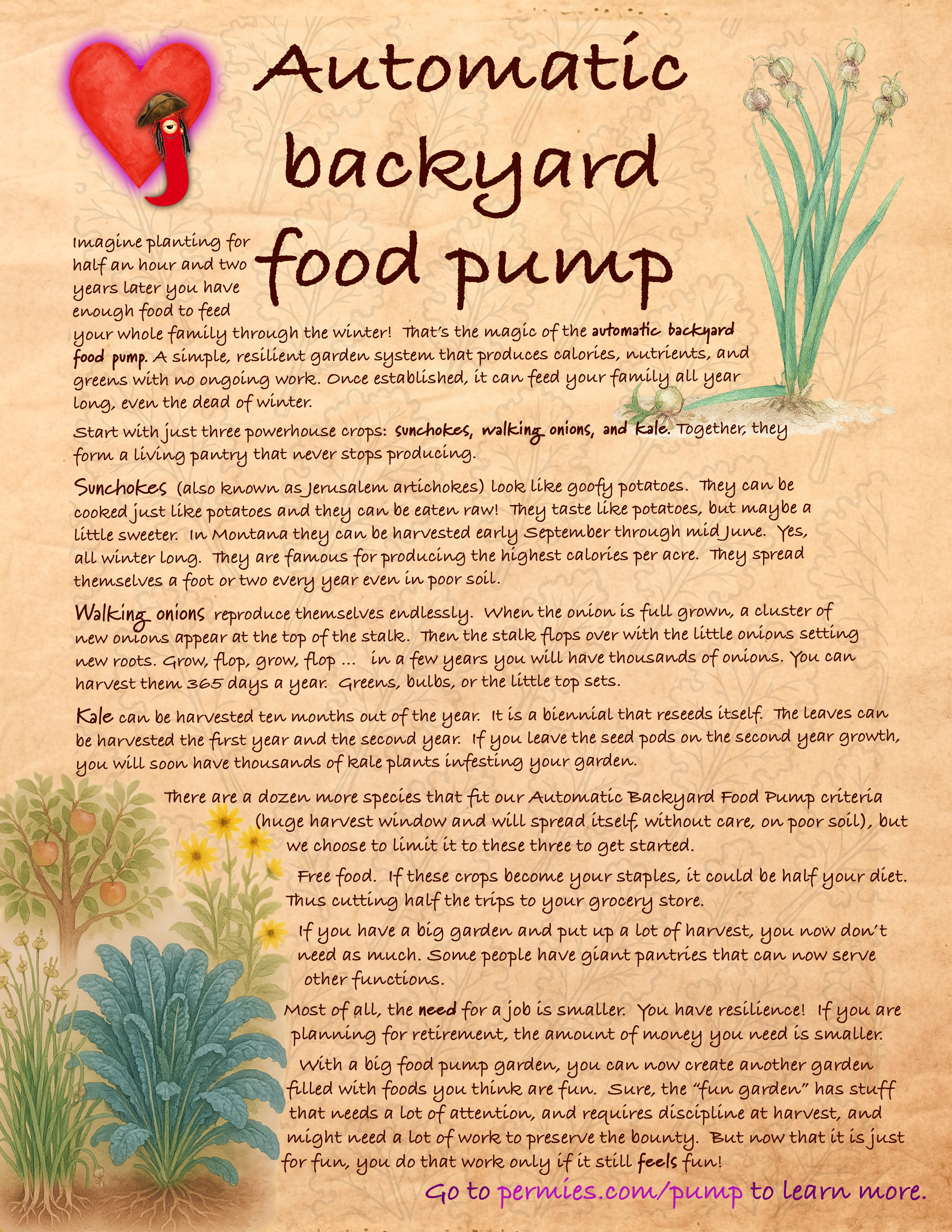
I like this general idea that this can be morphed into other zones, other conditions, other challenges ...   Before I can contemplate those, I guess I would like to ask


     is there anything that would bump something off of my current top 3?

           (sunchokes, walking onions and kale)


I think the requirements are:

    - a huge harvest window that includes a big part of winter
    - if forgotten for four years, there will be more
    - food that can be eaten raw, or is very easy to prepare

I do think it is gonna take five years of experimentation - beyond what I have done already.  

Also, it is my opinion that the comedy of sunchokes can be mitigated.  I would appreciate it if any comments about this can be moved to some other thread.  It has been about seven years since I have experience ANY comedy from eating sunchokes.


////////////////////////////////


This whole idea is borne from a massive collection of other things.  What I really want to do is be able to say something like

      - spend 30 minutes gardening the way I tell you.  NO FUCKING VARIATIONS!  Obey my instructions or fuck off.  Yes, there exist enough variations to fill one and a half full sized libraries.  I just want to spell something out that is so brain dead simple that it is nearly impossible to fuck up.  

      - ignore it for a year or two.  Or three or four.

      - now there is a huge amount of food.  Especially in winter.  In montana (or similar cold climates).    

Rather than soy+wheat+corn being the three staples, and tying you to politicians and a workee-job, these three foods will be your staples.  Total cost is, maybe twenty bucks?  Total time put in is 30 minutes.  Harvest will be less time than going to a grocery store or restaurant.  

Give these plants a bit more love, you get even more food.  But I don't even want to talk about that.  


I love the idea that ABFP could, in time, expand to have a dozen authors, each with their own ABFP strategy.  And they do a similar thing - share what they do that works for them.  

I feel like when I try to talk about gardening as a solution for a lot of things, I get flooded with:

    - what about people that live in apartments?
    - what about people that live at the north pole?
    - what about people that live at the sahara desert?
    - what about people that live on a boat?
    - what if people move?
    - what if their mom says no?
    - what about tomatoes?
    - what about crunchy cereal?
    - what about restaurants?
   
And all this stuff makes the conversation impossible.  And while I try to talk about trying something in montana, there is always a response that sounds like it cannot possibly work for me in montana because somebody in the world lives in a submarine stationed at the north pole.


////////////////////////////////

In time, i might write a book or make a movie about this.  It will show what was done for me.  And maybe there will be some others that will add to it about their story.   And the submarine people can yell at the book or movie all they want and nobody will hear them.  We will be able to tell our story without the distractions.


////////////////////////////////

Mark's book "restoration agriculture" does an excellent job of shooting down wheat, corn and soy.  

I think that when we grow wheat and corn, they have an okay harvest window.  Then we store it.  Cool.  And now what is the work that we do to eat it?  Mark makes a lot of excellent points about how we should never eat these.  But I just wanna point out that that is a LOT of work to eat that.

Sunchokes, kale and onions can be eaten raw.  Wheat and dried corn cannot.

I do feel like it would be good to come up with a list of dishes with minimal prep where these staples are 70% or more of the dish.


L Anderson
pollinator
Posts: 122
Location: Willamette Valley, OR
42
5
  • Likes 7
  • Mark post as helpful
  • send pies
    Number of slices to send:
    Optional 'thank-you' note:
  • Quote
  • Report post to moderator
1. You crack me up with your cat herding attempts ( no sarcasm there - it really did tickle me).

2. You already had me years ago with the sunchokes and the onions. But I’m still not eating kale.

3. I finished Restoration Agriculture last week. You’re right - Shepard already did all the work.

4. I wonder how many of your restricted target audience are already growing those things? If the answer is “most,” perhaps that’s why some of us persist in spinning off into other scenarios?

I love your posts. They always get me thinking differently about my own backyard. (Plus you can be very funny.)
 
Christopher Weeks
master gardener
Posts: 5503
Location: Carlton County, Minnesota, USA: 3b; Dfb; sandy loam; in the woods
3066
7
forest garden trees books chicken food preservation cooking fiber arts seed woodworking homestead ungarbage
  • Likes 2
  • Mark post as helpful
  • send pies
    Number of slices to send:
    Optional 'thank-you' note:
  • Quote
  • Report post to moderator

paul wheaton wrote:is there anything that would bump something off of my current top 3?

           (sunchokes, walking onions and kale)


There's some discussion toward the (current) end of the great big sunchoke thread about how productivity falls off if they're not harvested (for thinning purposes) each year. That makes it less automatic. But you've seen what you've seen and it seems like you've seen different.

I'm pretty skeptical that kale will self-seed enough to continue production for four years and especially if you're looking for increase -- but maybe...I don't live where you live.
 
out to pasture
Posts: 12985
Location: Portugal
4004
goat dog duck forest garden books wofati bee solar rocket stoves greening the desert
  • Likes 12
  • Mark post as helpful
  • send pies
    Number of slices to send:
    Optional 'thank-you' note:
  • Quote
  • Report post to moderator
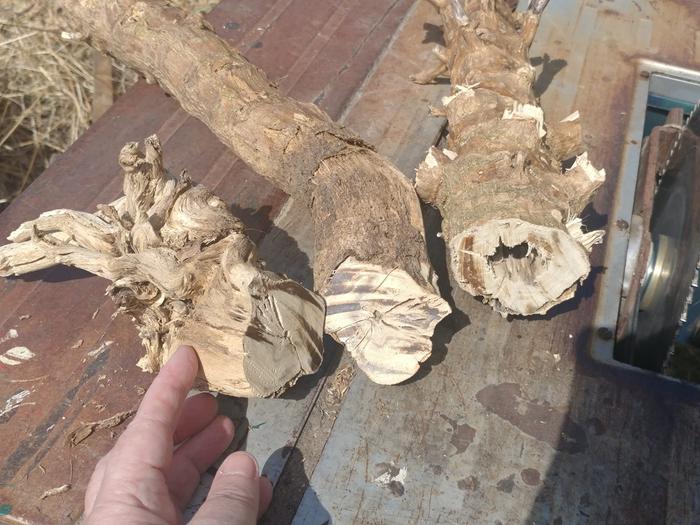
I think I need to find a way to get some of my galega seed to you. It's a perennial tree cabbage, very similar to kale but 'older' genetics, which is usually kept perennial by removing the flower buds- But I've been selecting for the ability to survive seeding and have seed off one that survived for four years and seeded successfully for three of those. Generally they live for seven or so years if you take the buds off.

This plant grew from the compost I dumped out from a pot of galega bush cabbage seedlings when we moved to the new place in April 2020.  It grew up with zero help whatsoever, in poor soil, battling with weeds.  It grew well despite having zero help and went to seed in 2022. To my surprise, it survived seeding so I began to take more notice of it.

By March 2023 it looked like this.


Not as tall as most of my other galega, but bushier. With strong survival instincts!

By June it had successfully seeded for a second time and despite dying right back, it decided it hadn't survived long enough and decided to grow back.


Then in February 2024 it seeded again, this time for the last time. I saved all the seed though!


Maximum height was a bit over 5 feet. I have no idea how long it would have lived if I'd taken flowers off, but I do have some of its babies in the GAMCOD bed and will be watching carefully next year to see how many survive seeding.

I cut the stem into sections to see how solid they were. The higher bits were hollow. The lower ones basically wood! I kept the pretty bit and put it in the display cabinet because I think it's awesome.


pollinator
Posts: 363
Location: New Mexico USA zone 6
70
3
  • Likes 1
  • Mark post as helpful
  • send pies
    Number of slices to send:
    Optional 'thank-you' note:
  • Quote
  • Report post to moderator

Burra Maluca wrote:I think I need to find a way to get some of my galega seed to you. It's a perennial tree cabbage, very similar to kale but 'older' genetics, which is usually kept perennial by removing the flower buds- But I've been selecting for the ability to survive seeding and have seed off one that survived for four years and seeded successfully for three of those. Generally they live for seven or so years if you take the buds off.


I don't think Galega (commonly known as goat's rue or French lilac) is a tree cabbage. It's in the legume family. Tree Kale is in the Brassica oleracea family. I think I would prefer it more than regular kale because supposedly it doesn't taste a whole lot like regular kale.
 
Lif Strand
pollinator
Posts: 363
Location: New Mexico USA zone 6
70
3
  • Likes 2
  • Mark post as helpful
  • send pies
    Number of slices to send:
    Optional 'thank-you' note:
  • Quote
  • Report post to moderator

paul wheaton wrote:I like this general idea that this can be morphed into other zones, other conditions, other challenges ...   Before I can contemplate those, I guess I would like to ask... etc  


and then

paul wheaton wrote: What I really want to do is be able to say something like
      - spend 30 minutes gardening the way I tell you.  NO FUCKING VARIATIONS!  Obey my instructions or fuck off.


Well, THAT made me consider leaving permies, until I calmed down and went to page one of this thread, the first post, where I saw that you wrote " I want to start putting the idea out there and see if a dozen others out there wanna play with this thought experiment."

I did not read that original post before I read the fuck off comment. Now that I have read it, I understand the frustration. I just would like to remind you that I'm probably not the only person who didn't read the first post, and I assumed it was just like any other thread where it's a conversation, not a controlled thought experiment. Really, the frustration would be nonexistent if the title of this thread had been "THOUGHT EXPERIMENT: Automatic Backyard  Food Pump" and that every Paul Wheaton post in this thread reminded us what the point was, along with the request to stick with the stated purpose of the thought experiment.

With that, I will bow out of the whole thread.
 
Burra Maluca
out to pasture
Posts: 12985
Location: Portugal
4004
goat dog duck forest garden books wofati bee solar rocket stoves greening the desert
  • Likes 6
  • Mark post as helpful
  • send pies
    Number of slices to send:
    Optional 'thank-you' note:
  • Quote
  • Report post to moderator

Lif Strand wrote:I don't think Galega (commonly known as goat's rue or French lilac) is a tree cabbage. It's in the legume family. Tree Kale is in the Brassica oleracea family. I think I would prefer it more than regular kale because supposedly it doesn't taste a whole lot like regular kale.


This is couve galega, and it's Brassica oleracea. Nothing to do with goat's rue. It's one of the original brassicas to be domesticated and never had its perennial tendencies bred out. Probably older than anything currently labelled 'kale'. Every self respecting Portuguese garden has these growing just outside the back door. The lower leaves double as toilet paper.
 
Lif Strand
pollinator
Posts: 363
Location: New Mexico USA zone 6
70
3
  • Likes 1
  • Mark post as helpful
  • send pies
    Number of slices to send:
    Optional 'thank-you' note:
  • Quote
  • Report post to moderator

Burra Maluca wrote:This is couve galega, and it's Brassica oleracea. Nothing to do with goat's rue. It's one of the original brassicas to be domesticated and never had its perennial tendencies bred out. Probably older than anything currently labelled 'kale'. Every self respecting Portuguese garden has these growing just outside the back door. The lower leaves double as toilet paper.


Aha - translation issue. Thanks for the correction!
 
  • Likes 2
  • Mark post as helpful
  • send pies
    Number of slices to send:
    Optional 'thank-you' note:
  • Quote
  • Report post to moderator
Interesting thread. For warmer climate I would add sweet potatoes. They really grow easy and are a good and pretty ground cover.
 
Posts: 9912
Location: a temperate, clay/loam spot on planet earth, the universe
3058
4
  • Likes 10
  • Mark post as helpful
  • send pies
    Number of slices to send:
    Optional 'thank-you' note:
  • Quote
  • Report post to moderator
We have grown sunchokes and walking (egyptian?) onions since 1973.
During that time we always moved some with us along with other seeds and roots.
After 4 moves I suppose we've left a trail although this is the first place we've lived without deer pressure and the deer (and our goats!) loved our sunchokes.

Those plants were probably among the most shared at my plant exchanges.

Kale, though, is difficult here because of the cabbage moth...even growing late season.
I keep trying.

This thread has me wanting to go check out what might have survived at our old place (other than wisteria🫤).

Here, I have to dig sunchokes early as the longer they are in the ground the more eaten up by a larvae I've yet to identify...

Now a days I ferment the sunchokes and we love them...they stay nice and crispy.
We lost our taste for cooking them years ago, back when they were a dependable winter food.
 
gardener
Posts: 715
Location: Semi-nomadic, main place coastal mid-Norway, latitude 64 north
410
  • Likes 6
  • Mark post as helpful
  • send pies
    Number of slices to send:
    Optional 'thank-you' note:
  • Quote
  • Report post to moderator

Kathleen Sanderson wrote:
The kale - I'm not sure about. It's a good choice in a lot of respects. Daughter tolerates sauerkraut well (and dill pickles); it seems likely that kale could be made into sauerkraut, though it would be a little different....


In my very limited experience, kale is no good for sauerkraut. It makes a horrible-smelling mess. I've understood that this happens when what you ferment contains too many leafy greens (too much chlorophyll maybe?) compared to the amount of available carbs. I remember reading a book where someone described the smell as "the most horrible dead thing you can imagine", but I personally thought it smelled more like some kind of poo. Hopefully someone with more fermentation experience than me will chime in. A thought occurs to me though: If the problem really is the ratio of chlorophyll to carbs, then a mix of kale and sunroots might work just fine? Hmm...
 
Posts: 8
Location: Riviera Nayarit, Mexico
6
  • Likes 12
  • Mark post as helpful
  • send pies
    Number of slices to send:
    Optional 'thank-you' note:
  • Quote
  • Report post to moderator
I am in Mexico near Lake Chapala. I planted 3 moringa seeds in 3 pots in 2022. All grew and I transplanted them to large pots ( more like bins, actually) in 2023. They did very well. In 2024 I harvested leaves every quarter, and 2025 too. I have had to keep pruning the tops to 11 feet as I live in rentals with no “growth space. In June 2025 , I gave one away to a friend for his birthday. He planted it in the soil and it has taken on furiously. They hate it when you prune them and won’t let them live in the ground. All 3 bore blossoms in 2024, one which I named Brenda. I harvested leaves from the two “males” . All blossoms fertilized and bore seeds. “Her brother” is now bearing lots of blossoms. Transgender?? Haha. That mature to 20-30 feet. Easy peasy, lemon squeezy. Rosemary and marigold foils the leaf cutter ants.
 
pollinator
Posts: 3387
Location: Meppel (Drenthe, the Netherlands)
1130
dog forest garden urban cooking bike fiber arts
  • Likes 7
  • Mark post as helpful
  • send pies
    Number of slices to send:
    Optional 'thank-you' note:
  • Quote
  • Report post to moderator

L Anderson wrote:Inge:
Thank you for this list of easy vegetables! It will help me to expand what I grow.
By the way, I wonder if your sweet beet is related to parsnip? I


Thank you. No, that beet isn't a parsnip, it is related to chard and beets. It might be a kind of  'mangelwurzel' or 'fodder beet'.
How I know? I have parsnips too, but their leaves are totally different. The leaves of this plant look exactly like a green Swiss chard.

 
paul wheaton
author and steward
Posts: 57500
Location: missoula, montana (zone 4)
hugelkultur trees chicken wofati bee woodworking
  • Likes 8
  • Mark post as helpful
  • send pies
    Number of slices to send:
    Optional 'thank-you' note:
  • Quote
  • Report post to moderator
We have a giant thread about sunchokes https://permies.com/t/sunchokes

I shared a vid from david the good about how he thinks sunchokes suck because the gas is unbearable.  I pointed out that he lives down south where it might not get cold enough - because i don't have the gas problems.  

And then samantha shared this excellent video

 
I agree. Here's the link: http://stoves2.com
reply
    Bookmark Topic Watch Topic
  • New Topic