
• Post Reply Bookmark Topic Watch Topic
  • New Topic
permaculture forums growies critters building homesteading energy monies kitchen purity ungarbage community wilderness fiber arts art permaculture artisans regional education skip experiences global resources cider press projects digital market permies.com pie forums private forums all forums
this forum made possible by our volunteer staff, including ...
master stewards:
  • Carla Burke
  • Nancy Reading
  • John F Dean
  • r ransom
  • Jay Angler
  • Timothy Norton
stewards:
  • paul wheaton
  • Tereza Okava
  • Nicole Alderman
master gardeners:
  • M Ljin
  • Christopher Weeks
gardeners:
  • Jeremy VanGelder
  • thomas rubino
  • Megan Palmer

Plants where all of it is edible

 
gardener
Posts: 620
Location: New England
276
cat monies home care books cooking writing seed wood heat ungarbage
  • Likes 8
  • Mark post as helpful
  • send pies
    Number of slices to send:
    Optional 'thank-you' note:
  • Quote
  • Report post to moderator
Turnips, beets. Nasturtiums too. Chickory. And sweet  potatoes?  I didn’t know the leaves were edible!

Are there lettuces where you also eat the roots? I know that there are some you eat the flower stalks, but don’t know which ones.

Is there a list? Except obviously you can’t keep them growing, it always seemed to me  to be the most efficient type of plant to grow...

 
pollinator
Posts: 11856
Location: Central Texas USA Latitude 30 Zone 8
1287
cat forest garden fish trees chicken fiber arts wood heat greening the desert
  • Likes 4
  • Mark post as helpful
  • send pies
    Number of slices to send:
    Optional 'thank-you' note:
  • Quote
  • Report post to moderator
I believe virtually all parts of Moringa are edible.  It can be grown as an annual in a cold climate, but must be started in warm temperatures.  http://www.fao.org/traditional-crops/moringa/en/
 
pollinator
Posts: 718
Location: South West France
263
  • Likes 5
  • Mark post as helpful
  • send pies
    Number of slices to send:
    Optional 'thank-you' note:
  • Quote
  • Report post to moderator
Radishes and carrots spring to mind.
 
gardener
Posts: 3074
Location: Central Texas zone 8a
827
2
cattle chicken bee sheep
  • Likes 4
  • Mark post as helpful
  • send pies
    Number of slices to send:
    Optional 'thank-you' note:
  • Quote
  • Report post to moderator
Chayote
 
steward
Posts: 18945
Location: USDA Zone 8a
4794
dog hunting food preservation cooking bee greening the desert
  • Likes 10
  • Mark post as helpful
  • send pies
    Number of slices to send:
    Optional 'thank-you' note:
  • Quote
  • Report post to moderator
This is a great topic!

I am probably the only person who eats spaghetti squash rind.  I roast it like acorn squash.

I feel that almost all parts of vegetable plants can be eaten though the problem is that some parts are not palatable.  Most roots and stems are too stringy.

This year the deer ate all the leaves off the tomatoes, peppers, watermelons and squash.  They must have enjoyed them though I have no desire to eat any of those leaves.

https://permies.com/t/58961/culinary-tomato-foliage

In Mexico, Corn Smut is a delicacy.  Our corn got it one year and I had no desire to try it.

https://permies.com/t/124120/Corn-Smut-huitlacoche

https://permies.com/t/35173/eat-corn-smut


Posts: 113
Location: West-central Pennsylvania
59
  • Likes 17
  • Mark post as helpful
  • send pies
    Number of slices to send:
    Optional 'thank-you' note:
  • Quote
  • Report post to moderator
Where'd everybody go?
I'll add Sunchokes, AKA Sunroots, Helianthus tuberosus, and by the Algonquins Kaishúcpenauk.
The flowers after being steamed or boiled taste like squash. I've used the broth from boiling them to make wine.
The leaves are hairy, so don't throw them raw into a salad, but when cooked they take on the flavor of anything they're mixed with and the fuzzies disappear.
The tender sprouts or the tender upper stalks when boiled or steamed have a flavor I can't describe. I'm drying and powdering some for flavoring.
The tubers of course are great food cooked any which way or even raw, dehydrated raw and ground into flour, dehydrated after boiling or steaming and made into instant mashed 'choke powder. I've made wine from the boiled tuber broth too.
 
gardener
Posts: 3464
Location: Cascades of Oregon
925
  • Likes 12
  • Mark post as helpful
  • send pies
    Number of slices to send:
    Optional 'thank-you' note:
  • Quote
  • Report post to moderator
Hollyhock
fava bean
scarlet runner bean

Hollyhock,  other than the flowers is mucilaginous, like okra, so in a gumbo or something to cover the texture works better for me.
 
pollinator
Posts: 781
Location: West Yorkshire, UK
334
  • Likes 12
  • Mark post as helpful
  • send pies
    Number of slices to send:
    Optional 'thank-you' note:
  • Quote
  • Report post to moderator
We've been eating our broccoli plants, little by little.  First the broccoli.  Then the leaves, mainly cooked as namul, but also cooked like plain cabbage--good with our Sunday roast dinner today.  I know broccoli stems/stalks are good to eat too (after peeling) though I've never tried my own, only the supermarket ones.  Maybe I'll give them a shot once I've picked all the leaves.  
 
pollinator
Posts: 1295
Location: Chicago
444
dog forest garden fish foraging urban cooking food preservation bike
  • Likes 12
  • Mark post as helpful
  • send pies
    Number of slices to send:
    Optional 'thank-you' note:
  • Quote
  • Report post to moderator
I let my radishes self-seed in the garden based. This time of year, they come up thickly and I pull up handfuls of young radish plants before the roots start to swell and cook them whole. Great in soup or steam sautéed as a side.
 
Rusticator
Posts: 9780
Location: Missouri Ozarks
5395
7
personal care gear foraging hunting rabbit chicken cooking food preservation fiber arts medical herbs homestead
  • Likes 11
  • Mark post as helpful
  • send pies
    Number of slices to send:
    Optional 'thank-you' note:
  • Quote
  • Report post to moderator
Sweet potatoes. From tubers to leaf tops - 100% edible - and tasty. The leaves are very spinach-esque, and the stems are somewhere between asparagus and green beans in texture and flavor. The tubers are, of course,  da bomb, almost any way they're cooked.
 
steward and tree herder
Posts: 13300
Location: Isle of Skye, Scotland. Nearly 70 inches rain a year
7179
6
transportation dog forest garden foraging trees books food preservation woodworking wood heat rocket stoves ungarbage
  • Likes 9
  • Mark post as helpful
  • send pies
    Number of slices to send:
    Optional 'thank-you' note:
  • Quote
  • Report post to moderator
I think all parts of all alliums are edible, most of them are pretty tasty too!
 
Robert Ray
gardener
Posts: 3464
Location: Cascades of Oregon
925
  • Likes 11
  • Mark post as helpful
  • send pies
    Number of slices to send:
    Optional 'thank-you' note:
  • Quote
  • Report post to moderator
Radish rat-tails, the seed pods make spicy stir fry addition, pickle too.
 
Posts: 5
Location: Maryland, USA - Zone 7A
6
  • Likes 13
  • Mark post as helpful
  • send pies
    Number of slices to send:
    Optional 'thank-you' note:
  • Quote
  • Report post to moderator
Essentially all parts of plants within the Mustard family (Brassicaceae or Cruciferae) are edible, including leaves, flowers, buds, seeds, pods, and roots.

When I forage garlic mustard, I make a horseradish-like sauce from the roots, pesto from the leaves and stirfry the stems.
 
Posts: 15
1
2
  • Likes 8
  • Mark post as helpful
  • send pies
    Number of slices to send:
    Optional 'thank-you' note:
  • Quote
  • Report post to moderator
I’ll add arugula.  I love to eat the flowers and especially the seed pods when young.

I didn’t know about the Jerusalem artichokes - leaves and flowers!  I’m excited to try them. Thanks!
 
Posts: 2
1
  • Likes 10
  • Mark post as helpful
  • send pies
    Number of slices to send:
    Optional 'thank-you' note:
  • Quote
  • Report post to moderator
I once grew curly (not Italian) parsley in Ottawa, Ontario, Canada.  It was a hot, dry and, sunny summer. The parsley got to about 9 cm high when I decided to harvest it. I had to wash/rinse it 9 times due to sand and mud.  I used a hose to excavate the parsley which brought up the roots intact.  I made delicious tabouleh with the shoots, but the small 3 to 4 mm diameter roots where definitely the main ingredient that boosted the no salt veggetable soup to outstanding taste levels 😋.
 
pollinator
Posts: 204
Location: Schofields, NSW. Australia. Zone 9-11 Temperate to Sub Tropical
107
forest garden fungi books medical herbs bee seed
  • Likes 11
  • Mark post as helpful
  • send pies
    Number of slices to send:
    Optional 'thank-you' note:
  • Quote
  • Report post to moderator
Celtuce which is the edible lettuce referred to by Jennie, the stems taste like mild asparagus, I love them when making Asian food.

All stems and leaves of broccoli, broccolini, kohl rabi or cauliflower if they have not turned woody.

Nasturtiums, I use the green seeds pickled in vinegar like capers, the very young leaves in salad for their peppery taste, the flowers are lovely with a little drop of honey hit at the base, and I sometimes use a leaf or 2 in a vegetable juice or in cooking.

Sweet potato leaves are a wonderful source of protein used in stews to thicken them or fried until they are crunchy to sprinkle over meals, as well as the roots being so tasty.

Hamburg Parsley can be used for leaves and the roots are yummy and give a parsley taste to anything you cook with.

Young dandelion leaves in salads or roasting the roots to dry and chop to make hot natural coffee substitute or brewed, cooled and used in icy cold drinks with a little maple syrup.

Radish leaves in juices or roots in Asian stir fries or patties.

Chayotes/chokoes. Fruits are similar in taste to zucchini and the large edible seed inside is very high protein. Another great use is to make dolmades from the chayote leaves - just as grape leaves, (used in normal dolmades), become mature and too thick, the chayote vines are bearing fresh leaves, so it extends my dolmade seasons a lot. They bear a lot of fruits suitable for making pickles and spreads.

Appreciating all the suggestions here, I love anything that produces little waste.
 
Posts: 14
3
2
  • Likes 10
  • Mark post as helpful
  • send pies
    Number of slices to send:
    Optional 'thank-you' note:
  • Quote
  • Report post to moderator
Wild multiflora rose-- except the roots.  Leaves, buds, blossoms, rose hips, and young shoots-- I imagine the older shoots would be pretty rough going down with all the thorns.  Many folks peel the young shoots, too.  My favorite uses are the young shoots and leaves for tea, older leaves for tea, too, blossom petals for a pretty addition to salads, and the rose hips-- high in vitamin C-- in the fall for tea or jelly.  So, pretty much all of that pesky wild critter.  And domestic roses, too, if you don't spray them.
 
Nancy Reading
steward and tree herder
Posts: 13300
Location: Isle of Skye, Scotland. Nearly 70 inches rain a year
7179
6
transportation dog forest garden foraging trees books food preservation woodworking wood heat rocket stoves ungarbage
  • Likes 7
  • Mark post as helpful
  • send pies
    Number of slices to send:
    Optional 'thank-you' note:
  • Quote
  • Report post to moderator

Luc Drouin wrote:II used a hose to excavate the parsley which brought up the roots intact.  I made delicious tabouleh with the shoots, but the small 3 to 4 mm diameter roots where definitely the main ingredient that boosted the no salt veggetable soup to outstanding taste levels .


Luc - I think parsley is closely related to parsnip. There is even a parsley bred for it's root - Hamburg parsley, although sometimes difficult to get hold of seed, it is supposed to taste delicious (and would be a bit less faff than roots of parsley!)
 
Posts: 183
52
kids urban seed
  • Likes 9
  • Mark post as helpful
  • send pies
    Number of slices to send:
    Optional 'thank-you' note:
  • Quote
  • Report post to moderator
Comfrey is a good one for this. Leaves for mulch or compost tea, flowers for pollinators, roots for propagating more plants. Not exactly a culinary plant but every part has a use. Borage is similar, flowers in salads, leaves edible when young, and it self-seeds so reliably you basically never have to plant it again.
 
Posts: 2
4
  • Likes 9
  • Mark post as helpful
  • send pies
    Number of slices to send:
    Optional 'thank-you' note:
  • Quote
  • Report post to moderator
I recently grew some broccoli from seed for the first time. The leaves are huge! I originally thought it was a cabbage of some sort. I was cutting off the leaves and stir frying them with eggs. I had no idea how good the broccoli leaves were or that was even a thing. Now I see the little broccoli. I’m thinking if I just keep cutting buts off it will continue to grow.
 
out to pasture
Posts: 13248
Location: Portugal
4388
goat dog duck forest garden books wofati bee solar rocket stoves greening the desert
  • Likes 13
  • Mark post as helpful
  • send pies
    Number of slices to send:
    Optional 'thank-you' note:
  • Quote
  • Report post to moderator

Nancy Reading wrote:  There is even a parsley bred for it's root - Hamburg parsley, although sometimes difficult to get hold of seed, it is supposed to taste delicious
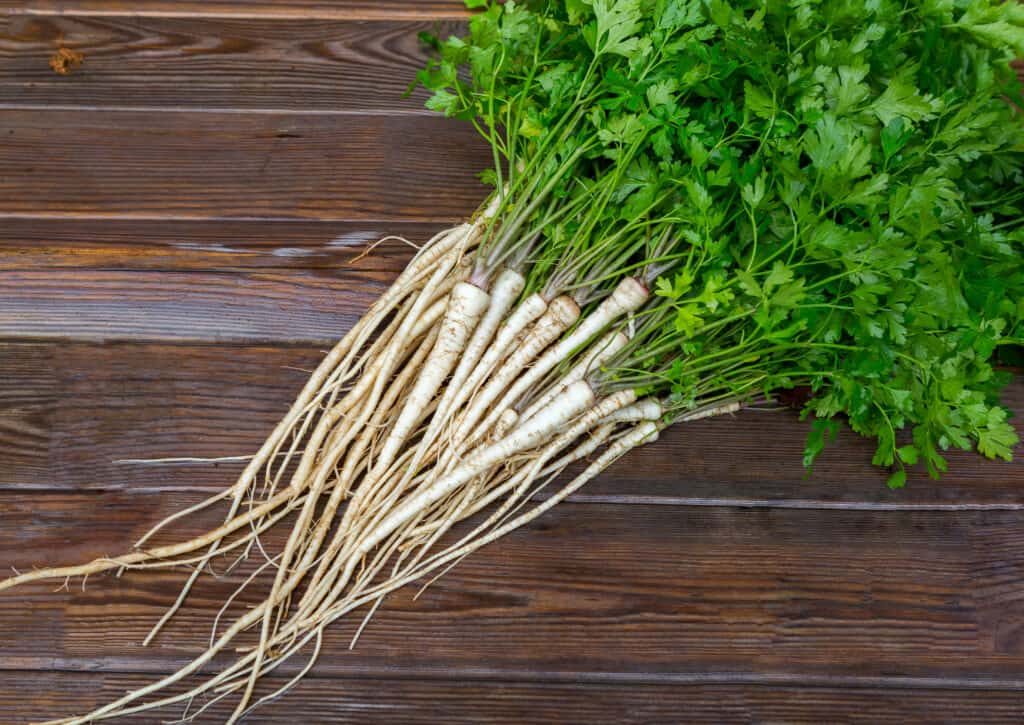

Why have I never heard of this? Or is my memory even worse than I think it is...

I'm not sure where I'm going to put them, but I just sent off for a pack of seed. I guess they can go where last year's parsley is now when they've finished seeding. Would seem an appropriate sort of place.


Has anyone else grown Hamburg parsley?

Are the tops as good as 'real' parsley?

Are the roots like parsnip? Or more mild?  Or just different?

Ah - I found a couple of articles.

One from British Food History and one from Harvest to Table, which is where I got the photo from.
 
Posts: 45
Location: Half acre on a hill in Central Alabama, Zone 8a and 8b
34
hugelkultur fungi foraging
  • Likes 7
  • Mark post as helpful
  • send pies
    Number of slices to send:
    Optional 'thank-you' note:
  • Quote
  • Report post to moderator
Peas!
I intentionally overplant snow peas and garden peas so we can harvest the leaves and stems, both for salads and greens. Oddly enough, they all taste like peas.
(Not sure about the root, but there's not much to them.)
 
Posts: 57
9
  • Likes 10
  • Mark post as helpful
  • send pies
    Number of slices to send:
    Optional 'thank-you' note:
  • Quote
  • Report post to moderator
Trying to think back when I worked at a microgreenery: pea shoots, mustard, violets, arugula. Well, I'm not going to list the whole inventory, because it wasn't my Company. But there are tons of things which are entirely edible, if harvested at the right time.
 
gardener
Posts: 1985
Location: Longbranch, WA Mild wet winter dry climate change now hot summer
489
3
goat tiny house rabbit wofati chicken solar
  • Likes 12
  • Mark post as helpful
  • send pies
    Number of slices to send:
    Optional 'thank-you' note:
  • Quote
  • Report post to moderator
I recommend Evening Primrose.  It makes a rosette of leaves over winter which are verry edible. The tender leaves as it starts to put up its flower stalk continue to be harvestable.  Then the flowers bloom for a long time and are the most delicious and fragrant.  As the name indicates they bloom after the heat of the day but will still be good in the morning.  The storage root could be harvested before it starts to put up the flower stalk.  It produces large amounts of seed which are used to produce an oil for it's healing properties. I have not tried using them as sprouted seeds but that should be posible.
 
Yeardly Arthur
Posts: 45
Location: Half acre on a hill in Central Alabama, Zone 8a and 8b
34
hugelkultur fungi foraging
  • Likes 7
  • Mark post as helpful
  • send pies
    Number of slices to send:
    Optional 'thank-you' note:
  • Quote
  • Report post to moderator

Hans Quistorff wrote:I recommend Evening Primrose.  It makes a rosette of leaves over winter which are verry edible. The tender leaves as it starts to put up its flower stalk continue to be harvestable.  Then the flowers bloom for a long time and are the most delicious and fragrant.  As the name indicates they bloom after the heat of the day but will still be good in the morning.  The storage root could be harvested before it starts to put up the flower stalk.  It produces large amounts of seed which are used to produce an oil for its healing properties. I have not tried using them as sprouted seeds but that should be posible.


Just to be clear, of the many flowering plants bearing the common name Primrose, I assume you are referring to the tall, yellow (Mexican) Evening Primrose, Oenothera biennis.
I'm surprised (and delighted!) to learn they are edible. We've had them before in our garden, but sadly they did not survive a recent -ahem- rearrangement process. I'll be eager to replace them soon!
 
Hans Quistorff
gardener
Posts: 1985
Location: Longbranch, WA Mild wet winter dry climate change now hot summer
489
3
goat tiny house rabbit wofati chicken solar
  • Likes 9
  • Mark post as helpful
  • send pies
    Number of slices to send:
    Optional 'thank-you' note:
  • Quote
  • Report post to moderator

Just to be clear, of the many flowering plants bearing the common name Primrose, I assume you are referring to the tall, yellow (Mexican) Evening Primrose, Oenothera biennis.
I'm surprised (and delighted!) to learn they are edible. We've had them before in our garden, but sadly they did not survive a recent -ahem- rearrangement process. I'll be eager to replace them soon!


Apparently so but the original seed came from a wiled flower mix that my mother ordered some 30 years ago.  I regularly loose many of them because the deer like to eat the same things I like to eat.  The seeds are viable for a long time and can be planted in spring if they can't be overwintered for fall blooms whereas the my overwintered one are preparing to bloom now,
 
Posts: 46
2
  • Likes 8
  • Mark post as helpful
  • send pies
    Number of slices to send:
    Optional 'thank-you' note:
  • Quote
  • Report post to moderator
I am interested in drinking chicory, but not sure where to get it and even how to grow or make my coffee. I believe it is the root, but not completely sure. Since I can't have caffeine, this has been a great alternative for me, but would love to grow instead of buying.
 
Yeardly Arthur
Posts: 45
Location: Half acre on a hill in Central Alabama, Zone 8a and 8b
34
hugelkultur fungi foraging
  • Likes 9
  • Mark post as helpful
  • send pies
    Number of slices to send:
    Optional 'thank-you' note:
  • Quote
  • Report post to moderator

Carla Terry wrote:I am interested in drinking chicory, but not sure where to get it and even how to grow or make my coffee. I believe it is the root, but not completely sure. Since I can't have caffeine, this has been a great alternative for me, but would love to grow instead of buying.


Common chicory (Cichorium intybus), or 'blue dandelion'  grows just about everywhere, often found on roadsides and in fields and meadows. It is related to dandelions (Taraxacum officinale), and the taller, lemon yellow false dandelions of desert chicory (Pyrrhopappus spp),  and catsear (Hypochaeris radicata). All of these are edible, and all of their roots can be roasted and brewed as a coffee substitute.    

Apparently chicory is easy to grow, since it has been introduced all over the world and seems to do well in any temperate environment. Seeds are readily available online, or you could ask your local garden center for help. We have saved and replanted the native desert chicory that volunteers in our yard, both for the flowers and as a coffee substitute.
DesertChicory.jpg
[Thumbnail for DesertChicory.jpg]
 
Annette Jones
pollinator
Posts: 204
Location: Schofields, NSW. Australia. Zone 9-11 Temperate to Sub Tropical
107
forest garden fungi books medical herbs bee seed
  • Likes 4
  • Mark post as helpful
  • send pies
    Number of slices to send:
    Optional 'thank-you' note:
  • Quote
  • Report post to moderator

Carla Terry wrote:I am interested in drinking chicory, but not sure where to get it and even how to grow or make my coffee. I believe it is the root, but not completely sure. Since I can't have caffeine, this has been a great alternative for me, but would love to grow instead of buying.


Hi Carla. Hope this helps.
Chicory Coffee - Cichorium intybus Description: Open pollinated heirloom variety that is a hardy plant with a long taproot topped by a rosette of leaves. Known since 4000BC throughout Europe, chicory roots have been dried and ground for use as a substitute for coffee and a vegetable. It is the ingredient used in coffee/chicory essence and many dried substitute coffees sold today. Its properties help support the liver. In the herb garden grow at the back as it grows up to 1 metre tall. An attractive herb with spikes of bright blue daisy like flowers it is also a wonderful pollinator plant and attracts butterflies and other pollinators. It is frost and drought tolerant.
Care: Prepare soil by deep digging in well-rotted manure or compost. Plant in full sun in spring, directly where it is to grow. Sow 1.2cms deep. Protect from snails and slugs. Keep moist, not wet. Plants should be 60cms apart to allow for good strong root growth. Add organic fish or seaweed fertiliser when plants are half grown.
Uses: Roots are dried, slow roasted and ground as needed as a coffee substitute. Leaves and young roots are steamed and used as vegies. Young leaves can be used in salads in spring, as the weather heats up they become too bitter to use this way. Roots grow up to 30cms long and weigh a kilo. A well-known liver tonic it supports the body and rids it of toxins. Fresh chicory root contains from 13-23% inulin and is used to fight colon cancer. (USDA.gov). Its other use is that the roots break up compacted soil areas. Left over parts of the plant thrown on the compost provide many valuable trace elements missing from our soils as the deep roots bring them up from the subsoil and then they are broken down in your compost.

Cichorium-intybus-Chickory.jpg
[Thumbnail for Cichorium-intybus-Chickory.jpg]
Chicory-Coffee-Magdeburg1.JPG
[Thumbnail for Chicory-Coffee-Magdeburg1.JPG]
 
I'm just a poor boy, I need no sympathy, because I'm easy come, easy go, little high, little low, little ad
grow your own garden and build your own home in the gardening gardeners program
https://wheaton-labs.com/bootcamp
reply
    Bookmark Topic Watch Topic
  • New Topic