
• Post Reply Bookmark Topic Watch Topic
  • New Topic
permaculture forums growies critters building homesteading energy monies kitchen purity ungarbage community wilderness fiber arts art permaculture artisans regional education skip experiences global resources cider press projects digital market permies.com pie forums private forums all forums
this forum made possible by our volunteer staff, including ...
master stewards:
  • Carla Burke
  • Nancy Reading
  • John F Dean
  • r ransom
  • Jay Angler
  • Timothy Norton
stewards:
  • paul wheaton
  • Tereza Okava
  • Nicole Alderman
master gardeners:
  • M Ljin
  • Christopher Weeks
gardeners:
  • Jeremy VanGelder
  • thomas rubino
  • Megan Palmer

Laundry with resource limitations

 
gardener
Posts: 272
Location: Idaho panhandle, zone 6b, 30” annual rainfall, silty soil
210
2
foraging rabbit books chicken food preservation cooking fiber arts medical herbs bee seed sheep
  • Likes 10
  • Mark post as helpful
  • send pies
    Number of slices to send:
    Optional 'thank-you' note:
  • Quote
  • Report post to moderator
As a student of history, I’m keenly aware that improved laundry technologies went a long way toward freeing up time to do other things for people in history—especially female people. I’m also keenly aware that my spouse and I will be living in our travel trailer for some period of months. As we are getting ready for that, I’m thinking about laundry. Drying is no problem, as I’m well acquainted with clotheslines! Washing is a different problem. I’ve done laundry in the sink and it takes up far too much of my limited time, plus there’s the fact that sinks in our trailer are not big enough to wash one pair of trousers/pants by themselves!

Washing clothes only when they are truly dirty is a habit we’re developing now. That helps. We’ll have access to my in-laws’ washer for bedding. That helps. What am I hoping to hear about here? Glad you asked.

What are your favorite off-grid or low-resources laundry tools that can be used in a small space? Which ones would you avoid like the plague? Which ones have a lower time investment per wash? (I still have a day job that I love and we’ll be establishing a new homestead at the same time.)
 
master rocket scientist
Posts: 7100
Location: latitude 47 N.W. montana zone 6A
4225
cat pig rocket stoves
  • Likes 20
  • Mark post as helpful
  • send pies
    Number of slices to send:
    Optional 'thank-you' note:
  • Quote
  • Report post to moderator
Hey Shawn;
A five-gallon bucket with a removable lid.
One new toilet plunger.
Drill a hole thru the lid for the plunger handle.
Water (hot) and soap of choice.
 
gardener
Posts: 3201
Location: Central Maine (Zone 5a)
1748
homeschooling kids trees chicken food preservation building woodworking homestead
  • Likes 14
  • Mark post as helpful
  • send pies
    Number of slices to send:
    Optional 'thank-you' note:
  • Quote
  • Report post to moderator
Hi Shawn,
I am no expert, but I had a few thoughts, and I'm sure others will chime in too.

Personally, I would make use of your in-law's washing machine.. a lot :), the other possibility might be a laundrymat.

Historically people would make good use of aprons, frocks, and a specific set of clothes that they used for the particularly dirty shores like cooking, barn cleaning, etc. The specific set of overclothes or coverings could be dirty and stay dirty and not be washed often, while the normal clothes would stay cleaner and not need to be washed as often.

Good luck
 
Rusticator
Posts: 9763
Location: Missouri Ozarks
5376
7
personal care gear foraging hunting rabbit chicken cooking food preservation fiber arts medical herbs homestead
  • Likes 9
  • Mark post as helpful
  • send pies
    Number of slices to send:
    Optional 'thank-you' note:
  • Quote
  • Report post to moderator
We lived without washer and dryer, for a few years (OK, 8 ), and I used to have a plastic version of this, but (along with to many other items!) it disappeared, in our last move. I picked up another one - metal, this time, at a local flea, for about $10. Back then, I used it in the bathtub. Now, I have a similar setup to what Thomas described, minus the lid, and I use 2 buckets - one to wash, one to rinse. One of my favorite things about the whole setup, is it all nests together, nice and compact, right along with the laundry soap & vinegar. I'm not using it regularly, anymore, but keep my kit on hand, for power outages. The laundry must get done, right? https://www.walmart.com/ip/Rapid-Laundry-Washer-Plunger-Tin-Plated-Steel-Fir-Wooden-Handle-USA-Made/721845493

P.s. I think I'm going to drill a hole in a lid, even if just to keep it all enclosed, when not in use.
 
steward & bricolagier
Posts: 16133
Location: SW Missouri
12442
2
goat cat fungi books chicken earthworks food preservation cooking building homestead ungarbage
  • Likes 8
  • Mark post as helpful
  • send pies
    Number of slices to send:
    Optional 'thank-you' note:
  • Quote
  • Report post to moderator
I agree with Matt, change clothes or shielding devices for types of tasks so things don't need washing as much, and I also agree with laundromat or in-law's washer when you have to. That's the easiest in this day and age.
Other than that, soak clothes before you agitate them if you are washing by hand.
 
Shawn Foster
gardener
Posts: 272
Location: Idaho panhandle, zone 6b, 30” annual rainfall, silty soil
210
2
foraging rabbit books chicken food preservation cooking fiber arts medical herbs bee seed sheep
  • Likes 6
  • Mark post as helpful
  • send pies
    Number of slices to send:
    Optional 'thank-you' note:
  • Quote
  • Report post to moderator

Matt McSpadden wrote:

Historically people would make good use of aprons, frocks, and a specific set of clothes that they used for the particularly dirty shores like cooking, barn cleaning, etc. The specific set of overclothes or coverings could be dirty and stay dirty and not be washed often, while the normal clothes would stay cleaner and not need to be washed as often.


Aprons and "grubby clothes" are already in my daily practice and I've got plans to make a set of detachable sleeves (think medieval clothing) for that purpose as well. Historical people were practical.

Those of you that have used the bucket-ish method, what do you do as a replacement for spin cycle/wringer? Clothes take so much longer to dry without that.
 
rocket scientist
Posts: 1909
Location: Coastal Salish Sea area, British Columbia
1084
2
books chicken food preservation pig bike solar wood heat rocket stoves homestead ungarbage
  • Likes 6
  • Mark post as helpful
  • send pies
    Number of slices to send:
    Optional 'thank-you' note:
  • Quote
  • Report post to moderator

Shawn Foster wrote:
Those of you that have used the bucket-ish method, what do you do as a replacement for spin cycle/wringer? Clothes take so much longer to dry without that.


I mostly do this with pants. But I roll the pants up like one would a sleeping bag. I try to get it tight, than I try to push the water out with my weight. The other method I have done is to Twist the clothes. However I believe twisting the clothes puts unnecessary stress on the joints/seams.
 
pollinator
Posts: 1455
Location: BC Interior, Zone 6-7
521
forest garden tiny house books
  • Likes 8
  • Mark post as helpful
  • send pies
    Number of slices to send:
    Optional 'thank-you' note:
  • Quote
  • Report post to moderator
We've gone the take the laundry to the parents' route, so I don't have much to say about low tech methods. The only thing I'll mention is that if you're washing in a bucket or other small container, do not skimp on water or crowd the container, otherwise your clothes will stink when they dry.
 
steward
Posts: 18921
Location: USDA Zone 8a
4788
dog hunting food preservation cooking bee greening the desert
  • Likes 8
  • Mark post as helpful
  • send pies
    Number of slices to send:
    Optional 'thank-you' note:
  • Quote
  • Report post to moderator
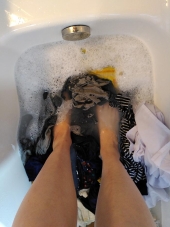
A bathtub is a great laundry tool.


Added a pair of feet:


From here:


A plunger is another great laundry tool.


from here:

Manual Washer:


From here:

This thread has lots of ideas for doing laundry by hand:

https://permies.com/wiki/108429/pep-nest/laundry-hand-PEP-BB-nest

Take some pictures and earn a PEP BB (Badge Bit).
 
Carla Burke
Rusticator
Posts: 9763
Location: Missouri Ozarks
5376
7
personal care gear foraging hunting rabbit chicken cooking food preservation fiber arts medical herbs homestead
  • Likes 10
  • Mark post as helpful
  • send pies
    Number of slices to send:
    Optional 'thank-you' note:
  • Quote
  • Report post to moderator
You can use a bucket with drain holes drilled into it, inside the wash bucket. Then, lift the clothes out, leaving your soapy water for another load, set the holey bucket on the ground or in the tub, and press the clothes with the plunger, to smush the soapy water out, before plunging the holey bucket into the rinse water. It's not going to be as effective as a spin cycle or a wringer, but much easier on the hands, than trying to squeeze or wring by hand. And, I'm sure Jordan is spot on, about twisting the clothes being hard on them - as well as on your hands.
 
pollinator
Posts: 616
Location: Scandinavia
446
trees
  • Likes 10
  • Mark post as helpful
  • send pies
    Number of slices to send:
    Optional 'thank-you' note:
  • Quote
  • Report post to moderator
Doing laundry by hand is not that difficult if you have modern detergents.

1. Have a 15 gallon bucket on a stool so you can work with a straight back.

2. SOAKING is your friend. Have enough water so that clothes are not packed.

3. Use a laundry plunger to work the dirt out.

4. Rinse with a bit of vinegar in the water - disinfects so that there are no microbes in the textile to start smelling

5. Invest in a clothers squeezer.

6. Iron clothes that get most use. Ironing makes the textile "slippery" so dirt does not stick so easily. I would iron pillowcases, but not sheets. Aprons but not skirts..

7.  hang to dry. In Scandinavia, we used to hang clothes outside to dry even when it was freezing outside. The clothes do dry, but you have to remove them carefully in order not to damage them since they will be stiff with frost 😄.

All this can be done without electricity.

s-l400.jpg
Laundry plungers sold everywhere including Amazon
81Ec2BnirkL.jpg
Clothes roller
Clothes roller
normal_wanha_silitysrauta.jpg
Iron does not need to be electric
 
gardener
Posts: 372
193
personal care foraging urban books food preservation cooking fiber arts medical herbs ungarbage
  • Likes 6
  • Mark post as helpful
  • send pies
    Number of slices to send:
    Optional 'thank-you' note:
  • Quote
  • Report post to moderator
I've heard a salad spinner can double as a washbasin and spin cycle for your smalls.
 
pollinator
Posts: 1295
Location: Chicago
444
dog forest garden fish foraging urban cooking food preservation bike
  • Likes 6
  • Mark post as helpful
  • send pies
    Number of slices to send:
    Optional 'thank-you' note:
  • Quote
  • Report post to moderator
Stomping on the clothes while you shower is good agitation.
 
Shawn Foster
gardener
Posts: 272
Location: Idaho panhandle, zone 6b, 30” annual rainfall, silty soil
210
2
foraging rabbit books chicken food preservation cooking fiber arts medical herbs bee seed sheep
  • Likes 5
  • Mark post as helpful
  • send pies
    Number of slices to send:
    Optional 'thank-you' note:
  • Quote
  • Report post to moderator
I’m loving seeing the solutions that people are actually using. Our plan is to do trial runs/experiments while we’re still in our current home. That way, we can minimize the impact of the learning curve by having the washer available if needed. I’ve ordered the plunger-type thingy and we have buckets already. Wringer/roller is a bit more of an investment, so that may wait until after the holidays.

Keep those experience-based suggestions coming! I have a BB to earn…
 
pollinator
Posts: 5757
Location: Canadian Prairies - Zone 3b
1647
  • Likes 5
  • Mark post as helpful
  • send pies
    Number of slices to send:
    Optional 'thank-you' note:
  • Quote
  • Report post to moderator
I always thought that a Rubbermaid trash bin and a concrete vibrator (used to remove air from wet concrete) would make short work of the washing process. Haven't tried it yet.
 
Shawn Foster
gardener
Posts: 272
Location: Idaho panhandle, zone 6b, 30” annual rainfall, silty soil
210
2
foraging rabbit books chicken food preservation cooking fiber arts medical herbs bee seed sheep
  • Likes 4
  • Mark post as helpful
  • send pies
    Number of slices to send:
    Optional 'thank-you' note:
  • Quote
  • Report post to moderator
Related question! I've been searching for wringers in various places, both new and used. Definitely not interested in the "antique" ones that are just for pretty; that's nice, but I want to put this to a practical use! I'm guessing that the state of the rollers makes a pretty big difference in the actual usability of the wringer, but what do I know? I've never used one.

Those who've used wringers, either free-standing or as a part of a wringer washer, what would be the dealbreakers in a preowned wringer? I don't want to have to reconstruct it completely, so I'm thinking that structural integrity of the frame is pretty important. Can the rollers be re-covered in some way if the rubber is perished? Or replaced with wooden rollers? Any other parts that can be fairly easily repaired, thereby keeping the item in use?
 
Posts: 18
Location: Buckley, WA 98321
  • Likes 3
  • Mark post as helpful
  • send pies
    Number of slices to send:
    Optional 'thank-you' note:
  • Quote
  • Report post to moderator

thomas rubino wrote:Hey Shawn;
A five-gallon bucket with a removable lid.
One new toilet plunger.
Drill a hole thru the lid for the plunger handle.
Water (hot) and soap of choice.


Only was clothes when they are dirty if they don't look dirty don't wash them. The same goes for bathing when you feel dirty that way you will save on water.
 
Posts: 33
Location: Siuslaw Territory, coastal Oregon, USA
5
  • Likes 5
  • Mark post as helpful
  • send pies
    Number of slices to send:
    Optional 'thank-you' note:
  • Quote
  • Report post to moderator
I used five gallon  bucket soaking for quite a few years when living off-grid in Hawai'i.
There is no need to do much (thoughtless and protracted) labor. The absurd amount of laundry labor you read about historically was mostly culturally imposed, not required to clean the clothes.
Soaking for ~24 hours, the water (an ultimate solvent) will do most of the work, in clean water with some soap in it. Put clothes & soap in, agitate by hand for a few minutes, come back 24 hours later. Or agitate a few times briefly in between if you want.
There's a book I've lost the title of, by an Amish woman decades ago, who says all this.

If you want to stack some functions, try something like in "Travels With Charley" - the protagonist puts clothes, water, soap in a 5-gal bucket with sealable lid, secured it in his vehicle, and driving (partly unpaved) to town for errands & supplies gave it plenty of agitation.

Ditto comments about not over-packing the clothes. Like cooking pasta, too little water is not good for the outcome.
Ditto the manual roller-wringer if you want to squeeze out max water with minimum effort.
Otherwise it's however much you can wring out by hand. Which, if you do it appropriately in terms of body mechanics/not hurting yourself, can be one or both of gym-free workout and emotional catharsis.
Also ditto the winter line drying outside works. If below freezing the water will sublimate (go from solid directly to gaseous form, skipping the liquid form) out of the clothing, unless you are somehow in an extremely humid but also below freezing context.
I've also used those great old style wooden collapsible indoor drying racks.
 
Posts: 5
5
  • Likes 3
  • Mark post as helpful
  • send pies
    Number of slices to send:
    Optional 'thank-you' note:
  • Quote
  • Report post to moderator
we use one of these.https://www.amazon.com/AmazonBasics-Wringer-Commercial-Bucket-Wheels/dp/B072VBNT17/ref=sr_1_1_sspa?keywords=mop+bucket&qid=1667660698&sr=8-1-spons&psc=1
 
pollinator
Posts: 4272
Location: Tennessee 7b
359
  • Likes 4
  • Mark post as helpful
  • send pies
    Number of slices to send:
    Optional 'thank-you' note:
  • Quote
  • Report post to moderator
Mop bucket works for jeans and towels. Twisting and squeezing for lighter stuff.

Wisemen trading sells good wringers but they will cost you. They are made for car washes so they are meant to withstand minimum wage laborers using them all day every day.

The right answer for a travel trailer for remote computer workers just sight seeing is very different than homesteading in a tiny house vs full house.

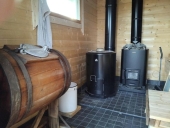
I will be building a wash house like grandma had asap when I get on my homestead, before the house. Small shed with heat that has enough space to get all the laundry done and shower. I am thinking a pebble RMH in the floor to keep water from freezing.
 
Anne Miller
steward
Posts: 18921
Location: USDA Zone 8a
4788
dog hunting food preservation cooking bee greening the desert
  • Likes 3
  • Mark post as helpful
  • send pies
    Number of slices to send:
    Optional 'thank-you' note:
  • Quote
  • Report post to moderator
I have washed a lot of clothes in the bathtub while in college and when we stayed in campgrounds.

A plunger helps this task.

A shower rod can be positioned in the middle of the tub to hang clothes so that they drip dry.
 
Posts: 762
Location: Iqaluit, Nunavut zone 0 / Mont Sainte-Marie, QC zone 4a
143
3
  • Likes 6
  • Mark post as helpful
  • send pies
    Number of slices to send:
    Optional 'thank-you' note:
  • Quote
  • Report post to moderator
I still wash most of my clothes by hand and when on vacation I hand wash and drip dry over the tub. I bring along extra bungee cords I suspend over the tub, and leave them for cleaning staff with the tip and extra flashlights and batteries when I pack up. (My son takes me to Cuba)

When we lived up north and walked everywhere and no laundry in the building, I used an expandable rack in the tub and didn't bother wringing too much.

I make use of a laundromat 2-6 times yearly and have done this for decades: go when it's quiet and practically fill all the machines with blankets and thicker clothing.

Edit: I still use the tub for soaking clothes after a bath (when the water is still clean, agitating with squeaky clean feet!) and also for hand washing any large items, then collect the gray water for flushing down the septic tank, then hang the items to drip dry on the clothes rack right in the bath, then do a couple of rinses, reusing that water as a prewash for soiled items like floor rags / dirty socks. I've been hand washing for over 40 years -- even hand washed the diapers way back.
 
pollinator
Posts: 849
Location: Clemson, SC ("new" Zone 8a)
204
11
  • Likes 3
  • Mark post as helpful
  • send pies
    Number of slices to send:
    Optional 'thank-you' note:
  • Quote
  • Report post to moderator
I know the OP indicated that drying clothes wasn't their main concern.  Regardless, I want to put this info out there for the alternative-clothes-processing community.  This copied from an older post in a different forum:

Matthew Nistico wrote:

Jerry Sledge wrote:High speed spin dryer.

https://www.amazon.com/Panda-Stainless-Steel-Portable-Dryer/dp/B01IRMBG7I/ref=sr_1_fkmr0_4?ie=UTF8&qid=1488293531&sr=8-4-fkmr0&keywords=high+speed+spin+dryer

https://www.amazon.com/Laundry-Alternative-Nina-Soft-Dryer/dp/B00CDWTQKI/ref=sr_1_fkmr0_3?ie=UTF8&qid=1488293531&sr=8-3-fkmr0&keywords=high+speed+spin+dryer

The one I saw in action in Dominican Republic years ago left me very impressed. The clothes were dry enough to iron (if you do that sort of thing). Am considering buying one of these myself.


Yes!!!  These laundry spinners are great.  I own an older model of the Laundry Alternative brand (2nd link above), that actually looks more in shape and function like the Panda brand (1st link above).  At the time I got it for about $120.  I used to use it all of the time.  If you rely on an electric or gas dryer, this can save you huge $.

It spins around a vertical axis like a centrifuge, reaching over 3000 RPM.  90% or 95% of the water is out of your clothes after 5 or 6 minutes.  No heat is involved.  You can then transfer heavy clothes, like denim or wool, to the conventional dryer and finish them up with 15 mins on the heated fluff cycle.  Thin clothes like t-shirts could probably finish on the un-heated fluff cycle.  Light weight synthetic clothes you could probably fold up straight out of the spinner.

And, unlike conventional washers and dryers, these spinners don't need to be installed.  You just pick them up, set them wherever you like, plug into a regular 120V wall outlet, and set a Tupperware under the drain spout.

Plus another benefit... it turns out that the water that you spin out of your clothes, even after a good wash in a functioning washing machine, is still surprisingly dirty.  Not "soiled," but definitely slightly soapy and often tinted with dyes from your clothes.  You can see this quite clearly, since the spinner exhausts into a Tupperware or bowel you set in front of it.  I looked at that water every time and thought "wow, without using the spin dryer, this is the stuff that a conventional dryer is baking onto my clothes every wash cycle."

Now for sure, it is a bit of a challenge to load the clothes properly so the machine spins in a balanced way; otherwise it wobbles and knocks into itself.  That doesn't harm anything, but it makes a terrible noise and doesn't reach full speed, so you have to rearrange the clothes and try again.  Over time you can get the knack of it.  And it takes small loads at a time - try to fill it to the tip top and you will NEVER get it to spin balanced - so if you have a large load from the washer you can only spin half of that at a time.

So, it is a little bit of a hassle, but it substitutes 6 minutes of spinning time for 45 or more minutes of drying time, and (assuming you have an electric clothes dryer) uses probably only 1% of the electricity in the process.

I bought one of these back when I was hand washing clothes.  Then I bought a used front loader HE washing machine and installed a clothes line.  The washer was great, a $900 machine for $150.  Only problem: the spin cycle didn't work, so clothes finished up the wash sopping wet.  I live in a wheelchair, so carrying a laundry basket of dripping clothes in my lap to the clothes line didn't sound like fun, nor did waiting days for them to dry.

But hey, I already owned the spin dryer.  Problem solved!  No water in my lap and, on a sunny or breezy day, clothes out of the spinner are dry after just a few hours.

I only occasionally use it these days, since my washer eventually died and I bought a new HE front loader.  Not only is its spin cycle functional, but it is a pretty fast spin cycle, so it usually does a good enough job on its own.  I still use the stand-alone spinner on occasion if a rain storm is coming, for instance, and I need an especially fast turn around of the clothes on my drying line.

 
Posts: 100
Location: La Bretagne
27
homeschooling solar rocket stoves
  • Likes 6
  • Mark post as helpful
  • send pies
    Number of slices to send:
    Optional 'thank-you' note:
  • Quote
  • Report post to moderator
Hello,
I had a peddle washing machine for the longest, but no longer have a working one. I use a large bucket, a plunger and let the laundry soak, with letting the kitchen and hand towels soak for at least 24 hours.

My husband made me a wringer because we're European and I think wingers are really sold only in north America now. Although I did find one on an English site, not part of Europe, again.

He never got the bottom dowel to turn, so it can be difficult to get the clothes in the wringer. I'm not sure whether the dowels not having a rubber surface affects the outcome or not. I can feel a huge difference in weight after passing towels through the wringer three times, so it's good enough for me. Even if I really would like the bottom rod to turn, also.
20260521_185712.jpg
[Thumbnail for 20260521_185712.jpg]
 
Matthew Nistico
pollinator
Posts: 849
Location: Clemson, SC ("new" Zone 8a)
204
11
  • Likes 5
  • Mark post as helpful
  • send pies
    Number of slices to send:
    Optional 'thank-you' note:
  • Quote
  • Report post to moderator
Here is my experience with actually washing - as opposed to drying - clothes without a big machine.  I no longer use these little WonderWash spinners, but for a while they did serve.  They do assume that you have a source of hot water.  Perhaps less work than filling a large tub with hot water and agitating manually...?  Certainly less space and less water required with the WonderWash.  This copied from an older post in a different forum:

Matthew Nistico wrote:

Jonathan 'yukkuri' Kame wrote:These little things get good reviews from the users:


link

I had a friend who had something similar and he liked it plenty. 


I have owned two of these.  I must agree with the opinion posted above that the WonderWash had earned a solid "okay" rating in their experience.  If you are off grid and looking for an effective way to wash clothes, this will work for you.  But there may be simpler ways to go about it.  Unlike what some reviewers have posted, mine did hold pressure.  And the pressurized hot water tumbling wash does indeed clean most soil from your clothes, though don't expect it to remove stains without some serious bleach.

The problem is that the whole device, at least as I first bought it, is rather flimsy.  All plastic, and not even particularly hearty plastic.  I built a wooden frame to reinforce and stabilize it.

I got a second one after complaining to the manufacturer, and it turned out to be an upgraded model.  The structure was thicker, to the point that the machine was fairly rigid while tumbling without me having to jerry-rig some wooden superstructure.  They had also added a drainage tap at the base of the tub, which was a huge improvement.  In its second incarnation, it was fairly usable.  I'm still not sure it was worth the trouble, as it was laborious to use and washed a small volume of clothes at a time.  Filling a bath tub full of hot water and soap would be easier and quicker.  But it would also use a lot more water, so if water is in short supply there is that to consider.

All of this was many years ago for me.  I have no idea what the WonderWash purchasing options are like today.

 
Matthew Nistico
pollinator
Posts: 849
Location: Clemson, SC ("new" Zone 8a)
204
11
  • Likes 6
  • Mark post as helpful
  • send pies
    Number of slices to send:
    Optional 'thank-you' note:
  • Quote
  • Report post to moderator
Here is the last bit of info I have to offer.  Ran across this nifty DIY demo on YouTube a while back and archived it because, hey, you never know what you might need, right?  Having said that, I have never built or used anything similar, so I can't vouch for any of this.  But the design seems pretty sound.  Certainly should be within the budget and skill set of any handy prepper looking to fabricate an off-grid solution to their laundry washing needs on the cheap.  No electricity required.  He is clearly washing in cold water from a garden hose, but if you have a conveniently located supply of hot water, that would surely increase effectiveness enormously.

YouTube: DIY off-grid clothes washer


In his YouTube poster notes, he links to a set of plans for building the washer.  Currently, the photos at that link illustrating his construction process seem to be broken, rendering the plans fairly useless.  I have the full plans in a text document, but don't see how to attach one to this post.  Instead, I have posted it to the cloud.  I think anyone should be able to view and download that document.

Plans: DIY off-grid clothes washer

In any case, here are his required materials and tools list; the best info I could extract from the document without the pictures:

MATERIALS
55 gallon barrel
30 gallon barrel
1 ¼ inch wooden rod
4 hinges
2 locking clasps
Screws
2 X 4 lumber
Short section of hose
Metal to use for a handle
Wire
Nuts and bolts
1 ¼ inch PVC pipe
Scrap tubing
Metal hook

TOOLS
Power drill
1 ¼ inch spade bit
Reciprocating saw
 
pollinator
Posts: 1162
Location: East of England/ Northeast Bulgaria
454
6
cat forest garden trees tiny house books writing
  • Likes 5
  • Mark post as helpful
  • send pies
    Number of slices to send:
    Optional 'thank-you' note:
  • Quote
  • Report post to moderator
It's not totally environmentally friendly -- all plastic and made in China -- but this giant salad spinner type works surprisingly well to both wash and spin. It can handle jeans or a double bed sheet. but probably nothing heavier. I've used ours for a couple of years now. It cost 26 GBP.

I used to just hand wash in a bucket but my arms got so sore from wringing clothes. A couple of minutes spinning in this (stopping to drain excess water every 30 seconds or so, switching arms so both get a workout), and it gets clothes dry enough I can hang them indoors in winter with no dripping.
Screenshot_20260521-194421-(1).png
[Thumbnail for Screenshot_20260521-194421-(1).png]
 
Posts: 5
  • Likes 6
  • Mark post as helpful
  • send pies
    Number of slices to send:
    Optional 'thank-you' note:
  • Quote
  • Report post to moderator
We used a smaller 5 gallon dual bucket a few times while boondocking best a fresh water source. It's not easy but it did work.

When backpacking with shower access, would wash once with clothes on than take off, wash the body and then rinse and twist and spin clothes and hang overnight to dry.
 
Posts: 21
Location: Manton, CA
2
4
trees wood heat homestead
  • Likes 6
  • Mark post as helpful
  • send pies
    Number of slices to send:
    Optional 'thank-you' note:
  • Quote
  • Report post to moderator

Matthew Nistico wrote:

In his YouTube poster notes, he links to a set of plans for building the washer.  Currently, the photos at that link illustrating his construction process seem to be broken, rendering the plans fairly useless.  I have the full plans in a text document, but don't see how to attach one to this post.  Instead, I have posted it to the cloud.  I think anyone should be able to view and download that document.

Plans: DIY off-grid clothes washer


If you couldn't access the link that Matthew Nistico posted,  Here it is also

Plans: DIY off-grid clothes washer]washing machine plans

https://1drv.ms/w/c/274af3d84f706095/IQArCyIdoSG1QZCQL1Hyr7gqATF-CfGDR84K0eOv0seVHW8?e=vJSDCm]Plans:%20DIY%20off-grid%20clothes%20washer
 
Ra Kenworth
Posts: 762
Location: Iqaluit, Nunavut zone 0 / Mont Sainte-Marie, QC zone 4a
143
3
  • Likes 4
  • Mark post as helpful
  • send pies
    Number of slices to send:
    Optional 'thank-you' note:
  • Quote
  • Report post to moderator

Nate Magee wrote:
When backpacking with shower access, would wash once with clothes on than take off, wash the body and then rinse and twist and spin clothes and hang overnight to dry.


I use my gym showers more than the equipment especially when my hair needs pressure washing and I do the same with clothes washing but I get two complimentary towels and once I'm done with them, I place the wringed out clothes inside the towels then twist and twist until I have a tight pretzel which rings out a lot more water. Then if I have time, the clothes sit in the sauna too while I take a class or two. The socks and undies dry on the dash afterwards!
 
Posts: 29
Location: tennessee
1
homeschooling cooking medical herbs
  • Likes 7
  • Mark post as helpful
  • send pies
    Number of slices to send:
    Optional 'thank-you' note:
  • Quote
  • Report post to moderator
When we lived in an Amish house, we had an old wringer washer that was adapted to run off a small Honda engine. It was great and didn't us a lot of gas. We also used a James washer - I didn't like that as much and preferred using washtubs with a plunger. The wringer washer for us was the best because we had a large household and doing the laundry with the plunger took all day long.
 
Your mother was a hamster and your father was a tiny ad:
grow your own garden and build your own home in the gardening gardeners program
https://wheaton-labs.com/bootcamp
reply
    Bookmark Topic Watch Topic
  • New Topic