|

|

|

|

|

|
|
|
|
|
|
|
|

|

|

|

|

|


 8
8


* Follow your curiosity , Do what you Love *
Permaculture page on Simperi website
8


 6
6
Anne Miller wrote:Neat idea. Some thoughts ...
I have not grown sunchokes because some folks say they cause gas.
My walking onions spread the first year doubling the amount of onions.
I did not have good luck with kale one the temperatures warm up the plants were attacked by aphids. That was before I knew about using a soap spray and killing the ants farming them with vinegar. I knew about vinegar just didn't know that ants farm aphids.
WARNING permaculture is highly addictive, it may cause life altering changes such as valuing people, community and resources, and promote respect, learning, support and kindness .
1
paul wheaton wrote:
Anne Miller wrote:I have not grown sunchokes because some folks say they cause gas.
I have heard the same thing. And I have learned three very important things:
THING-1: I have eaten sunchokes about 50 times and had gas only once. But it was sooooo good, I ate way, way, way more than i should have.
THING-2: my understanding is that you need to build up the ability to thoroughly digest sunchokes. Start small.
THING-3: apparently, if you harvest after the first hard frost, there will be less digestive issues.
Here's a thing? Ferment sunchokes so they're partially digested prior to consumption to reduce gas.
How to Ferment Jerusalem Artichokes - The Backyard Larder https://backyardlarder.co.uk/2020/12/how-to-ferment-jerusalem-artichokes/
Many thanks
Steve Marquis
Permaculture Teacher and Mentor
Climate Action Educator


 7
7
How Permies works: https://permies.com/wiki/34193/permies-works-links-threads
My projects on Skye: The tree field, Growing and landracing, perennial polycultures, "Don't dream it - be it! "
10
S. Glass wrote:Fairy potatoes: grows wild in many climates, entire plant is edible, no real maintenance necessary
1
Cassie Martin wrote:I don't know if they do this everywhere, but potatoes are tenacious where I live. If you miss just one or two little potatoes, they grow big, healthy plants next year. There are potatoes growing in the lawn areas where we had garden beds years ago. They could hypothetically be harvested any time, you would just need to know where they were in the winter.
Any potatoes left in the ground would have already frozen solid during the colder months. The freezing process ruptures the potato's cell walls, turning the flesh gray or reddish-brown. When thawed, the potatoes would become a mushy, inedible mess.
7
paul wheaton wrote:I asked google and google said
Any potatoes left in the ground would have already frozen solid during the colder months. The freezing process ruptures the potato's cell walls, turning the flesh gray or reddish-brown. When thawed, the potatoes would become a mushy, inedible mess.
How Permies works: https://permies.com/wiki/34193/permies-works-links-threads
My projects on Skye: The tree field, Growing and landracing, perennial polycultures, "Don't dream it - be it! "
 7
7
Nancy Reading wrote:
paul wheaton wrote:I asked google and google said
Any potatoes left in the ground would have already frozen solid during the colder months. The freezing process ruptures the potato's cell walls, turning the flesh gray or reddish-brown. When thawed, the potatoes would become a mushy, inedible mess.
Google obviously doesn't live in a mild area! They overwinter quite happily here too.


 6
6
Or a very harsh area! We occasionally hit -40 C/F and potatoes overwinter for me too, but it depends on the variety. A theory I'd been playing with is that our sand allows all water to drain away from the tubers, but I've also seen people on clay say taters overwinter for them as well. So I guess genetics is my current best theory.
Life doesn't always follow the plan.
No, I'm not all-right - I'm half left!
6
paul wheaton wrote:I think it is good to note which things get chomped by deer, but I also think that getting chomped by deer does not excludesit from "the top 3".
I have a fenced area. And a lot of unfenced area. And a LOT of deer pressure.
The deer eventually chomp the kale and the sunchokes. But I can still get a big kale harvest before they chomp it. And the sunchokes tolerate some chomping late in the season. So kale is mostly grown in the fenced area.
The deer do not chomp the onions.
Everybody is going to have different zones and challenges. Some people have zero deer problems.
There are thousands of gardening books where people talk about growing gardens and there is zero mention of deer.
And thousands of gardening books growing stuff that will not grow in a tropical climate and they have zero mention of citrus, bananas, etc.
I mention all this because I appreciate the discussion of challenges ("grow in a fenced area" or "the deer don't seem to want it") but some of the wording seems dark to me because it seems to discourage anybody trying due to challenges.
Many thanks
Steve Marquis
Permaculture Teacher and Mentor
Climate Action Educator
3
5
8
2
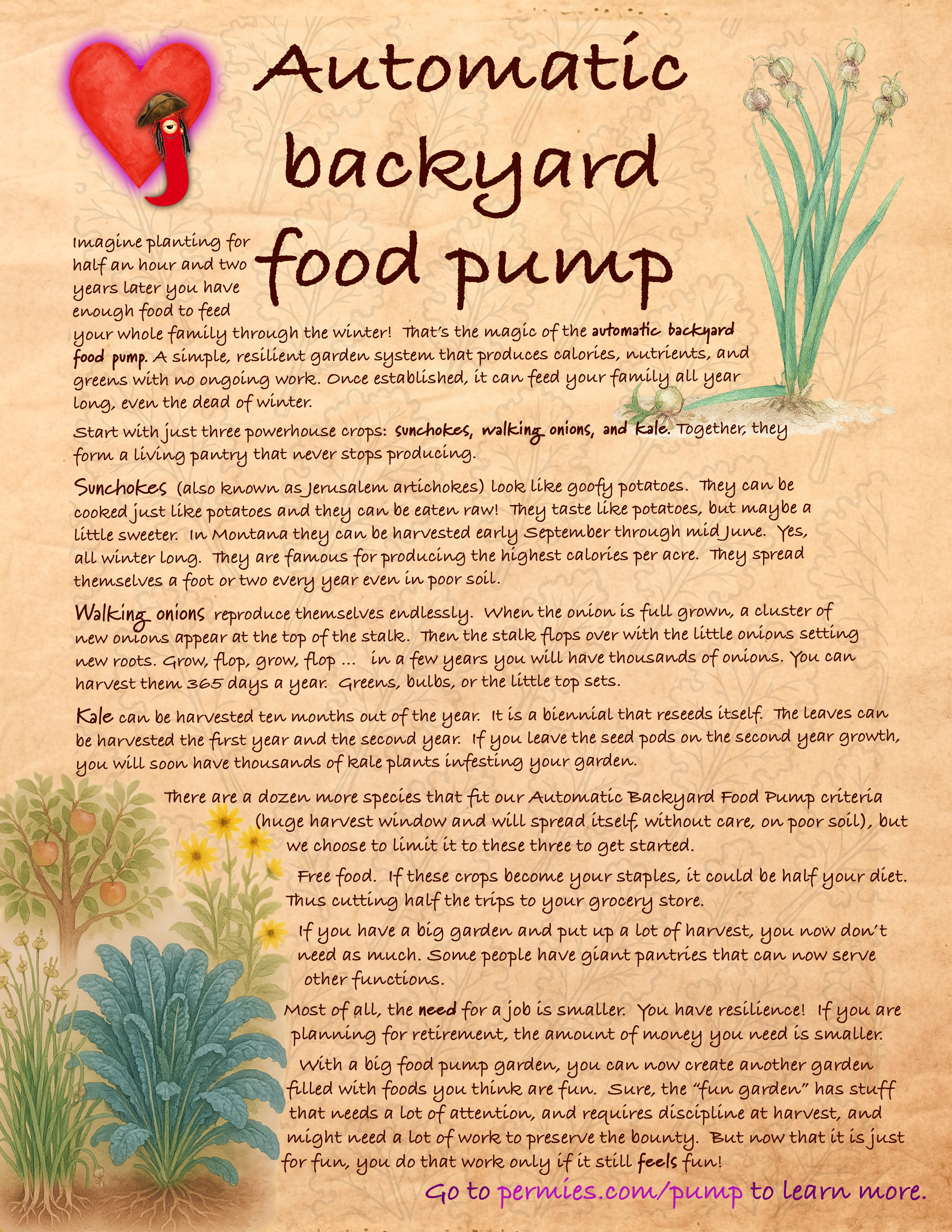
paul wheaton wrote:is there anything that would bump something off of my current top 3?
(sunchokes, walking onions and kale)
16


How permies.com works
What is a Mother Tree ?


 3
3
Burra Maluca wrote:I think I need to find a way to get some of my galega seed to you. It's a perennial tree cabbage, very similar to kale but 'older' genetics, which is usually kept perennial by removing the flower buds- But I've been selecting for the ability to survive seeding and have seed off one that survived for four years and seeded successfully for three of those. Generally they live for seven or so years if you take the buds off.
Lif Strand
New Mexico USA
3
paul wheaton wrote:I like this general idea that this can be morphed into other zones, other conditions, other challenges ... Before I can contemplate those, I guess I would like to ask... etc
paul wheaton wrote: What I really want to do is be able to say something like
- spend 30 minutes gardening the way I tell you. NO FUCKING VARIATIONS! Obey my instructions or fuck off.
Lif Strand
New Mexico USA
7
Lif Strand wrote:I don't think Galega (commonly known as goat's rue or French lilac) is a tree cabbage. It's in the legume family. Tree Kale is in the Brassica oleracea family. I think I would prefer it more than regular kale because supposedly it doesn't taste a whole lot like regular kale.
How permies.com works
What is a Mother Tree ?
1
Burra Maluca wrote:This is couve galega, and it's Brassica oleracea. Nothing to do with goat's rue. It's one of the original brassicas to be domesticated and never had its perennial tendencies bred out. Probably older than anything currently labelled 'kale'. Every self respecting Portuguese garden has these growing just outside the back door. The lower leaves double as toilet paper.
Lif Strand
New Mexico USA
2
Trying to regenerate depleted soil by making loads of compost and use watermanegment techniques.
11
"We're all just walking each other home." -Ram Dass
"Be a lamp, or a lifeboat, or a ladder."-Rumi
"It's all one song!" -Neil Young
6
Kathleen Sanderson wrote:
The kale - I'm not sure about. It's a good choice in a lot of respects. Daughter tolerates sauerkraut well (and dill pickles); it seems likely that kale could be made into sauerkraut, though it would be a little different....
12
There are no coincidences or accidents, only lessons. We are all creators, blessing the Earth with our talents. We observe, allow, assess, release and move on, becoming more of who we REALLY are! God, Gaia. and the Elementals are waiting with baited breath! " Kimberlay

 7
7
L Anderson wrote:Inge:
Thank you for this list of easy vegetables! It will help me to expand what I grow.
By the way, I wonder if your sweet beet is related to parsnip? I
"Also, just as you want men to do to you, do the same way to them" (Luke 6:31)


 10
12
10
12
 8
8
 4
4
 4
4
 4
4
Lina
https://catsandcardamom.com
7
7
(Reminder to myself) God didn't say, "well said, well planned, and well thought out." He said, "well done."
Nikki's Wishlist


 5
5
Nikki Roche wrote:I met a couple of requirements of this thought experiment. I'm in zone 7b in southeastern US, and I have 1/6 acre fenced-in garden that's been largely ignored for about 4 years. I chopped and dropped a lot of it a few years ago, and then health problems got in the way. The lesson I learned was "don't put all of your eggs in one basket." I like the idea and simplicity of 3 main crops, but I think having only 3 and then ignoring them until needed would make me more concerned. Because interestingly, the sunchokes and walking onions, which were thriving and spreading for several years, all died during the last 4 years. There was weed pressure, deer pressure for the sunchokes, record low temperatures in winter, and a record drought one summer. Kale has never reseeded itself for me. A couple of radishes still show up here and there from reseeding, and I find garlic in various places that I missed harvesting.
Over those 4 years, a couple of pine trees and lots of blackberries showed up. Blueberries and muscadines are thriving. Perennial herbs are doing well, and asparagus is still producing, though it's not a fan of all the weeds. Lambsquarter and chickweed show up each year, but often not in the same spots they were in the year before. During the winter, my fresh (not stored) choices were dandelion, henbit, plantain, wild onions, and chickweed, unless I wanted to collect and process acorns.
If I were to plant food that I could leave for extended periods, I'd feel the need to opt for a variety of perennial veggies, lots of berries, trees if there's room, and annual edible "weeds." I might miss some windows of harvest, but there'd be *something* to harvest at almost any time and I wouldn't be in a clutch if one of those harvests failed or died. I imagine 3 core crops would work great for some people, but I'm not built for that after my gardening experiences.
After reading this thread, I want to look into skirret. I haven't had any luck with carrots, yet. And I want to investigate more edible tubers, as I don't know if achira or chufa would be options for me.
"Also, just as you want men to do to you, do the same way to them" (Luke 6:31)
3
5
Daniel Andy wrote:I'd like to expand on this question for those with greenhouses.
If you have a (small!) greenhouse and can grow tropical (or subtropical crops) year round...which plants are the ideal ones for low effort food? I assume various tropical fruit trees, but I could be wrong. Beyond that I have no idea and I would love to hear what people think.
The assumption is this is a small greenhouse....
"Also, just as you want men to do to you, do the same way to them" (Luke 6:31)
5
paul wheaton wrote:
I have never tried to harvest potatoes in winter.
I asked google and google said
Any potatoes left in the ground would have already frozen solid during the colder months. The freezing process ruptures the potato's cell walls, turning the flesh gray or reddish-brown. When thawed, the potatoes would become a mushy, inedible mess.
4
Inge Leonora-den Ouden wrote: Where I live a greenhouse can be used for growing peppers, tomatoes, cucumbers, a.a. Real tropical plants need not only more heat, but also more light than there usually is in this cloudy climate. To heat the greenhouse and have grow-lights on ... can't be called 'automatic'.
Visit Redhawk's soil series: https://permies.com/wiki/redhawk-soil
How permies.com works: https://permies.com/wiki/34193/permies-works-links-threads


 4
4
Inge Leonora-den Ouden wrote:
Daniel Andy wrote:I'd like to expand on this question for those with greenhouses.
If you have a (small!) greenhouse and can grow tropical (or subtropical crops) year round...which plants are the ideal ones for low effort food? I assume various tropical fruit trees, but I could be wrong. Beyond that I have no idea and I would love to hear what people think.
The assumption is this is a small greenhouse....
Hi Daniel. Where I live a greenhouse can be used for growing peppers, tomatoes, cucumbers, a.a. Real tropical plants need not only more heat, but also more light than there usually is in this cloudy climate. To heat the greenhouse and have grow-lights on ... can't be called 'automatic'.
But of course in other regions, with other climates, tropical plants can be grown in a greenhouse. In that case my first choice would be: bananas! Because I love them.

|
Those cherries would go best on cherry cheesecake. Don't put those cherries on this tiny ad:
better than composting toilets
https://www.richsoil.com/willow
|