
• Post Reply Bookmark Topic Watch Topic
  • New Topic
permaculture forums growies critters building homesteading energy monies kitchen purity ungarbage community wilderness fiber arts art permaculture artisans regional education skip experiences global resources cider press projects digital market permies.com pie forums private forums all forums
this forum made possible by our volunteer staff, including ...
master stewards:
  • Carla Burke
  • Nancy Reading
  • John F Dean
  • r ransom
  • Jay Angler
  • Timothy Norton
stewards:
  • paul wheaton
  • Pearl Sutton
  • Tereza Okava
master gardeners:
  • Christopher Weeks
  • M Ljin
gardeners:
  • thomas rubino
  • Jeremy VanGelder
  • Megan Palmer

!!!!!!!!!!!!!!!!!!!!! what if the cost of food goes up 10x?

 
Posts: 6
Location: France. Bretagne
  • Likes 2
  • Mark post as helpful
  • send pies
    Number of slices to send:
    Optional 'thank-you' note:
  • Quote
  • Report post to moderator

I was 'freaking the fuck out' for quite a long time...not because the gloriously horrible v. wealthy society didn't have enthusiasm to support me, or my 6 cats...who needs support from nit wits? But. There seemed to be some enthusiasm to dispose of me pronto... Haha. Just try it people...
And because it dawned on me that my two tiny islands and one cliff were all v ancient, slate quarry territory, so bye bye that dream of entirely home grown self sufficiency, at least for a while.
It took ages to recognize that the planet supports abundant vigorous life, but not at all in any way that supports posh homes and fitted carpets. Kind of irrelevant.  
Now I live my own kind of fabulous deluxe.
Gorgeous huge spicy stews that can change every day, with more vital vits and mins, more flavour than any posh nosh in Harrods. I keep all costs to microscopic as a fun way to Win against all odds. And I'm winning.


paul wheaton wrote:(I'm gonna delete anything with the slightest whiff of politics.  I am starting this thread to talk about solutions, not being angry at bad guys)

I am currently on the phone with andres.  He is ...  well ....  I wanna say "concerned", but it is closer to "freaking the fuck out" ...   Maybe I need a word between these two.  

Andres has several topics "concerning" him.  Political, climate stuff, economic changes ....   he isn't weeping right now, but i suspect that that is on the agenda for later.  

Andres wants all of everybody in the world to know about our big gardening resources.  And then this discussion can move on to "what if?"

    https://gardenmastercourse.com
    https://pdcvid.com
    https://earthworksmovie.com
    https://permies.com/pump - automatic backyard food pump
    https://permies.com/hug - hugelkultur


What if the price of food goes up 10x?

Naturally, if you have a humble home and a large garden, this isn't such a big deal.  In fact, with a humble home and a large garden, all of politics becomes small and far away.

I guess some of us are ready.  I am growing enough food to feed 20 people.  Most of it can be harvested through the winter.

I get the impression that there is huge concern for people that are currently not growing food.  I feel like I have been trying to persuade people to grow their own food for decades, so I want to direct those people to all the stuff I have shared over the last couple of decades.  I do feel the best stuff is my most recent "automatic backyard food pump."


pollinator
Posts: 3451
Location: Meppel (Drenthe, the Netherlands)
1168
dog forest garden urban cooking bike fiber arts
  • Likes 7
  • Mark post as helpful
  • send pies
    Number of slices to send:
    Optional 'thank-you' note:
  • Quote
  • Report post to moderator
Hi. I did not yet read all posts in this thread.

I just want to say: in case of emergency the sunchokes grow right behind my back door. And some type of Allium (but not exactly walking onions) too. And more herbs.
The rhubarb is doing great, this morning I picked the first two stalks and had them (slightly cooked) with pancakes and honey.
I try to grow more perennial kale now too. The one I had only lasted for a few years. Yesterday I planted seeds of Sutherland kale, I hope that's a more 'perennial' type.

In my allotment garden I grow all kinds of greens and beans (also pulses). My allotment garden has lots of berry bushes too, all different kinds of berries that like to grow in this climate/soil. So I make many jars of berry-jam. I often give a jar of jam as a gift to my friends. But I think : in case of emergency it's good to have friends!
 
pollinator
Posts: 674
Location: Zone 8A
152
homeschooling kids rabbit tiny house books chicken composting toilet medical herbs composting homestead
  • Likes 6
  • Mark post as helpful
  • send pies
    Number of slices to send:
    Optional 'thank-you' note:
  • Quote
  • Report post to moderator

paul wheaton wrote: I get the impression that there is huge concern for people that are currently not growing food.  I feel like I have been trying to persuade people to grow their own food for decades, so I want to direct those people to all the stuff I have shared over the last couple of decades.  I do feel the best stuff is my most recent "automatic backyard food pump."


I share that concern due to the learning curve involved in growing your own food and meat. Some people, who do not garden, think it is as simple as going out in your yard and planting seeds and getting a couple of chickens.

Not even taking into account soil preparation, mulching, composting, you have to take a year (or more) to figure out what does well in your location and what your willing to baby that needs extra attention. You have to figure out what you like to eat or take the time to adjust your palate to what you can grow in your area.

For animals, a breeding program is very helpful unless you happen to get some excellent breeders to start with. Selecting rabbits to breed based on size, good mothering, litter sizes, and that they eat the fresh stuff you give them. The plan does not need to be formal or written down. Just mental notes about which rabbit does and likes this and that.

If you are raising non commercial chicken breeds, selecting for size is very helpful. Seeing how much of your livestock you can feed from your land. We know if chicken feed became unavailable, we need to cull down to about half of our flock number and then could keep them alive.

I am sure folks here can multiply examples.

I am saying these things as an encouragement, not a discouragement. The learning curve is a lot of fun and very satisfying to solve a piece of the puzzle every so often and try new things.

But the learning curve does exist and the encouragement from us would be to start now. Even if it is only a balcony or a suburban yard.
 
pollinator
Posts: 138
40
  • Likes 4
  • Mark post as helpful
  • send pies
    Number of slices to send:
    Optional 'thank-you' note:
  • Quote
  • Report post to moderator
The situation is bleak,  forget oil,  because nitrates are the biggest  problem,  I believe Canada and USA can be OK because there is lots of oil and gas here, and they make nitrates and urea from natural gas and it isn't that difficult.  But we all import a hell of a lot of food that we could grow ourselves. This food supply will stop.   By the fall, there could easily be mass starvation across South America,  Europe,  Africa and Asia, because of the Nitrate problem.   Think about it,  natural nitrate is produced across the land and oceans by mostly blue green algae, beans, peas, legumes in general, alders, azolla, and  lightning   and that is it!    Scientists have measured natural nitrate production across the globe and manufactured nitrates from humans and it is neck and neck, with the humans producing slightly more.   So 50 50,  and the human produced stuff all goes on agricultural land, meaning that it has an enormous impact on yields and we cannot simply replace it with natural nitrate because it can never be produced in such a huge  quantity.  So what to do?  I  actually have a bit of a plan for this.   I have a Tracking solar reflector (about 600 watts) that runs when the sun is in the sky.  I steam sterilize soil layered with chopped up weeds in a 14 liter pot.  (chopped by running the lawn mower over them).  Roughly 2.5 hours for 10 liters of soil.   That skips the composting step, the composting is done in the soil.  Chopped weeds rot quicker than unchopped weeds,  and you what rots quicker than chopped weeds?   Cooked chopped weeds!  So there will be a period when the soil bacteria and fungi come back and go into overdrive, and plants might struggle a bit, but once that is past, it should be good times for the plants.  I'm going to try to automate the soil steaming, so there will be a hopper, that I fill with soil in the morning, and an auger that will be switched on and off by a thermostat, to bring soil through the hot zone as soon as it is fully steamed,  kind of like pasteurization.  So, end product lots of steamed soil (hopefully). If you are worried about the soil biome, there is a solution,  just use the steamed soil as a 4 inch layer as a heavy mulch.  The bacteria and fungi will come up from below.   I also use it to run a solar dehydrator.  BUT, it needs a fan, to stop stuff from burning.  Even so, I dehydrated a lot of stuff last year and solar dehydration beats the freezer on running costs big time.      Another thing is Azolla.   I was reading up research findings over the last couple of days,   Azolla fixes nitrogen roughly twice as fast as beans!   You cannot beat that.  But azolla has something in it that makes animals  and chickens not thrive so well.   Drying or cooking the azolla seems to reduce this anti-thriving factor but doesn't seem to eliminate it.   Pretty amazing to me that they have not exactly figured out what the problem is in all these years!  My goldfish love duckweed, they mildly dislike azolla. Azolla grows in shallow water and it  can double its biomass in 4 to 10 days,  so I plan  to grow it with wood ash as fertilizer,  have it pull nitrogen from the air,  layer it with the soil and steam it in the solar cooker, as a complete organic fertilizer.    If I have too much azolla,  I will steam it separately and  both try to feed it to my fish and use it as steamed mulch.    I'm also pushing an idea called the "well trompe",  Trompes in "wells" at low head hydro sites along rivers,  to collect and remove sediment, to strongly oxygenate the water, and provide areas where river shellfish and baby fish can shelter.  The trompe produces low pressure air,  which is not useful for electricity, so I am talking to the Lego air engine guys, to try to get them to make tesla turbines,  and di Pietro engines that will run on 3.5 psi air.  And then we CAN use the well trompes to produce electricity!   (Currently governments are getting rid of river hydroelectricity to allow fish to migrate.   This includes small hydropower because the turbine blades slice up fish and that isn't great when they migrate).   But a trompe doesn't have a turbine!  And hopefully that makes a difference to officialdom.  Here is one of the best Azolla videos that I found yesterday.  Lets all try growing and processing azolla!  They grow  a lot of azolla on a shallow lake and they pellet it for chickens!      
 
Posts: 9
6
  • Likes 7
  • Mark post as helpful
  • send pies
    Number of slices to send:
    Optional 'thank-you' note:
  • Quote
  • Report post to moderator
What happened to all the covid gardeners?  I thought covid got everyone back into life’s simple pleasures?  I guess people got traumatized.

We’re good.  I will be a bit more diligent with continual harvest this year in case I need to share even more with family, friends, and neighbors, but I believe our garden is well stocked otherwise.  Will pass on more seeds to my local library too in case the panic has started.

I do need to get some supplies for this year’s home maintenance projects that I better get on before tariffs and fuel costs blow it up, but otherwise life goes on while the stupid goes on around us. (That concludes my thought on politics.)

 
out to pasture
Posts: 13167
Location: Portugal
4269
goat dog duck forest garden books wofati bee solar rocket stoves greening the desert
  • Likes 9
  • Mark post as helpful
  • send pies
    Number of slices to send:
    Optional 'thank-you' note:
  • Quote
  • Report post to moderator

Brian White wrote:... nitrates are the biggest  problem  


The orange tree and the prickly pears love it if you pee by them. I have a pee-bucket in the house which gets emptied near the most deserving looking plant or empty garden bed.

We compost humanure which gets applied to the fruit trees when it's ready, though we are currently switching to a willow feeder system which will do the same job but with far less effort.
 
pollinator
Posts: 269
73
9
hugelkultur books chicken cooking food preservation greening the desert
  • Likes 4
  • Mark post as helpful
  • send pies
    Number of slices to send:
    Optional 'thank-you' note:
  • Quote
  • Report post to moderator

Burra Maluca wrote:

snip

I'm on the hunt for a couple of lovage plants as I think they will make basic home-cooked meals much tastier, and they live for about 15 years. Much cheaper than buying celery, and easier than growing celery every

snip


Garlic chives. readily reseed, very tasty, bees love them and they grow for a very long season.

asparagus, another long term one.. even here in the desert we cone across patches that were planted along arroyos years ago, and are now forgotten but still producing!!

Sandy
 
Posts: 43
Location: 10a
25
dog cooking woodworking
  • Likes 4
  • Mark post as helpful
  • send pies
    Number of slices to send:
    Optional 'thank-you' note:
  • Quote
  • Report post to moderator

Edward Lye wrote:I have a prepared response to such topics:


Precisely - Outstanding!

Carrie Savo wrote:What happened to all the covid gardeners?  ...I guess people got traumatized.


Again: 'Normalcy Bias' - Same people that buy that '2K Watt Honda Genny' when Hurricane-Whatever approaches... then Return the Genny when the storm passes.. <facepalm>

Three Cheers for this-place, that helps people 'See Outside the Matrix'.  That's what will Rescue the World - Food Independence.  (well, and seeing 'Politicians turned into Fertilizer'.. But I digress..
 
gardener
Posts: 1435
Location: Miami, 11a, Am, apartment dweller
965
10
hugelkultur kids forest garden trees books wofati cooking bike rocket stoves
  • Likes 10
  • Mark post as helpful
  • send pies
    Number of slices to send:
    Optional 'thank-you' note:
  • Quote
  • Report post to moderator
i think that anyone replying to this thought experiment with some version of 'no biggie' or 'not much will change for me' are real permaculture millionaires https://permies.com/t/gert
 
Posts: 1
  • Likes 1
  • Mark post as helpful
  • send pies
    Number of slices to send:
    Optional 'thank-you' note:
  • Quote
  • Report post to moderator
Good Day,

I work in the organic food industry. Importing food around the world.

In approximately, 1-2 years we will have a serious shortage (intentionally or not) of organic imported foods due to high prices. Mainly for 2 reasons, container shipping prices will be getting out of hand. This will be the first problem as we get to the end of 2027 into 2028 there will be a currency issue causing the imported goods to be comparatively really expensive as it relates to the currencies around the world, namely the Unit.

 
author & steward
Posts: 5934
Location: Southeastern United States - Zone 7b
3742
7
goat cat forest garden foraging food preservation fiber arts medical herbs writing solar wood heat homestead
  • Likes 10
  • Mark post as helpful
  • send pies
    Number of slices to send:
    Optional 'thank-you' note:
  • Quote
  • Report post to moderator
All I know is that by producing at least some of our own food and staying out of debt, we've weathered unemployment, inflation, ordinary price hikes, supply chain disruptions, lockdowns, and silly social trends (remember when people were boasting about buying up all the toilet paper?). And we've weathered it all quite comfortably. We've had very little lifestyle disruption.

My husband and I started with a garden, and gradually expanded our food production: fruit trees, grain, chickens, goats. Thanks to permies, i have someplace to go if I have a question or a problem. I've learned to cultivate perennial foods like sunchokes, hopness, lambs quarter. I've learned better preservation techniques and how to make things like cheese, kefir, kimchi, and sourdough bread.

We all start at the same place - the beginning. Modern society is all about buying everything, so learning how to grow food is something new to learn. It's challenging because there is no one-size-fits-all solution for every gardener. Every time I've moved I've faced a new learning curve in terms of soil, weather patterns, growing conditions, etc. I think it's those who see the value of the goal who stick with it. It requires experimentation and while we've had some failures, we've had many successes. There's just something incredibly satisfying about going out to the garden and picking lunch or dinner.
 
pollinator
Posts: 113
65
3
  • Likes 13
  • Mark post as helpful
  • send pies
    Number of slices to send:
    Optional 'thank-you' note:
  • Quote
  • Report post to moderator
We upgraded the garden & back field to make 1.5 times as much food as we consume, if food cost goes up 10x then I'll be sharing even more food with neighbors and helping them fortify their gardens.
 
author and steward
Posts: 60002
Location: missoula, montana (zone 4)
hugelkultur trees chicken wofati bee woodworking
  • Likes 8
  • Mark post as helpful
  • send pies
    Number of slices to send:
    Optional 'thank-you' note:
  • Quote
  • Report post to moderator

J. Syme wrote:We upgraded the garden & back field to make 1.5 times as much food as we consume, if food cost goes up 10x then I'll be sharing even more food with neighbors and helping them fortify their gardens.


Maybe that's the true core:  save our apple seeds to plant in the neighbor plots.  Visit our neighbors to plant sunchokes, walking onions and kale.  

Maybe do a little "forage gardening" once a week or so.  In time, there could be enough food to feed a few hundred people nearby.


Posts: 43
Location: Omaha, United States
20
3
  • Likes 3
  • Mark post as helpful
  • send pies
    Number of slices to send:
    Optional 'thank-you' note:
  • Quote
  • Report post to moderator
I'm not so concerned about growing food.  If I put my mind...and back...to work I could grow plenty of food in my backyard to cover a food cost increase.  My concern is that my family won't eat what I grow.  i realize that starvation is a good motivator, but is there somewhere in here that talks about cooking what we can grow in a way that is palatable to picky eaters?  Or a way to slowly move from processed food to more natural food without having the crew revolt.
 
Burra Maluca
out to pasture
Posts: 13167
Location: Portugal
4269
goat dog duck forest garden books wofati bee solar rocket stoves greening the desert
  • Likes 9
  • Mark post as helpful
  • send pies
    Number of slices to send:
    Optional 'thank-you' note:
  • Quote
  • Report post to moderator

paul wheaton wrote:Maybe that's the true core:  save our apple seeds to plant in the neighbor plots.  Visit our neighbors to plant sunchokes, walking onions and kale.  


A couple of years ago I planted a load of quince seed and took cuttings off my best fig tree. I've given away a lot of the young fruit trees from that, and also planted quince in places on my own land where they might or might not survive with no help. If they do survive, there will be surplus to share.

I also heard from someone whose father used to work on the railway line that the railway workers used to plant fig trees alongside the line where they could pick them whilst working. I was inspired by that, as our access track passes between the railway line and my son's land, so I planted a couple of fig trees on the edge of the land where, in a few years, anyone walking past can help themselves to any ripe fruit. It's not quite guerilla gardening, but it's close.

I have some young apple trees that are nearly big enough to go out alongside the access track too, and I have a load of mulberry cuttings that I'm not quite sure if they've taken or not yet. If they have I intend to plant a few of those around the place and hand the rest out to friends and neighbours too.
 
gardener
Posts: 875
Location: N.E.Ohio 5b6a
601
food preservation homestead ungarbage
  • Likes 6
  • Mark post as helpful
  • send pies
    Number of slices to send:
    Optional 'thank-you' note:
  • Quote
  • Report post to moderator
I think we would be extremely wealthy if this happens.  Our Ohio soil naturally produces an abundance.  Permaculture has given our soil the ability to have zero outside the farm inputs.   I bet we can grow enough food in one year to feed us 10 years.  I am working on better storage and upgrading proteins from what we can grow.  For example, corn is one of the best high calorie food/feeds that easily stores in outdoor nonenergy consuming spaces.  Corn has many open pollinated lines for different uses. All of them will feed chickens and animals for upgrading proteins.  The nut trees with legumes and dandelions grow many squirl and rabbits.  Selling our extra at 10x prices would easily pay all our bills and then some.  Darn garden, I am never going to get skinny.
 
jd hutton
Posts: 43
Location: 10a
25
dog cooking woodworking
  • Likes 6
  • Mark post as helpful
  • send pies
    Number of slices to send:
    Optional 'thank-you' note:
  • Quote
  • Report post to moderator

paul wheaton wrote:...Maybe that's the true core:  save our apple seeds to plant in the neighbor plots... Visit our neighbors to plant sunchokes...


I did that! Forgot about that.. Last harvest of Sunchokes, took a half-dozen tubers literally to the 'Girl Next Door' (unbeknownst to Her and planted 'em around her 'Ornamental' Ficus Americana - and in a few weeks, Blammo - she, too, had Sunchokes ('course, she had no Clue, but "pretty!"

So... 'Guerilla Gardening'? Sounds legit.
 
steward and tree herder
Posts: 12965
Location: Isle of Skye, Scotland. Nearly 70 inches rain a year
6823
6
transportation dog forest garden foraging trees books food preservation woodworking wood heat rocket stoves ungarbage
  • Likes 6
  • Mark post as helpful
  • send pies
    Number of slices to send:
    Optional 'thank-you' note:
  • Quote
  • Report post to moderator

Jason Tuller wrote:is there somewhere in here that talks about cooking what we can grow in a way that is palatable to picky eaters?  Or a way to slowly move from processed food to more natural food without having the crew revolt.


I found this thread on feeding children which is probably appropriate for older people too! this one talks about swapping unhealthy diets to be healthy family dinners. I suspect the key is to do it gradually....
 
master gardener
Posts: 2207
Location: Zone 5
1227
ancestral skills forest garden foraging composting toilet fiber arts bike medical herbs seed writing ungarbage
  • Likes 4
  • Mark post as helpful
  • send pies
    Number of slices to send:
    Optional 'thank-you' note:
  • Quote
  • Report post to moderator

Jason Tuller wrote:I'm not so concerned about growing food.  If I put my mind...and back...to work I could grow plenty of food in my backyard to cover a food cost increase.  My concern is that my family won't eat what I grow.  i realize that starvation is a good motivator, but is there somewhere in here that talks about cooking what we can grow in a way that is palatable to picky eaters?  Or a way to slowly move from processed food to more natural food without having the crew revolt.


These threads might be interesting to you:

Plants that are money in the bank, food in the ground

How do you cook your weeds?


I’ve found that family will eat wild greens happily if they’re well prepared, but if you ask them if they want dandelion or nettle or garlic mustard or parsnip, they will be very slow to admit it. Even dogs like my cooked greens!

I think anything people think of as a “noxious weed” tends to be a bit hard to sell, at least at first. People seem to have a lot of preexisting aversion.

Dame’s rocket and milkweed have come to be “officially vegetables” so to speak because they are good, and relate to “ordinary” vegetables in a meaningful way. Milkweed is said to be like asparagus but a bit better, and the same with dame’s rocket and broccoli. Sunchokes are also very well loved. Ramps and fiddleheads have already been long appreciated.

Rhubarb also is a crowd favorite.
 
M Ljin
master gardener
Posts: 2207
Location: Zone 5
1227
ancestral skills forest garden foraging composting toilet fiber arts bike medical herbs seed writing ungarbage
  • Likes 4
  • Mark post as helpful
  • send pies
    Number of slices to send:
    Optional 'thank-you' note:
  • Quote
  • Report post to moderator
Acorns are treated like pig food or worse which is very sad. They are healthy, filling, and delicious, but I’ve been told they taste like nothing. Some people like them a little undercooked for the astringency, interestingly. I don’t think silly family dynamics can be underestimated.

my recent acorn post
 
J. Syme
pollinator
Posts: 113
65
3
  • Likes 5
  • Mark post as helpful
  • send pies
    Number of slices to send:
    Optional 'thank-you' note:
  • Quote
  • Report post to moderator
forage gardening, hmm, I have a slingshot & hiking shoes, anyone have a good seed bomb recipes for Ohio/Pennsylvania areas? Dropping wild radish seeds into deer track holes isn't as fun as launching clay seed balls thru the air. best time to plant a tree, ten years ago, second best time right now....


paul wheaton wrote:

J. Syme wrote:We upgraded the garden & back field to make 1.5 times as much food as we consume, if food cost goes up 10x then I'll be sharing even more food with neighbors and helping them fortify their gardens.


Maybe that's the true core:  save our apple seeds to plant in the neighbor plots.  Visit our neighbors to plant sunchokes, walking onions and kale.  

Maybe do a little "forage gardening" once a week or so.  In time, there could be enough food to feed a few hundred people nearby.


gardener
Posts: 3653
Location: Western Slope Colorado.
844
5
goat dog food preservation medical herbs solar greening the desert
  • Likes 2
  • Mark post as helpful
  • send pies
    Number of slices to send:
    Optional 'thank-you' note:
  • Quote
  • Report post to moderator
It’s an interesting question.  Between the extra food I ate in the past and keep with me at all times😉, the food I have on hand, the existing food plants, the pasture, and the seeds and animals I have on hand, I think I have about a year’s lead time. It would be a hungry year, but not uncomfortably so.

I’m also in a position to trade skilled “labor” for food. (Currently weeding the garlic at an organic small farm in exchange for garlic seconds, tomato and other surplus as the season passes.  I am also allowed to take home the weeds I remove.  Onion sprouts, plantain plants, dandelions etc.)

After a couple years I would be the one needing help, having food to provide in return.

Might even happen that my neighbors with wealth and HOA values and mentality would see me and my style in a different light.  If their property were managed with different objectives it would benefit me too.  They just don’t know it yet.
 
Posts: 1
Location: Townsend, MT - Zone 4B
fungi composting homestead
  • Likes 5
  • Mark post as helpful
  • send pies
    Number of slices to send:
    Optional 'thank-you' note:
  • Quote
  • Report post to moderator
Paul, it's always great to get your monthly-ish emails.  At first I thought I was crazy to get on another email list.  But this list I actually enjoy reading.  The subject matter here is 100% appropriate.  Top things I need to add to my food forest this year are sunchokes and walking onions.  I couldn't agree with you more here.  The best medicine to avoid those price hikes is to plant more in your food forest.  Whether it's sunchokes and walking onions or wine cap mushroom spawn.  Those gifts that keep on giving are the best ones.  Oh and flax.  Flax are being planted this year too!


My next question is what are you top quicks for your food forest for those of us who live up north in Zone 4 or lower.

 
steward & author
Posts: 45892
Location: Left Coast Canada
18393
10
art trees books chicken cooking fiber arts
  • Likes 8
  • Mark post as helpful
  • send pies
    Number of slices to send:
    Optional 'thank-you' note:
  • Quote
  • Report post to moderator

Jason Tuller wrote:I'm not so concerned about growing food.  If I put my mind...and back...to work I could grow plenty of food in my backyard to cover a food cost increase.  My concern is that my family won't eat what I grow.  i realize that starvation is a good motivator, but is there somewhere in here that talks about cooking what we can grow in a way that is palatable to picky eaters?  Or a way to slowly move from processed food to more natural food without having the crew revolt.


I'm the fussy eater in the house.  I completely understand this concern as it is a thing that happens.

Two main approaches work for me.

1. I grow a lot of kale because it's the most nutritious green veg that survives our climate.  It loves our climate.  It's the lowest effort edible crop, even easier than weeds.  I let it self seed every year and it can out compete most weeds.  So even if we don't garden that year, kale will still be there.

I also lothe eating kale.

I tried, I really tried to like it.  I faled.

But I know it as backup food.  Like money under the mattress for emergencies.  It's not everyday food, but I feel better knowing it is there and it can be quite a decorative plant.

People around me love eating kale, so it has good trading value for foods I like better.

2. Encourage participation and start with snack foods.  

As a kid, I would rather read a book indoors than go outside, but my parents encouraged me to help with the garden planting.   I could see the plants grow and when it came harvest time, my 4-year old self understood that I helped make that food.  Because I made it, it tasted better than bought foods and I was allowed to eat as much as I liked.

Most of it was food we could eat in the garden.  One meal a day (usually a big one), would be garden meal.  Peas, beans, tomatoes, cherry tomatoes, fruit, berries.... foods that can be taken off the plant and put in the mouth without any prep.  

Most of what I grow now is that kind of snack garden and usually have lunch and dinner. I can never eat it all.  I grow extra beans and peas to blanch and freeze.  Dry beans and peas make tasty winter soup. (japanese snow peas make a good edible pod pea, shelling pea, and dry pea, so one plant can do three foods).  Fruit gets dry or frozen.  There are never enough tomatoes to sun dry, but maybe this year.

Snack foods are also some of the most expencive foods to buy in the store, but if one can just send the family out to the garden for snacks/meals, it saves money on groceries and cooking.  From my personal budget, snacks are the most grocery money saved for least garden effort.

And if they do well with snacks, you can expand to other foods.

I don't plant foods I hate like eggplant or zucchini. That's a waste of space and time.

Nor do I plant foods that are cheap in the grocery store like cabbage.

 
paul wheaton
author and steward
Posts: 60002
Location: missoula, montana (zone 4)
hugelkultur trees chicken wofati bee woodworking
  • Likes 5
  • Mark post as helpful
  • send pies
    Number of slices to send:
    Optional 'thank-you' note:
  • Quote
  • Report post to moderator

Joe Gill wrote:My next question is what are you top quicks for your food forest for those of us who live up north in Zone 4 or lower. ;-)


First, I kinda don't intend a "food forest" but prefer to grow gardens and, in time, a forest/jungle starts to appear.  

These days most of my brain leans heavy on calories-per-acre.  Combined with big-harvest-window.

I saw a beautiful video where I disagreed with a lot of the content.  They grew all the food to feed a family of 6 - admirable!  And their food storage area looked like three bedrooms worth.  And they made a snotty comment about "we only grow what we actually eat, none of that crazy-hippie-food-shit."  They made a show of potatoes - good.  And grains "because that's what we eat".  I think human beings would be wise to shift their staples AWAY from grains and toward stuff that is currently in the garden.   So if this family were to obey my philosophies (which, of course, they will not) then I would like to see their winter food storage be half a bedroom of much smarter storage.  And they would 100x foods that can be harvested in winter.  Maybe foods they currently don't eat because the food they are used to come from "the machine" of subsidies and long shelf life.

Zone 4:  winter keeper apples, rhubarb, lovage, stinging nettles ...  that's just off the top of my head.  

I am trying skirret this year.  And parsnips.  Both can be harvested all winter.  

As for apples:  not only my favorite food, but I think that apple juice concentrate + apple syrup + apple sugar will become a foundation ingredient for heaps of other foods here.  Plus there are a dozen more ways to preserve apples, and if you have a dozen winter keeper apple trees, you will have a really big harvest window.

 
pollinator
Posts: 186
20
  • Likes 1
  • Mark post as helpful
  • send pies
    Number of slices to send:
    Optional 'thank-you' note:
  • Quote
  • Report post to moderator
Paul how do you harvest parsnips in the winter.  Are you growing them in a greenhouse where the ground kind of freezes and thaws.  Coastal Maine here on the 45th parallel, recently a zone 6.  The ground here is rock solid for months on end.  I can't imagine trying to get them out of the ground.  Same goes for sunchokes.  Also kale spinach and greens will last in our greenhouses through the winter, but they don't grow.  And when they come out of "hibernation" in late February their growth isn't much.  Better off putting in transplants.  We grew produce for restaruants back in Fingerlakes for almost 18 years.  We can still get plenty of crabs, clams and mussels through the winter months and we store lots of our produce in a "root cellar"

Taking this opportunity to thank you for your site.  I don't post much but visit every single day.  Learn something new with every visit.

There was a substack that I read around 2 weeks ago.  I didn't save it and I haven't been able to find it again.  What the author said, was that based on past experiences that if we experience a 20% increase in the price of food that the number of food insecure people in the US would go from 47M to over 90M.  Lots of foodnotes, well researched paper.
 
r ransom
steward & author
Posts: 45892
Location: Left Coast Canada
18393
10
art trees books chicken cooking fiber arts
  • Likes 6
  • Mark post as helpful
  • send pies
    Number of slices to send:
    Optional 'thank-you' note:
  • Quote
  • Report post to moderator

Ed Waters wrote:Paul how do you harvest parsnips in the winter.  .


Pre industrial way is to clamp them...aka, cover the row with an insulation layer.  Even better if snow can go on top as that adds insulation.

Henry Stephen Book of the Farm has some examples of different clams useful in the UK and westerners European winters.  The climate in his day was much colder than we have now.  

I don't know the local climate to paul, but it helps to hang out at an old age home and find someone lonely who likes to talk about farming and gardening to learn what people locally used to do before all this technology taught us it's not possible...
 
gardener
Posts: 1790
Location: Proebstel, Washington, USDA Zone 6B
1174
4
wheelbarrows and trailers kids trees earthworks woodworking
  • Likes 7
  • Mark post as helpful
  • send pies
    Number of slices to send:
    Optional 'thank-you' note:
  • Quote
  • Report post to moderator

Carrie Savo wrote:What happened to all the covid gardeners?
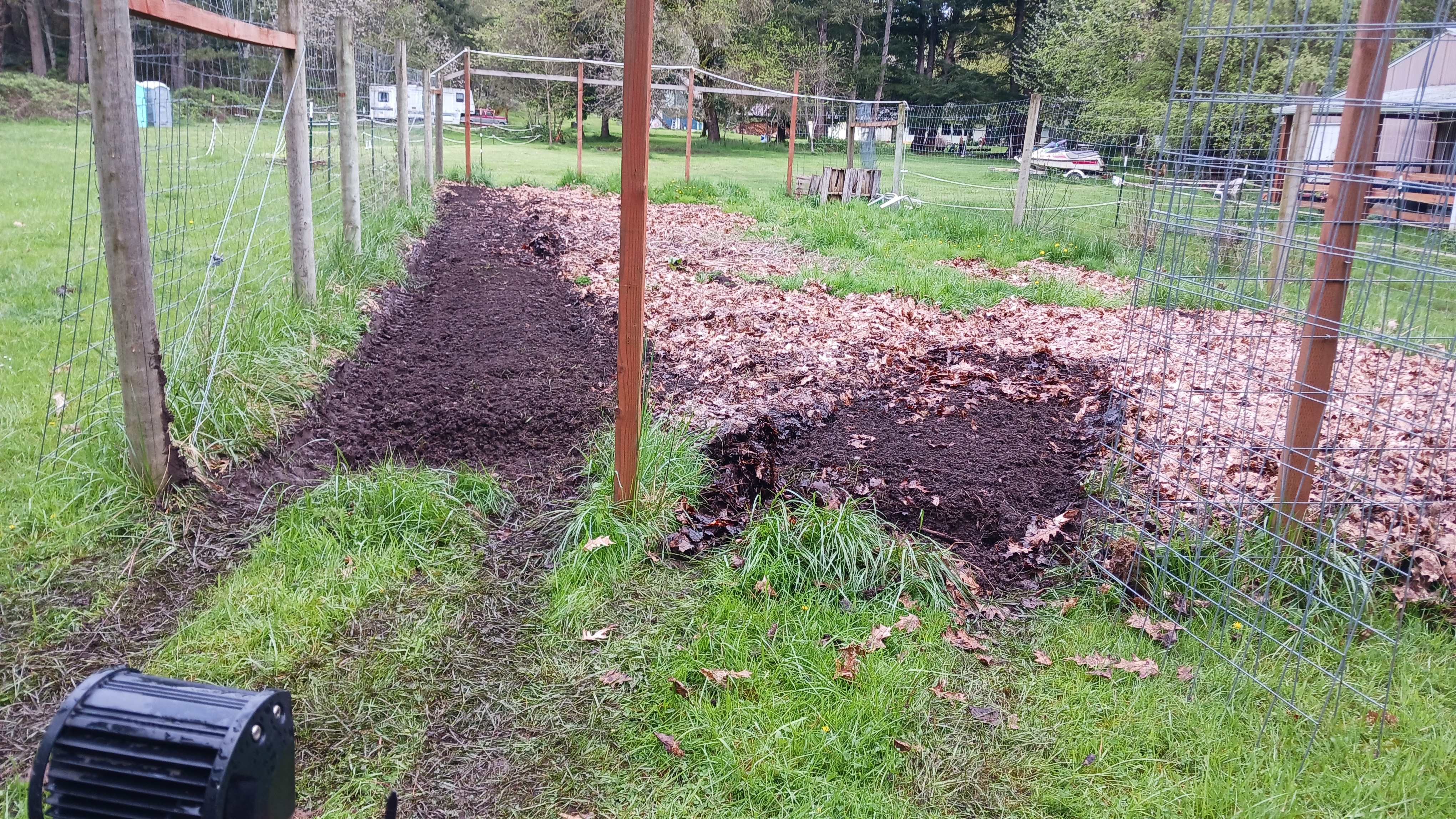

I started our garden during Covid and it has been a powerhouse, churning out good food. When we decided to put a garden there early in the year, I dumped whatever leaves I could find on it to weaken the sod. Later that year we ripped and tilled it. Then we planted it and built a massive deer fence. Since then we have covered it every fall. This year I only tilled a small strip of it. The other beds are waiting under the leaves. We still have dry beans, potatoes and pumpkins from last year. So Covid gardeners are still here. But at this point we just think of ourselves as gardeners.
20260413_172821.jpg
a mostly no-till garden ready to be planted
 
jd hutton
Posts: 43
Location: 10a
25
dog cooking woodworking
  • Likes 4
  • Mark post as helpful
  • send pies
    Number of slices to send:
    Optional 'thank-you' note:
  • Quote
  • Report post to moderator

paul wheaton wrote:As for apples:  not only my favorite food, but...


'Off Topic' a bit, but.. Just wanted to 'poke this' to help you reach your 60,000th Post - Almost There!

What's your Favorite Variety(s)? For me, it's mainly Honeycrisp, Sugarbee, Fuji, Gala, and Golden Delish, with an occasional dip into Granny Smith.

We await your 60Kth. (unless you see / reply to someone Else, first..    Edit: and/or the 'Postometer' only Goes to 59999 - and you've actually already surpassed that by 1.21 Gajillion..
 
paul wheaton
author and steward
Posts: 60002
Location: missoula, montana (zone 4)
hugelkultur trees chicken wofati bee woodworking
  • Likes 1
  • Mark post as helpful
  • send pies
    Number of slices to send:
    Optional 'thank-you' note:
  • Quote
  • Report post to moderator

Ed Waters wrote:Paul how do you harvest parsnips in the winter.  


This will be my first year growing parsnips.

However, for other winter crops:

   - i wait for a warm day and harvest then

   - if i don't wanna wait for a warm day, i toss hot water on the patch and harvest in about three minutes

 
paul wheaton
author and steward
Posts: 60002
Location: missoula, montana (zone 4)
hugelkultur trees chicken wofati bee woodworking
  • Likes 4
  • Mark post as helpful
  • send pies
    Number of slices to send:
    Optional 'thank-you' note:
  • Quote
  • Report post to moderator

jd hutton wrote:

paul wheaton wrote:As for apples:  not only my favorite food, but...


What's your Favorite Variety(s)? For me, it's mainly Honeycrisp, Sugarbee, Fuji, Gala, and Golden Delish, with an occasional dip into Granny Smith. :)


Favorite variety:   from seed

second favorite:  My grandad

       https://permies.com/t/205491/Lawton-Emerson-McDaniel

 ... grew one apple tree.  It is famous for being the apple that ripens earliest.  And it has a distinct flavor.  We have two of these trees and one is bearing fruit.  And it is intense the good feels I get when I bite into one.  The variety is called "yellow transparent."
 
On my planet I'm considered quite beautiful. Thanks to the poetry in this tiny ad:
Learn Permaculture through a little hard work
https://wheaton-labs.com/bootcamp
reply
    Bookmark Topic Watch Topic
  • New Topic